Federal funding runs out at the end of Friday, December 11. That date comes from the stopgap Congress passed in September, the Continuing Appropriations Act, 2027, and nothing has replaced it. If no new funding law is signed in time, a shutdown starts on Saturday, December 12.
The majority that has to stop it just lost its gavels, effective January 3.
Democrats won both the House and the Senate on November 3, and HNGN reports that the Republican led Congress returns on Monday, November 9, for a lame duck session that runs until Christmas. The new Congress is sworn in on January 3. So the search everyone keeps typing, will there be a government shutdown in December, comes down to what an outgoing majority does with a deadline it will not be around to finish. We have five recent answers to that.
Will there be a government shutdown in December 2026?
Nobody can tell you yet, and anyone who says they can is guessing. What we can tell you is that nothing is law today, the stopgap ends on December 11, and Congress has three real choices: pass all 12 bills in one big package (an omnibus), pass another short stopgap that pushes the fight to the new Congress, or pass nothing and shut down.
HNGN lists all three as still open, with the first two as the paths leaders are actually weighing. The FY2027 bills themselves are far from done: the House has passed 3 of 12 and the Senate none, as our bill by bill status of all 12 spending bills shows.
History is the best guide we have. Since 1994, control of the House has flipped five times in a midterm year. Here is what each outgoing Congress did with the money.
What past lame ducks did with the money
1994. Republicans won the House for the first time in 40 years. The outgoing Congress had already finished its work: according to a Heritage Foundation review, all 13 bills of that era were done before the lame duck began. Nothing was left to fight about.
2006. Democrats won both chambers, the closest match to this year. The outgoing Congress passed short stopgaps instead of the bills, ending with H.J.Res. 102, signed December 9, 2006, which funded the government through February 15, 2007. The new Democratic Congress then wrote a full year stopgap (P.L. 110-5), signed on February 15, 2007, the day the old one ran out.
2010. Republicans won the House. The lame duck passed H.R. 3082, signed December 22, 2010, which kept the government open through March 4, 2011. The fight moved to the new House.
2018. Democrats won the House. Five of the 12 bills were already law, but the stopgap covering the other seven expired on December 21, 2018. The Congressional Research Service counts the funding gap that followed at 34 full days. It ended on January 25, 2019, under the new Democratic House, with P.L. 116-5.
2022. Republicans won the House. On November 21 that year, Heritage argued that no outgoing House majority had ever passed an omnibus in a lame duck. Five weeks later one did: the Consolidated Appropriations Act, 2023 became law on December 29, 2022.
The scorecard
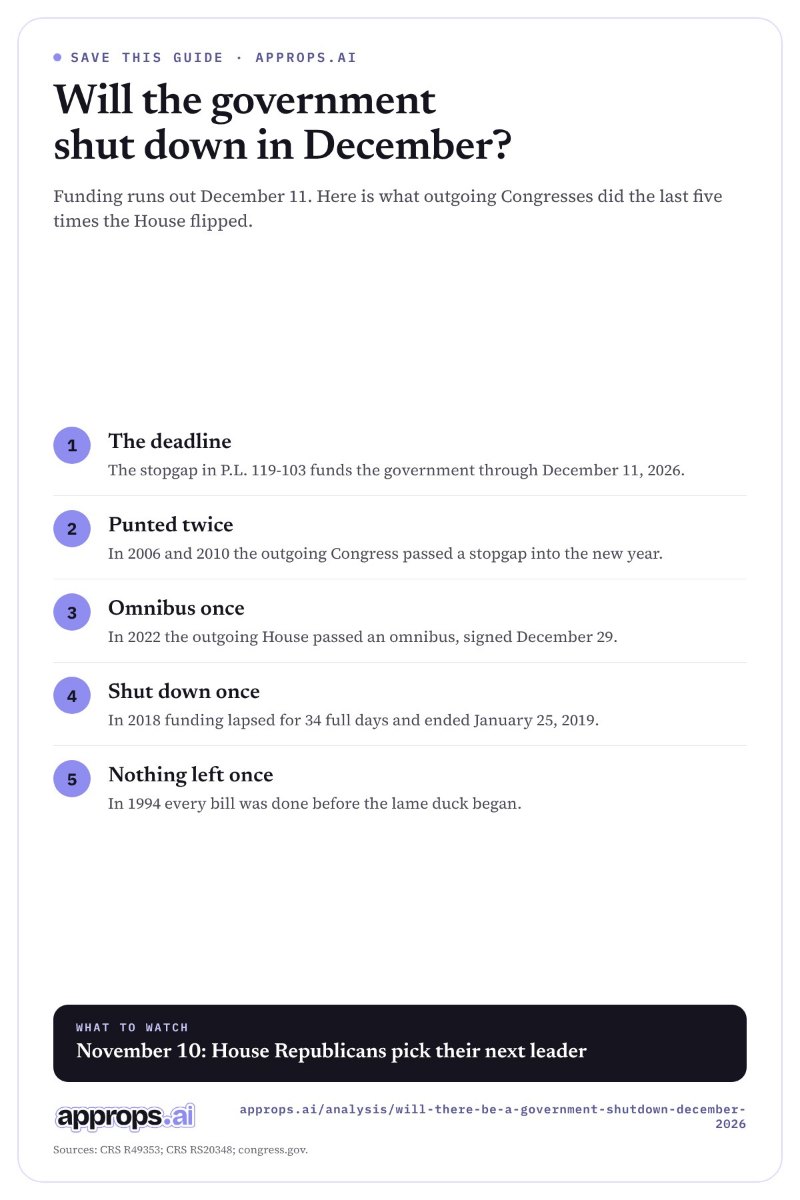
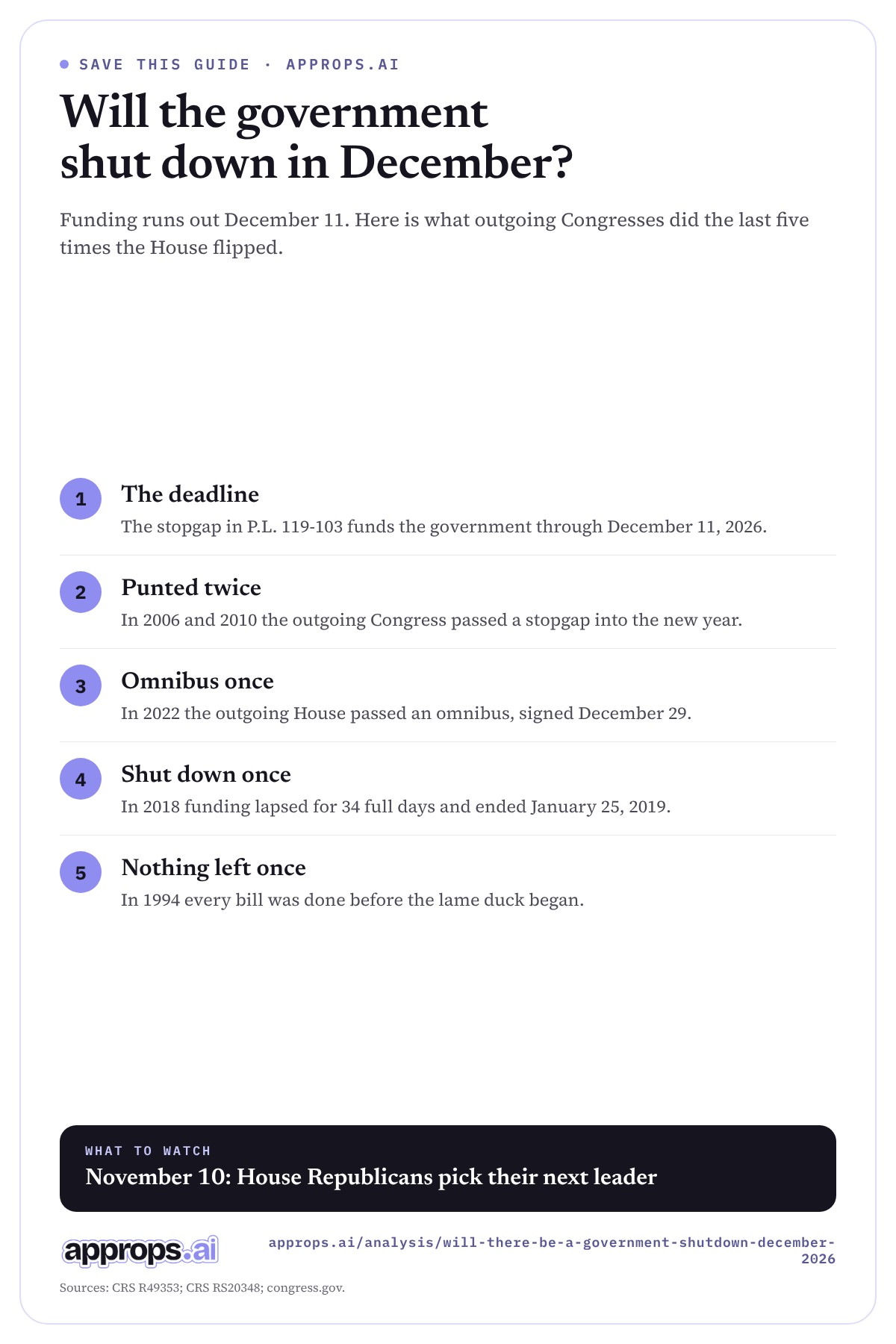
Put those together and you get a mixed record. Two outgoing Congresses punted with a stopgap (2006 and 2010). One passed everything in an omnibus (2022). One ended in a shutdown that the new majority had to close (2018). And one had nothing left to do (1994).
So the most common result is the punt. That is not the same as a prediction.
The year that looks most like 2026 is 2006, when the same party lost both chambers in one night. That Congress chose not to write the bills for the people taking over. It handed them a stopgap into February and left town.
What is different this time
Three things make 2026 harder to read off the old record.
First, there is more unfinished business. In 2018 five bills were already law before the lame duck started. This year none are. A punt this time means the entire government rides on a stopgap into the new year, the way it did in 2006 and 2010.
Second, the money is bigger and the fight is louder. HNGN reports the administration wants a record $1.5 trillion for the military, a number Senate Democrats reject, and that leaders are also weighing a debt limit increase in the same weeks. Every one of those competes for the floor time a funding bill needs.
Third, this Congress already knows what a long shutdown looks like. CRS counts the FY2026 gap that began September 30, 2025, at 42 full days, the longest on its list. It broke the 2018 record of 34 days.
What changes if they punt to January
A short stopgap into the new year does not end the fight. It moves the people.
Democrats would chair the Appropriations Committees in both chambers and write the bills from their own starting point. Republicans would still have the White House and the veto, and most bills would still need 60 votes in the Senate. In 2007 the new majority ended up passing a full year stopgap rather than 12 fresh bills. If you want the plain difference between the two kinds of law, here is how a regular appropriations bill compares to a continuing resolution.
For federal workers and anyone who depends on a federal program, a punt is good news in the short run. Paychecks keep coming and offices stay open until the new date.
What happens next
The first real signal comes this week. House Republicans pick their next leader on November 10, and that person negotiates the funding bill for the rest of the year. After that, watch for which kind of bill leaders introduce: a new end date in the text means a punt, a thick stack of 12 bills means an omnibus.
If nothing passes by the end of December 11, here is what a December 12 shutdown would stop and what keeps going. For the back and forth since Election Day, see where appropriations talks stand after the midterms. For the 13 days both chambers have left to vote, see when is the next government shutdown vote. The live countdown is on the shutdown page, and every bill's status is on the appropriations tracker.
Save this guide
Frequently asked questions
Will there be a government shutdown in December 2026?
It is not decided. The stopgap funds the government through December 11, 2026, and nothing has replaced it yet. Congress can pass an omnibus, pass another stopgap, or let funding lapse on December 12.
When is the next government shutdown deadline?
The end of Friday, December 11, 2026, when the Continuing Appropriations Act, 2027 (Division A of P.L. 119-103) expires. A shutdown would start Saturday, December 12 only if no new funding law is signed.
What did past lame duck Congresses do after losing the House?
Since 1994: in 1994 the bills were already done, in 2006 and 2010 the outgoing Congress passed a stopgap into the new year, in 2018 funding lapsed for 34 full days, and in 2022 the outgoing Congress passed an omnibus on December 29.
How long was the last government shutdown?
The Congressional Research Service counts the FY2026 funding gap that began September 30, 2025 at 42 full days, the longest on its list.
Sources
- CRS R49353, continuing appropriations for FY2027 (P.L. 119-103)
- CRS RS20348, Federal Funding Gaps: A Brief Overview (May 26, 2026)
- Congress.gov, H.J.Res. 102 (109th), P.L. 109-383
- Congress.gov, H.R. 3082 (111th), P.L. 111-322
- Congress.gov, H.R. 2617 (117th), Consolidated Appropriations Act, 2023
- Heritage Foundation, outgoing House majorities and lame duck omnibus bills, Nov. 21, 2022
- HNGN, lame duck Congress returns with funding deadline, Nov. 5, 2026