Government funding runs out at the end of Friday, December 11. The stopgap Congress passed in September, P.L. 119-103, was signed September 2 and pays for the whole government through that date. If nothing new is signed by then, a shutdown starts at 12:01 a.m. on Saturday, December 12.
Nothing else is in the pipeline yet. The CRS status table shows the House has passed 3 of the 12 regular FY2027 bills (Agriculture, Military Construction and VA, and National Security and State), the Senate has passed none, and none has become law. So every agency is on the same stopgap and would hit the same wall.
Most people searching this don't want the procedure. They want to know what happens to their check, their flight and their passport. Here is what the record says, mostly from the plans agencies used during the last lapse, the 43 day shutdown that ran from October 1 to November 12, 2025.
Will Social Security and Medicare keep paying?
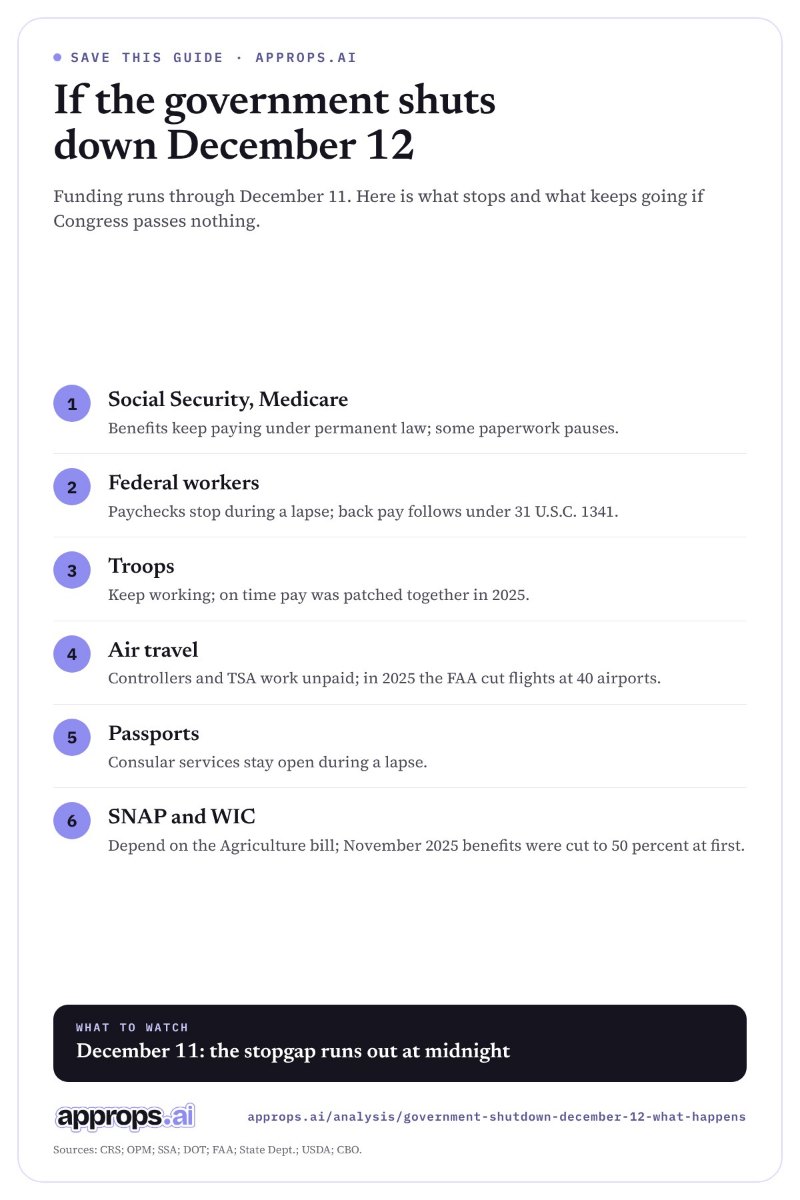
Yes. Those benefits are paid under permanent law, not the annual bills, so a lapse does not cut them off. The Social Security Administration's lapse plan says funding for the retirement and disability programs, SSI and Medicare "will continue."
Some of the paperwork around them stops. That same plan lists benefit verifications and replacement Medicare cards among the work that halts during a lapse. Checks go out. Letters may not.
The difference between money that runs on autopilot and money Congress votes on every year is the whole reason some programs keep going and others don't. Our explainer on discretionary vs. mandatory spending walks through it.
A shutdown is also not a default. That risk comes from the debt limit, a different deadline with different rules, explained in debt ceiling vs government shutdown.
What happens to federal workers' pay?
Federal employees split into two groups. Furloughed workers are sent home, and OPM's January 30, 2026 guidance says those whose work is funded by annual appropriations and not marked excepted "are barred from working." Excepted workers keep working, and OPM says they "will be paid after Congress passes and the President signs" a new funding law.
Either way, the paycheck stops for the length of the lapse. It comes back later.
The back pay rule is written into 31 U.S.C. 1341, the 2019 law that says furloughed employees "shall be paid for the period of the lapse" and excepted employees get paid "at the earliest date possible" once the lapse ends. OPM's guidance reads more cautiously on furloughs: "Congress will determine via legislation whether furloughed employees receive pay for furlough periods." Last time Congress settled it in the bill itself. CRS says Section 116 of the law that ended the 2025 lapse, P.L. 119-37, authorized back pay, and Section 120 reversed the layoffs started during it.
There is one new piece of paper this time. On October 23, OMB and OPM issued memo M-27-01, which says the September 2025 documents on reductions in force during a lapse are rescinded "in full and are no longer operative."
Do troops get paid?
Troops keep working. The Pentagon's October 2025 lapse guidance says active duty members "will continue to report for duty and carry out assigned duties." Whether the paycheck shows up on time is a separate question, and the guidance does not promise it.
Last fall the answer was improvised. For the October 15 payday, the President directed the Pentagon to use "all available funds," and AP reported the department found about $8 billion in unspent research and development money from the prior year. The Pentagon also accepted a $130 million anonymous donation to help cover pay. A December lapse would bring the December 15 and December 31 paydays into play, and nothing in law today guarantees the same workaround.
Will flights and airports be affected?
Air traffic controllers and TSA officers keep working, without pay until the lapse ends. The Transportation Department's 2025 plan kept 13,294 controllers on the job "excepted without pay." The DHS plan kept 58,488 of TSA's 61,475 employees.
The trouble shows up weeks in, when people have missed paychecks. On November 6, 2025, the FAA ordered flight cuts at 40 high traffic airports, starting at 4 percent and planned to reach 10 percent. It never got there. Later orders held the cuts at 6 percent and then 3 percent, and the FAA lifted them on November 17. A lapse starting December 12 would run straight into holiday travel.
Can I still get a passport?
Yes. The State Department says that during a lapse, consular operations at home and abroad "will remain operational," with some domestic support suspended. Passport and visa work kept going last fall.
National parks are a coin flip by park. The Park Service's 2025 plan said roads, trails and open air memorials "will generally remain accessible," but parks without accessible areas would not operate, and it planned to furlough 9,296 of about 14,500 employees. Expect open gates and locked visitor centers.
What about SNAP and WIC?
This is where a long lapse hurts first. SNAP is paid through the annual Agriculture bill, so it depends on Congress acting. Last November, USDA told states on November 4 to cut benefits to 50 percent of each household's allotment, citing two federal court orders. A week of court fights followed. Full benefits came back only after the funding law passed, when USDA told states on November 13 that full FY26 funding was available.
WIC, the nutrition program for mothers and young children, got a stopgap of its own. AP reported the administration moved $300 million in tariff revenue to keep it running.
That was last year's Agriculture bill. This year's has passed the House only, so SNAP and WIC would be exposed again.
What does a shutdown cost?
Small businesses felt it early. The SBA said the lapse stopped approvals in its 7(a) and 504 loan programs and kept $5.3 billion from reaching about 10,000 small businesses.
The whole economy takes a hit too. CBO estimated on October 29, 2025 that a six week lapse would permanently cost the economy about $11 billion and an eight week one about $14 billion. CBO expects most of the lost output to come back once the government reopens. Most, not all.
What happens next
Members return November 9 for the lame duck session. The choices on the table are full year bills, another stopgap into 2027, or some mix, and our piece on where the talks stand after the midterms has the politics. If they pass something by December 11, none of the above happens. For how this has gone before, here is what past lame duck Congresses did when a funding deadline met a flipped House. For the days left to hold that vote, see when the next government shutdown vote could happen.
The live countdown, and the official status each day, is on the shutdown page. You can follow every bill on the tracker.
Save this guide
Frequently asked questions
Will Social Security checks stop if the government shuts down on December 12?
No. Social Security, SSI and Medicare are paid under permanent law, and SSA's lapse plan says their funding continues. Some services, like benefit verifications and replacement Medicare cards, stop.
Do federal employees get back pay after a shutdown?
Under 31 U.S.C. 1341, furloughed and excepted employees are paid for the lapse once it ends. In 2025, Congress also wrote back pay into the law that reopened the government, P.L. 119-37.
Can I get a passport during a government shutdown?
Yes. The State Department says consular operations at home and abroad remain operational during a lapse in funding, including passport and visa services.
What happens to SNAP if the government shuts down?
SNAP depends on the annual Agriculture bill, so a long lapse can cut benefits. In November 2025, USDA first told states to pay 50 percent of allotments, and full benefits returned only after funding passed.
Sources
- CRS appropriations status table, FY2027
- White House, H.R. 6500 signed into law, Sept. 2, 2026
- OPM guidance for shutdown furloughs, Jan. 30, 2026
- 31 U.S.C. 1341, back pay after a lapse
- CRS R48765, continuing appropriations for FY2026 (P.L. 119-37)
- SSA lapse in appropriations contingency plan
- FAA, temporary flight reductions at 40 airports, Nov. 6, 2025
- CBO, the effects of the 2025 shutdown, Oct. 29, 2025