The Trump administration wants $50 billion more for the Federal Aviation Administration, and House Speaker Mike Johnson says he will try to move it in a package before the government funding deadline of December 11. The ask jumped from about $30 billion after Friday's nationwide ground stop, CNN reported on November 15.
So the shutdown fight now has an air traffic control fight inside it.
What happened Friday
On the evening of Friday, November 13, the FAA stopped flights nationwide. The House Transportation and Infrastructure Committee's top Republican and top Democrat, Chairman Sam Graves of Missouri and Rep. Rick Larsen of Washington, put out a joint statement that night thanking controllers for acting fast.
Transportation Secretary Sean Duffy said the stop most likely traced to work by contractor L3Harris, which was switching an old copper line to fiber optic cable at an air traffic site in El Dorado, Arkansas, according to CNN. It is still unclear whether the cause was faulty equipment or contractor error.
By Sunday the money ask was on television. "I have no money in that $12.5 billion that I can use for a new architecture for telecom," Duffy told CNN's State of the Union. "There's no money for towers. Our towers are old." President Trump posted that Congress should "give the money, FAST!"
Where the $12.5 billion went
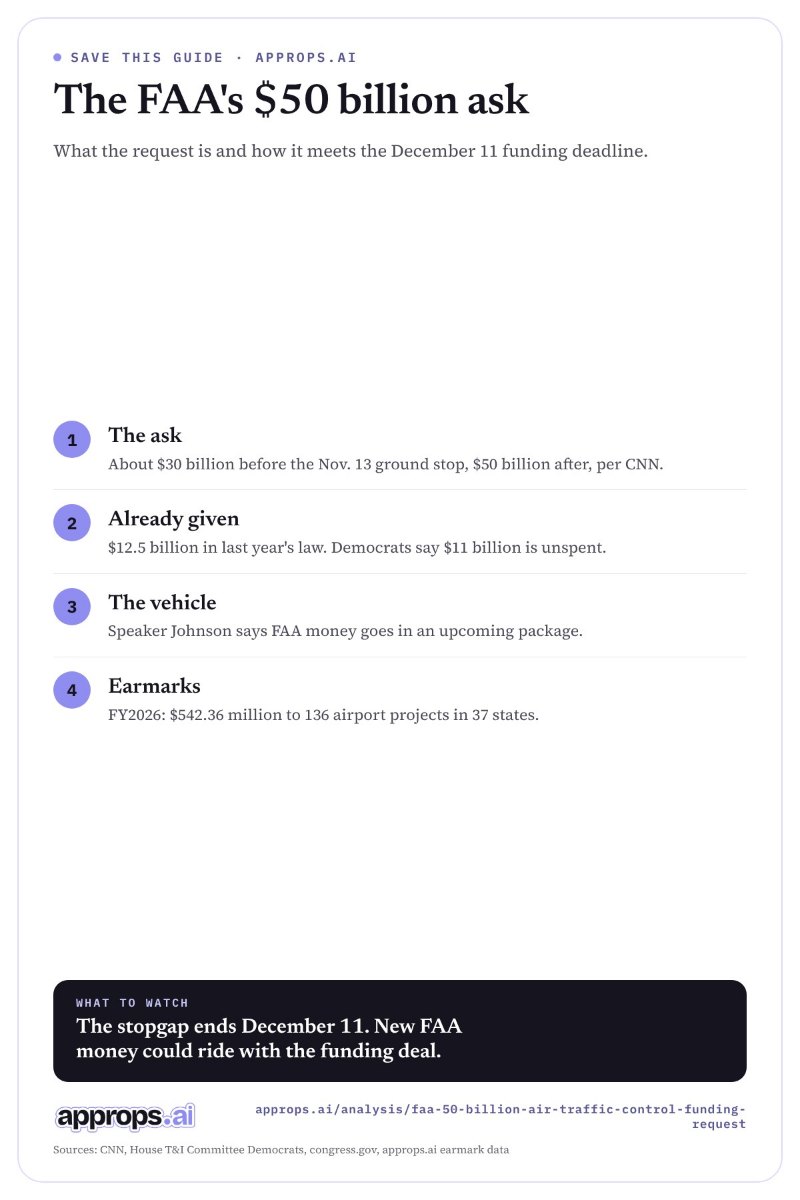
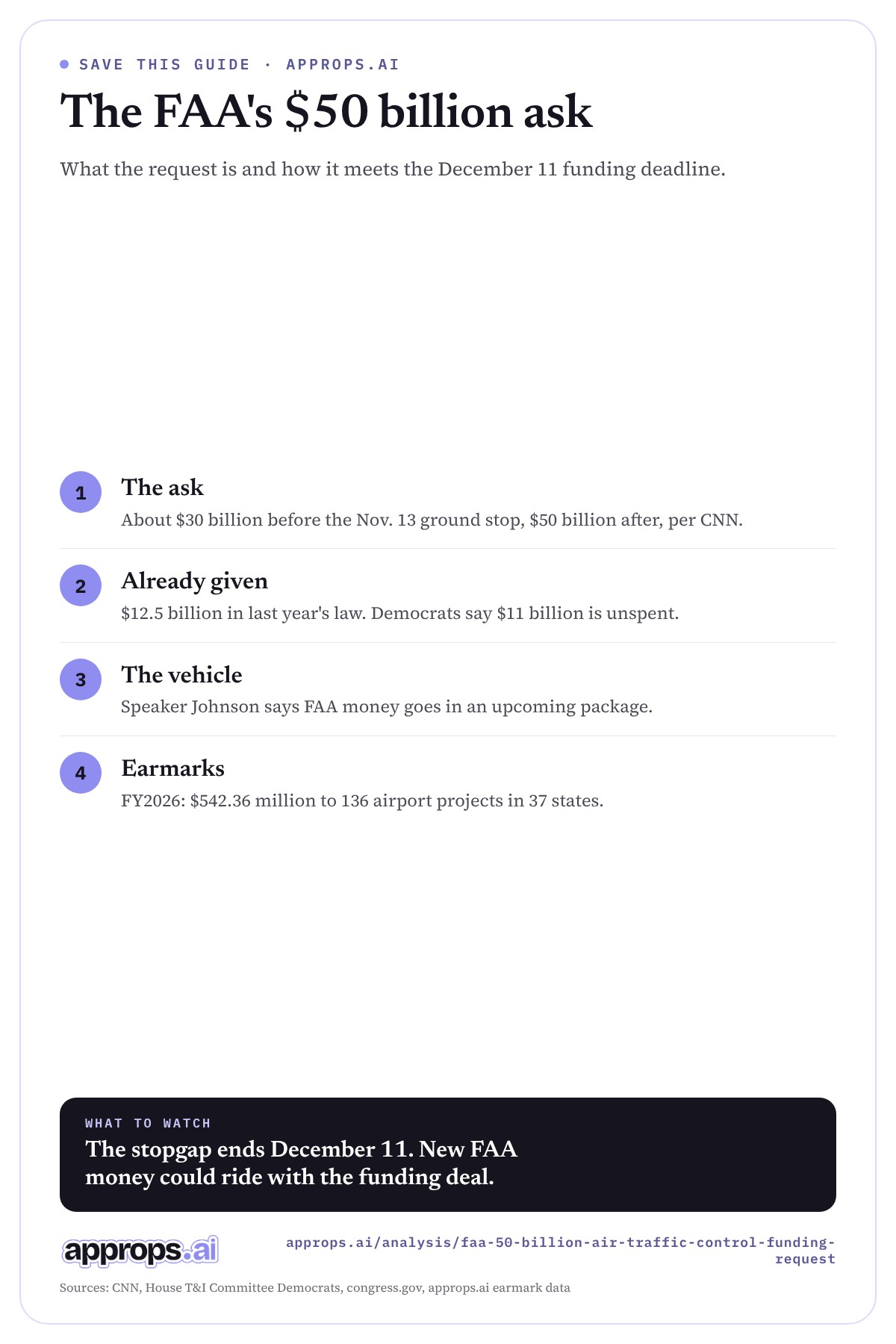
That $12.5 billion is the FAA money in the big tax and spending law Republicans passed last year. CNN reports it runs over three years, and $4.75 billion of it is for "telecommunications infrastructure modernization and systems upgrades." Duffy said at a Saturday news conference that the agency has spent about a third of the modernization money so far.
Democrats on the committee read the same law and see a lot of money sitting there. Larsen and Rep. André Carson of Indiana, the top Democrat on the aviation subcommittee, said in their November 14 statement that "fifteen months later, the administration's obligated $4.3 billion but only spent $1 billion, leaving $8 billion unobligated and $11 billion unspent."
Their question for the administration: "Explain to Congress, again, why they need more money?"
Duffy's answer is that the $12.5 billion cannot pay for the rest of the job. "All I need is the money to finish it," he said. Both of those can be true at the same time, which is why the committee staff briefing with FAA and DOT on Monday matters. The Democrats also expect FAA Administrator Bryan Bedford at an early December hearing.
Can it ride on the December 11 bill?
Johnson told Fox News on Saturday that he would add FAA funding to an upcoming "legislative package." "We're going to work to get it done," he said, per CNN. The package he means is not spelled out, and CNN reported it was not immediately clear to congressional aides how leaders would pass new money.
Here is the plumbing. The FAA's yearly budget lives in the Transportation and Housing (T-HUD) appropriations bill. For fiscal 2027, the House version is H.R. 9170, which the full House Appropriations Committee approved 34 to 27 on June 3. It never got a floor vote. The Senate committee has not posted its T-HUD bill at all.
So the FAA, like most of the government, is running on the stopgap. H.R. 6500, now Public Law 119-103, keeps agencies at fiscal 2026 rates through December 11.
That leaves three realistic paths for new FAA money in the next 25 days:
- Inside a full year funding deal. If appropriators finish T-HUD (alone or in a bundle), they can raise the FAA lines there.
- As emergency money on a stopgap or package. Congress often attaches extra money to whatever bill has to pass. That is the "legislative package" route.
- On its own. Sen. Eric Schmitt of Missouri is pushing his Modern Skies Act, which CNN says would put $30 billion into the system. A standalone bill needs its own floor time, and floor time is the scarcest thing in a lame duck.
The first two run straight through the December 11 talks. Anything that makes the must pass bill bigger also makes it harder to pass.
What the other side wants
Democrats are not saying no to the FAA. They are saying show us. Rep. Rosa DeLauro of Connecticut, the top Democrat on House Appropriations, called the $50 billion figure a "ransom." Sen. Brian Schatz of Hawaii wants some of it to come out of the extra money already given to ICE, so no new taxpayer dollars are added.
Sen. Chris Van Hollen of Maryland was more open. "I will support whatever level of money is necessary to fix this problem," he told CNN, while saying the administration should "come up and justify it."
That is the real gap: not whether to fix the system, but how much new money it takes and who has to prove it.
Congress already pays for towers, one airport at a time
Duffy said there is no money for towers. In the annual bills, a little of it does show up, as earmarks.
In the enacted fiscal 2026 T-HUD bill, Congress sent $542.36 million to 136 airport projects in 37 states through the FAA's Grants-in-Aid for Airports account, according to the committee's official earmark table. The biggest was $30 million for a concourse expansion at Sioux Falls Regional Airport. Six of those projects, about $24.9 million all together, build or move air traffic control towers, at places like San Angelo, Texas and Mankato, Minnesota.
The fiscal 2027 House bill does more of the same: 117 airport projects worth $239.86 million in 38 states, and 11 of them (about $33.45 million) are tower projects. The largest tower item is $8 million for a new tower in Oklahoma City.
To be clear about scale, these are runways, terminals and local towers. They are not the radar, telecom and software backbone that failed Friday, which is national FAA equipment money. You can look up every airport project by state on the earmarks map, or browse the whole bill on the T-HUD projects page.
What happens next
On Monday, November 16, FAA and DOT staff brief House committee staff on the request. Then the question moves to the appropriators, who were already trying to close a deal before the stopgap runs out at the end of December 11. If they agree on FAA money, it could ride with whatever funds the government. If they do not, the FAA keeps flying on last year's rates like everyone else. On November 16 the Senate also posted its regular Transportation-HUD bill, with $4.5 billion for air traffic control modernization; see the Senate FY27 Defense, Labor-HHS and Transportation-HUD bills.
Thanksgiving is November 26. The deadline is two weeks behind it.
You can follow the countdown on the shutdown page, every bill's status on the tracker, and the state of the talks in where the funding talks stand.
Save this guide
Frequently asked questions
How much money is the FAA asking Congress for?
Transportation Secretary Sean Duffy asked for about $30 billion, then raised it to $50 billion after the nationwide ground stop on November 13, 2026, according to CNN.
Didn't Congress already give the FAA $12.5 billion?
Yes, in last year's tax and spending law, over three years. House Transportation Democrats say $4.3 billion has been obligated and $1 billion spent, while Duffy says that money cannot cover the rest of the work.
Will FAA funding be in the December 11 funding bill?
Speaker Mike Johnson says he will add FAA money to an upcoming legislative package. As of November 16, no bill text is public and the stopgap still ends December 11.
Does Congress earmark money for airports?
Yes. The enacted fiscal 2026 bill sent $542.36 million to 136 airport projects in 37 states through the Grants-in-Aid for Airports account, including six air traffic control tower projects.
Sources
- CNN, Trump administration implores Congress for additional FAA funding (Nov. 15, 2026)
- House T&I Committee Democrats, Larsen and Carson statement on the nationwide ground stop (Nov. 14, 2026)
- House T&I Committee Democrats, press releases (Graves and Larsen joint statement, Nov. 13, 2026)
- Congress.gov, H.R. 9170, FY2027 Transportation and HUD appropriations
- Congress.gov, H.R. 6500, Continuing Appropriations and Extensions Act, 2027
- Senate Appropriations Committee, FY2026 T-HUD enacted congressionally directed spending table