On Thursday, November 12, the Senate Appropriations Committee posted five more FY2027 spending bills: Commerce-Justice-Science, Energy and Water, Homeland Security, Interior-Environment and Legislative Branch. Each came with bill text, an explanatory statement and a one page summary. Two days earlier the committee had posted Agriculture-FDA and MilCon-VA the same way.
That makes seven of the 12 bills with Senate text. None of them has had a markup.
What did the Senate release on November 12?
The text of five bills, the explanatory statements that carry the committee's instructions to agencies (and its earmark tables), and a summary of each. The release itself gives no dollar figures and no quotes. It says only that putting the bills out "is an important part of completing the FY 2027 annual appropriations process."
The bills went up on the Republican majority's press page, like Tuesday's pair. No vote was taken on any of them, and the committee did not announce one.
The five bills by the numbers
Each total below is the committee's own figure from its summary, in discretionary money (the part Congress sets every year).
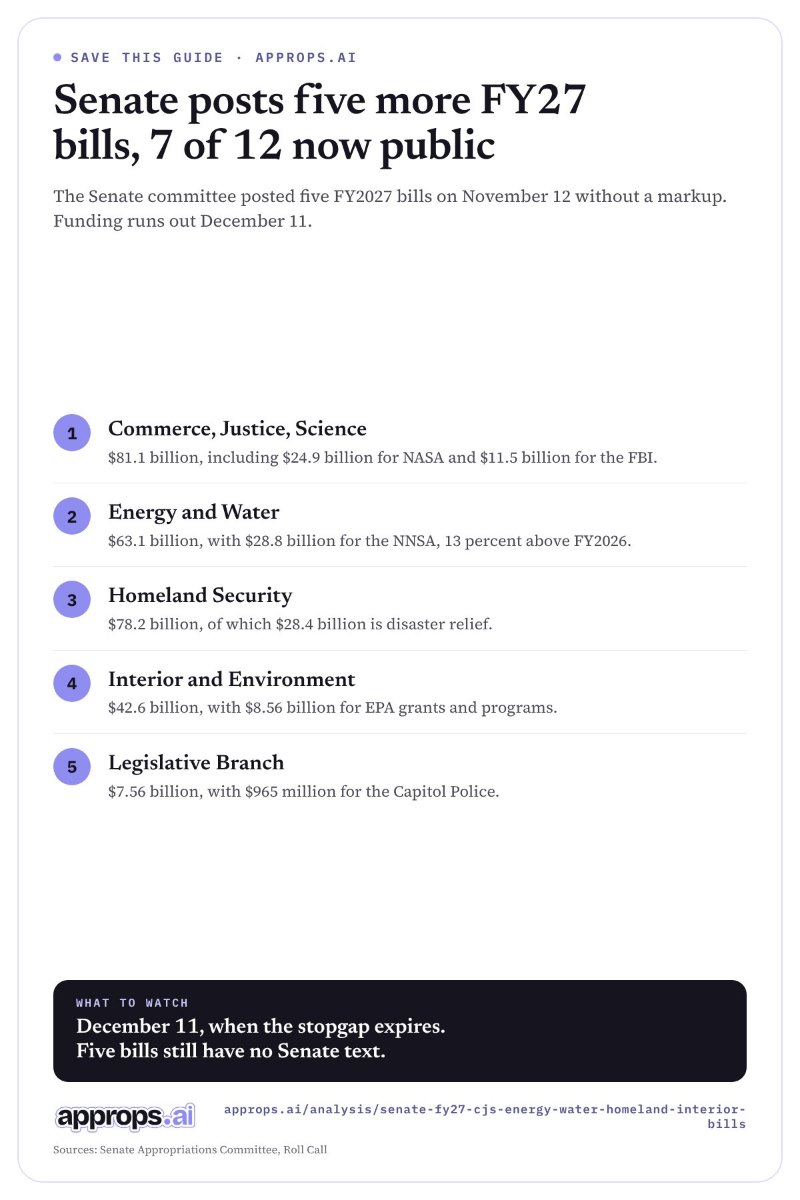
- Commerce, Justice, Science: $81.1 billion. NASA gets $24.9 billion, including $8.3 billion for the Artemis moon program. The FBI gets $11.5 billion, the National Science Foundation $8.8 billion, NOAA $6.2 billion and the Census Bureau $1.9 billion to start preparing for 2030. Summary.
- Energy and Water: $63.1 billion. Most of it is the nuclear weapons complex. The National Nuclear Security Administration gets $28.8 billion, 13 percent above FY2026, and weapons activities alone are $23.3 billion. The Army Corps of Engineers gets $10.6 billion for civil works. Summary.
- Homeland Security: $78.2 billion. That number needs a footnote! $28.4 billion of it is disaster relief, so the regular budget is $49.8 billion. Customs and Border Protection gets $11.6 billion, $255 million above FY2026, and TSA gets $11.7 billion. Summary.
- Interior and Environment: $42.6 billion. Of that, $39.7 billion is regular spending and $2.95 billion goes to the wildfire reserve fund. Interior gets $15.3 billion, the Forest Service $8.85 billion and EPA $8.56 billion, with $4.4 billion of the EPA money in state and tribal water grants. Summary.
- Legislative Branch: $7.56 billion. The Capitol Police get $965 million, GAO $860 million and CBO $76.3 million. Summary.
Add the five together and you get about $273 billion. Those totals mix regular and emergency style money in different ways, so treat the sum as a size check. It is not a topline.
Why post bills nobody has voted on?
Because the clock is short and negotiators need numbers on paper. Funding under the current stopgap, P.L. 119-103, runs out at the end of December 11. With Senate text out, House and Senate staff can now line up both chambers' versions of seven bills account by account.
The Tuesday pair were committee drafts stamped in early August, prepared for a markup that never happened. Without a committee vote, the new five are the Senate majority's opening offer, not a bipartisan committee product. Punchbowl News described them as partisan bills from Senate Republicans.
Which bills still have no Senate text?
Five, and they include the two biggest. Defense is the largest bill by far, and Labor-HHS-Education is the largest domestic one. Transportation-HUD, Financial Services and General Government, and National Security-State (the old State and Foreign Operations bill) are also still waiting. Those five carry most of the money. They also carry most of the fights. Update: the committee posted all five on November 16; here is what is in the Senate FY27 Defense, Labor-HHS and Transportation-HUD bills.
The House has reported all 12 from committee and passed three. Here is who chairs each Appropriations subcommittee in both chambers. You can see every bill's position in both chambers on the tracker.
Where are the Senate earmarks in these bills?
In the explanatory statements, in tables of congressionally directed spending (the Senate's name for earmarks). Like the House lists, they are recommendations until a final bill is signed. The House project lists for the same five bills are already searchable: CJS, Energy and Water, Homeland Security and Interior. Legislative Branch carries no community projects.
The fight these bills walk into
The texts landed in the middle of a dispute over the war with Iran. Roll Call reported on Thursday that Sen. Tim Kaine of Virginia is drafting language to end the war that he wants attached to the next stopgap. "I know it's going to be my main push," he said. Sen. Patty Murray of Washington, the committee's top Democrat, said "we're still going to have language stopping this war," without committing to the December bill.
Republicans say that is a line they will not cross. "If they make the budget or the CR contingent upon us cutting and running in Iran, yeah, we'll have a shutdown," Sen. John Kennedy of Louisiana told Punchbowl News. House Appropriations Chair Tom Cole of Oklahoma has said a Republican Congress will not send the President bills he would veto.
Roll Call also reported that the White House is weighing a stopgap that runs through March but has not sent Congress its list of anomalies (the specific money fixes an agency needs to survive a stopgap). For the full lay of the land, see where the funding talks stand.
What happens next
The deadline is the end of Friday, December 11. Between now and then, Congress can pass a package of full year bills built from these texts, another stopgap, or some mix of the two. The seven Senate bills make the first path possible on paper. They do not make it likely on their own.
Watch for three things: Senate text on the last five bills, a markup notice from either committee, and the White House anomaly list, which usually signals a stopgap is coming. The countdown is on the shutdown page, and when the next shutdown vote could happen walks through the calendar.
Save this guide
Frequently asked questions
Which FY27 appropriations bills has the Senate released?
Seven of 12. The Senate Appropriations Committee posted Agriculture-FDA and MilCon-VA on November 10, 2026, then Commerce-Justice-Science, Energy and Water, Homeland Security, Interior-Environment and Legislative Branch on November 12.
Has the Senate Appropriations Committee marked up any FY27 bills?
No. The committee posted text, explanatory statements and summaries without a markup, and it has not announced one. No committee vote has been taken on any FY2027 bill.
How much does the Senate FY27 Homeland Security bill spend?
$78.2 billion, according to the committee summary. $28.4 billion of that is disaster relief, so the regular budget is $49.8 billion.
Which FY27 bills still have no Senate text?
Defense, Labor-HHS-Education, Transportation-HUD, Financial Services and General Government, and National Security-State.
Sources
- Senate Appropriations Committee, five FY2027 funding bills released (Nov. 12, 2026)
- Senate summary, Commerce, Justice, Science FY2027
- Senate summary, Energy and Water FY2027
- Senate summary, Homeland Security FY2027
- Senate summary, Interior and Environment FY2027
- Senate summary, Legislative Branch FY2027
- Roll Call, Democrats mulling Iran war funding cutoff strategy (Nov. 12, 2026)
- Punchbowl News, Iran war puts government funding in jeopardy (Nov. 13, 2026)