On Tuesday evening, November 10, the Senate Appropriations Committee posted its first two FY2027 spending bills: Agriculture-FDA and Military Construction-Veterans Affairs, each with bill text, an explanatory statement and a summary. It is the first Senate text for any of the 12 bills this cycle, and it landed one month before funding runs out on December 11.
Nobody voted on them.
Did the Senate committee mark these bills up?
No. The Senate committee has not held a markup on any FY2027 bill. A full committee markup planned for late June was postponed during the standoff over the topline (the one number that sets how much the whole package spends), and CRS still listed no Senate bill reported when it wrote up the current stopgap in September.
The texts say where they came from. The agriculture bill has placeholder zeros for a bill number, a date line that reads July with the day left blank, a line saying Sen. John Hoeven of North Dakota reported it from the committee, and a notice on the cover that it is a draft for the committee and its staff "in preparation for markup." Every page carries an August 3 time stamp. The MilCon-VA text reads the same way, with Sen. John Boozman of Arkansas and an August 4 stamp. These are the bills the committee had ready in early August, for a markup that never came, posted three months later.
The announcement ran on the Republican majority's press page. As of Wednesday morning, the Democratic side's page had nothing on either bill.
MilCon-VA matches the President's construction number
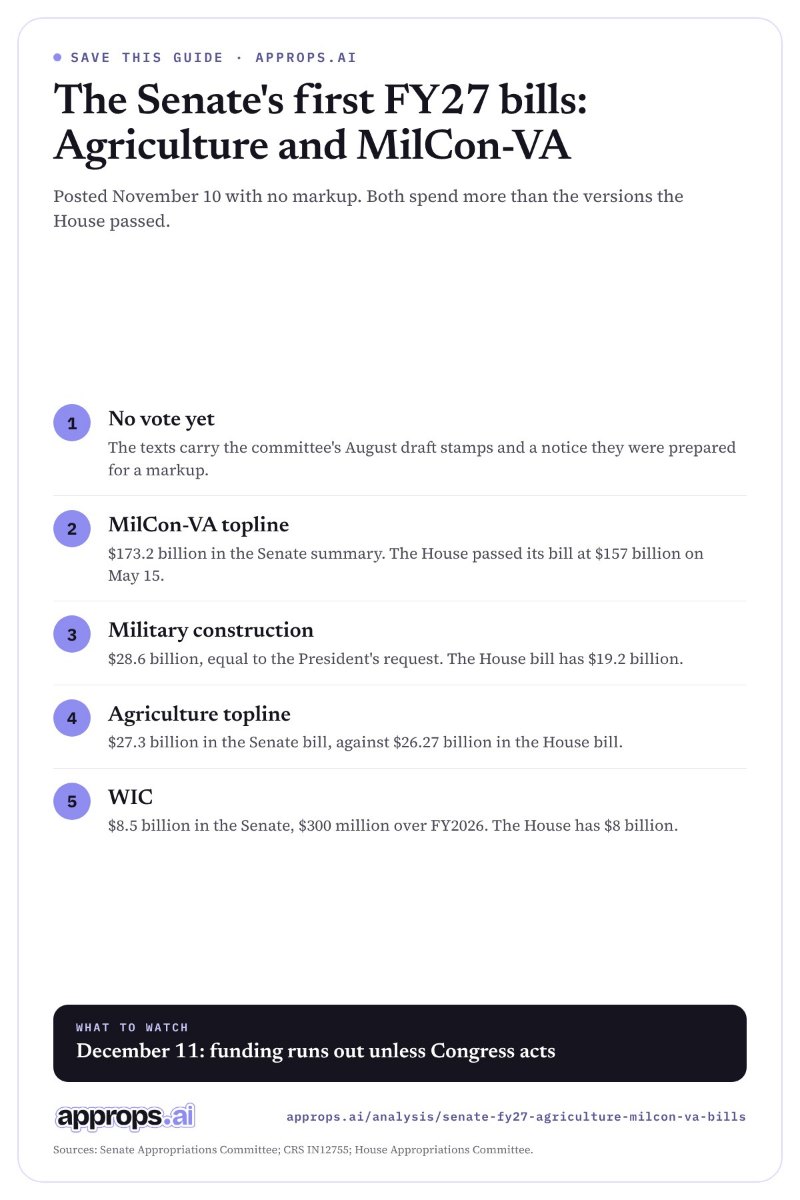
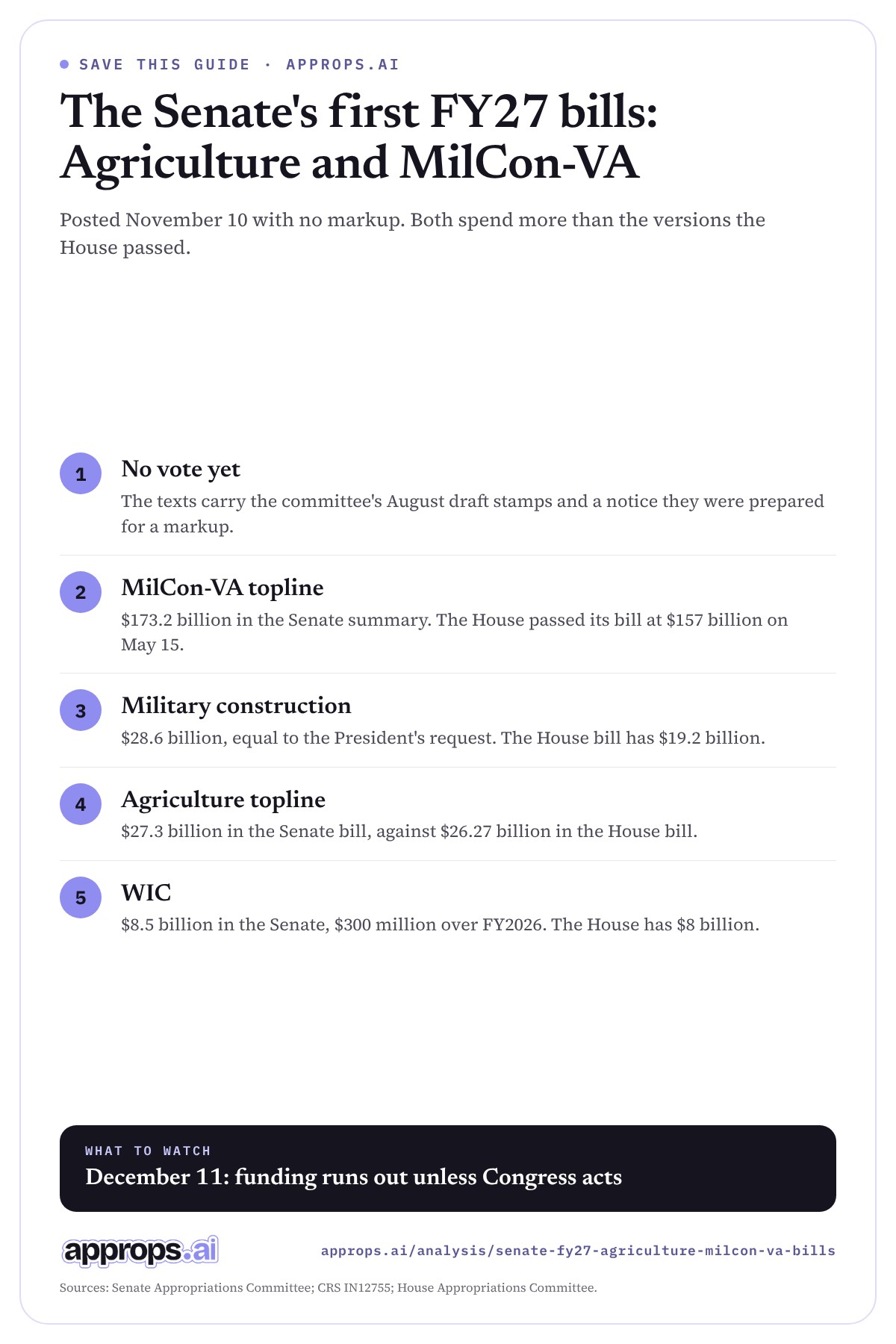
The Senate summary puts the bill at $173.2 billion in base discretionary spending. The House passed its version, H.R. 8469, 400 to 15 on May 15 at $157 billion. That is a gap of about $16 billion, and most of it sits in one account.
Military construction. The Senate provides $28.6 billion for military construction and family housing, equal to the President's request and 45 percent more than FY2026. The House bill has $19.2 billion, about a third less than the request, according to CRS. That one line is a $9.4 billion difference.
Here is some of what the Senate number buys, per its summary:
- New weapons: nearly $7 billion for facilities tied to the B-21 bomber, the F-47 fighter and the Sentinel missile.
- Shipyards: $1.5 billion for the Navy's Shipyard Infrastructure Optimization Program.
- Housing: $2.2 billion for military family housing and $1.5 billion for barracks and dorms.
- NATO: $604 million for the NATO Security Investment Program, also equal to the request.
The Veterans Affairs side gets $144.2 billion in discretionary money, $11.1 billion more than FY2026. The House passed bill had $137.4 billion, per CRS. VA construction is where the Senate leans in hardest: $3.7 billion for new hospitals, cemeteries and smaller projects, more than double the FY2026 level. The electronic health record gets $4.1 billion, up $720 million.
On the money veterans count on most, the two chambers are already close. Veterans medical care, counting the Toxic Exposures Fund, comes to $175.5 billion in the Senate summary and $175.6 billion in the House Democrats' summary of the House bill. Both bills give VA health care $138.2 billion in advance for FY2028 (an advance appropriation, approved now and available the next fiscal year).
Agriculture runs about $1 billion over the House
The Senate agriculture summary lists $27.3 billion in base discretionary spending. The House version, H.R. 8646, passed on June 4 at $26.27 billion, which House appropriators said was $380 million below FY2026.
WIC (the Special Supplemental Nutrition Program for Women, Infants, and Children) is the clearest split. The Senate gives it $8.5 billion, $300 million more than FY2026, according to the comparison table in the explanatory statement. The House gave it $8 billion, $200 million less, and its summary says it cuts the fruit and vegetable benefit (the cash value voucher) by 10 percent "to begin a reset to pre-COVID levels." The Senate text goes the other way. It tells USDA to keep the voucher for women and children at the amount the National Academies recommend.
Two more gaps are easy to hold:
- Food for Peace: $1.38 billion in the Senate bill, up from $1.2 billion in FY2026. The House bill had $900 million.
- FDA: $3.53 billion in discretionary money not counting user fees, $100 million more than FY2026. The House bill had $3.4 billion, $56 million below, per House Democrats.
The Farm Service Agency gets $85 million more for county office staff, and the bill keeps the ban on closing county offices. APHIS, the animal and plant health inspectors, gets $1.2 billion, as requested, with $5 million more for the fight against New World screwworm. SNAP ($101.2 billion) and child nutrition ($37.9 billion) are mandatory money, and the Senate funds both at the request.
Where are the Senate earmarks?
In the explanatory statements. The agriculture statement's table of congressionally directed spending (the Senate's name for earmarks) starts on page 201 and lists each item's account, state, project, recipient, amount and the senators who requested it. The MilCon-VA statement lists its projects account by account and state by state.
These are Senate recommendations, not law. The House versions of both bills carry their own project lists, which you can browse by account on the Agriculture-FDA and MilCon-VA pages, and a project only gets paid if it survives into the final bill. For how each subcommittee's Senate list usually looks, see what to expect from the Senate's FY27 tables.
Why these two bills first?
They have a track record. Last November, Agriculture, MilCon-VA and Legislative Branch were the first three FY2026 bills signed into law, packaged with the stopgap that reopened the government, as Chair Susan Collins of Maine later recounted on the Senate floor. In the House this year, MilCon-VA was the first FY2027 bill passed and Agriculture was the second.
MilCon-VA is also one of the few spending bills left that clears the House with 400 votes.
What happens next
Funding runs out at the end of Friday, December 11. The committee has not announced a markup for these two bills or a date for Senate text on the other ten. (Update: two days later it posted five more, covered in the Senate FY27 CJS, Energy-Water, Homeland, Interior and Legislative Branch bills.) Bloomberg Government reported that the release came while lawmakers are still looking for a path forward before the deadline.
The texts matter even without a vote. On two of the 12 bills, negotiators now have both chambers' numbers on paper, and the gaps are specific: $9.4 billion on military construction, $500 million on WIC, $480 million on Food for Peace. Those are the lines to watch in whatever funding bill comes next, whether that is a package of full year bills or another stopgap.
For what each side wants from that funding bill, see where the government funding talks stand. For the calendar math, see when the next shutdown vote could happen, and for who is negotiating in the lame duck, see where the talks stand after the midterms. Both bills' House and Senate status is on the tracker, and the countdown is on the shutdown page.
Save this guide
Frequently asked questions
Has the Senate released its FY27 appropriations bills?
Two of them. On November 10, 2026, the Senate Appropriations Committee posted bill text, explanatory statements and summaries for Agriculture-FDA and MilCon-VA. The other ten bills have no Senate text yet.
Did the Senate Appropriations Committee mark up the FY27 Agriculture and MilCon-VA bills?
No. The texts were posted without a committee vote, and they still carry the committee's draft notice and time stamps from early August 2026.
How much does the Senate FY27 MilCon-VA bill spend?
The Senate summary lists $173.2 billion in base discretionary spending, including $28.6 billion for military construction and $144.2 billion for Veterans Affairs. The House passed its version at $157 billion.
How much does the Senate FY27 Agriculture bill give WIC?
$8.5 billion, which is $300 million more than FY2026. The House bill has $8 billion and cuts the fruit and vegetable benefit by 10 percent.
Sources
- Senate Appropriations Committee, release of Nov. 10, 2026
- Senate Appropriations Committee, FY2027 MilCon-VA bill summary
- Senate Appropriations Committee, FY2027 Agriculture-FDA bill summary
- Senate Appropriations Committee, FY2027 Agriculture-FDA explanatory statement
- CRS IN12755, FY2027 Proposed Military Construction Appropriations: A Summary (Nov. 6, 2026)
- CRS R49347, Overview of the Department of Veterans Affairs FY2027 Appropriations
- House Appropriations Committee, FY27 Agriculture-FDA full committee summary
- Bloomberg Government, Senate Appropriations Unveils $27.3 Billion Agriculture-FDA Bill (Nov. 11, 2026)