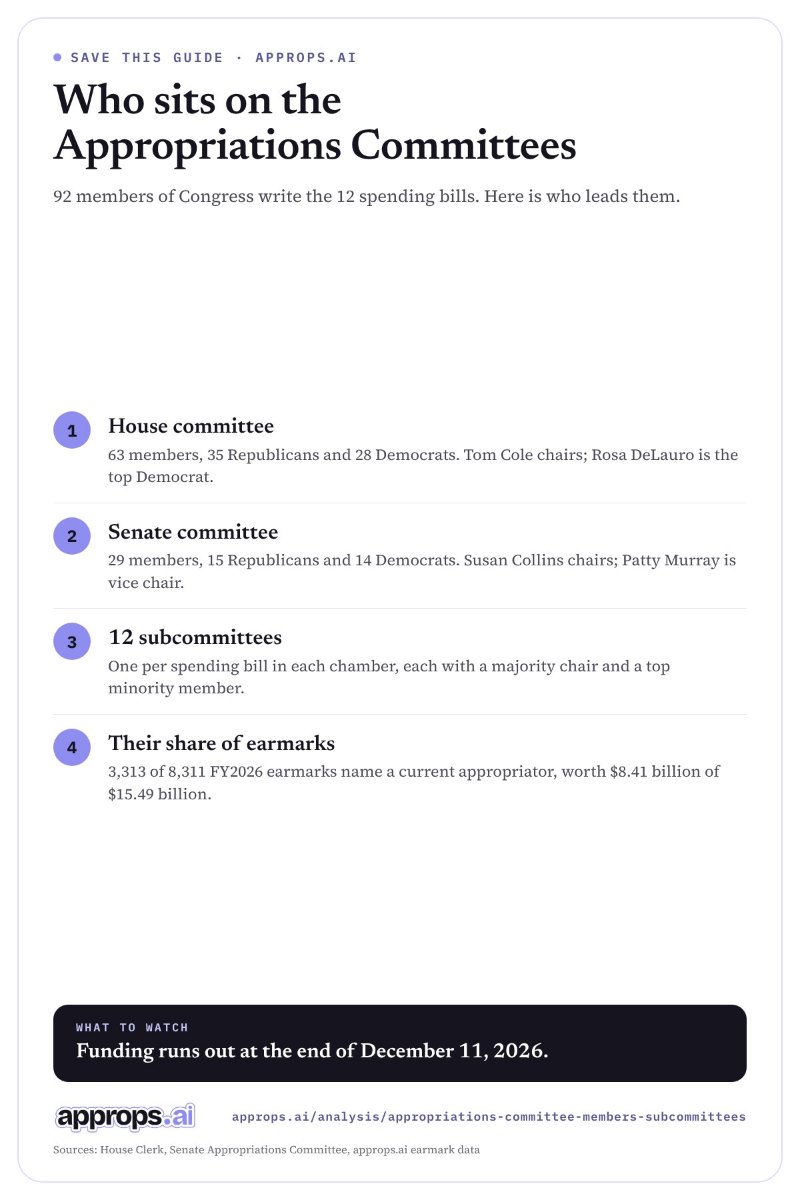
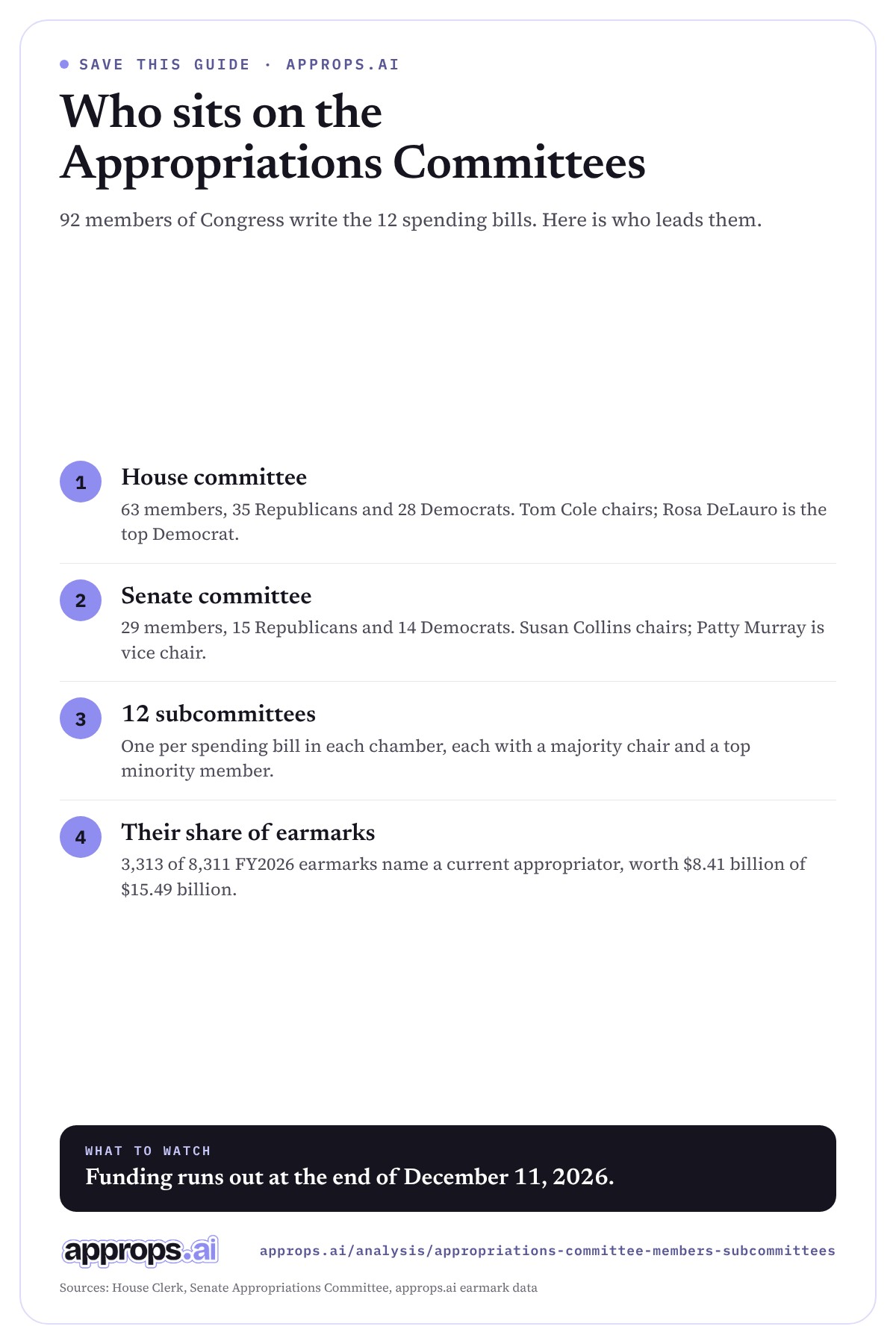
Ninety two members of Congress sit on the two Appropriations Committees: 63 in the House (35 Republicans and 28 Democrats, according to the House Clerk) and 29 in the Senate (15 Republicans and 14 Democrats, according to the Senate committee). Each committee splits into the same 12 subcommittees, one for each annual spending bill, and every subcommittee has a chair from the majority and a top member from the minority.
Those 92 people will write whatever keeps the government open after December 11. That is 27 days from today.
Who runs the two committees?
In the House, Rep. Tom Cole of Oklahoma chairs the committee and Rep. Mario Diaz-Balart of Florida is vice chair. Rep. Rosa DeLauro of Connecticut is listed first among the Democrats, which makes her the committee's top Democrat.
In the Senate, Sen. Susan Collins of Maine is chair and Sen. Patty Murray of Washington is vice chair. The Senate calls its top minority member the vice chair, so Murray holds the job DeLauro holds in the House.
These are the top Senate and House appropriators who met on November 9 and left without a deal, The Washington Post reported. Four people, two chambers, one deadline.
The 12 subcommittees and who leads them
Here is each subcommittee with its House chair and top Democrat, then its Senate chair and ranking member, from the House Clerk's subcommittee pages and the Senate committee's subcommittee pages.
- Agriculture and FDA: House, Andy Harris of Maryland and Sanford Bishop of Georgia. Senate, John Hoeven of North Dakota and Jeanne Shaheen of New Hampshire.
- Commerce, Justice, Science: House, Harold Rogers of Kentucky and Grace Meng of New York. Senate, Jerry Moran of Kansas and Chris Van Hollen of Maryland.
- Defense: House, Ken Calvert of California and Betty McCollum of Minnesota. Senate, Mitch McConnell of Kentucky and Christopher Coons of Delaware.
- Energy and Water: House, Chuck Fleischmann of Tennessee and Marcy Kaptur of Ohio. Senate, John Kennedy of Louisiana and Patty Murray of Washington.
- Financial Services and General Government: House, David Joyce of Ohio and Steny Hoyer of Maryland. Senate, Bill Hagerty of Tennessee and Jack Reed of Rhode Island.
- Homeland Security: House, Mark Amodei of Nevada and Henry Cuellar of Texas. Senate, Katie Britt of Alabama and Chris Murphy of Connecticut.
- Interior and Environment: House, Michael Simpson of Idaho and Chellie Pingree of Maine. Senate, Lisa Murkowski of Alaska and Jeff Merkley of Oregon.
- Labor, Health and Human Services, Education: House, Robert Aderholt of Alabama and Rosa DeLauro of Connecticut. Senate, Shelley Moore Capito of West Virginia and Tammy Baldwin of Wisconsin.
- Legislative Branch: House, David Valadao of California and Adriano Espaillat of New York. Senate, Deb Fischer of Nebraska and Martin Heinrich of New Mexico.
- Military Construction and Veterans Affairs: House, John Carter of Texas and Debbie Wasserman Schultz of Florida. Senate, John Boozman of Arkansas and Jon Ossoff of Georgia.
- National Security and State: House, Mario Diaz-Balart of Florida and Lois Frankel of Florida. Senate, Susan Collins of Maine, listed as interim chair, and Brian Schatz of Hawaii.
- Transportation and Housing: House, Steve Womack of Arkansas and James Clyburn of South Carolina. Senate, Cindy Hyde-Smith of Mississippi and Kirsten Gillibrand of New York.
Two quirks are worth knowing. The House renamed its foreign affairs panel National Security, Department of State, and Related Programs, while the Senate still calls it State, Foreign Operations, and Related Programs. Same bill, two names. And Murray and DeLauro each hold the top minority seat on a subcommittee on top of leading their party's side of the full committee.
What does a subcommittee chair actually do?
Writes the first draft, which is most of the power. Each chair gets a slice of the total, the 302(b) allocation (the spending ceiling each subcommittee gets), and builds a bill to fit it. The full committee then marks it up (debates, amends and votes on it) before it goes to the floor.
You can see the chairs' fingerprints on this week's Senate bills. When the Senate committee posted five more FY2027 bills on November 12, each came from a subcommittee on this list. None of them has had a markup yet, and the tracker shows where all 12 stand in each chamber.
Every House appropriator
Republicans (35): Tom Cole, Harold Rogers, Robert B. Aderholt, Michael K. Simpson, John R. Carter, Ken Calvert, Mario Diaz-Balart, Steve Womack, Chuck Fleischmann, David P. Joyce, Andy Harris, Mark E. Amodei, David G. Valadao, Dan Newhouse, John R. Moolenaar, John H. Rutherford, Ben Cline, Guy Reschenthaler, Ashley Hinson, Julia Letlow, Michael Cloud, Michael Guest, Ryan K. Zinke, Andrew S. Clyde, Stephanie I. Bice, Scott Franklin, Jake Ellzey, Juan Ciscomani, Chuck Edwards, Mark Alford, Nick LaLota, Dale W. Strong, Celeste Maloy, Riley M. Moore and Jefferson Shreve.
Democrats (28): Rosa L. DeLauro, Steny H. Hoyer, Marcy Kaptur, James E. Clyburn, Sanford D. Bishop, Jr., Betty McCollum, Debbie Wasserman Schultz, Henry Cuellar, Chellie Pingree, Mike Quigley, Grace Meng, Mark Pocan, Pete Aguilar, Lois Frankel, Bonnie Watson Coleman, Norma J. Torres, Ed Case, Adriano Espaillat, Josh Harder, Lauren Underwood, Susie Lee, Joseph D. Morelle, Mike Levin, Madeleine Dean, Veronica Escobar, Frank J. Mrvan, Marie Gluesenkamp Perez and Glenn Ivey.
Every Senate appropriator
Republicans (15): Susan Collins, Mitch McConnell, Lisa Murkowski, Jerry Moran, John Hoeven, John Boozman, Shelley Moore Capito, John Kennedy, Cindy Hyde-Smith, Bill Hagerty, Katie Britt, Deb Fischer, Mike Rounds, Jon Husted and Darline Graham, who joined the committee in July.
Democrats (14): Patty Murray, Richard Durbin, Jack Reed, Jeanne Shaheen, Jeff Merkley, Christopher Coons, Brian Schatz, Tammy Baldwin, Chris Murphy, Chris Van Hollen, Martin Heinrich, Gary Peters, Kirsten Gillibrand and Jon Ossoff.
Every name links to that member's page, with the earmarks they secured in FY2026 and what they asked for in FY2027.
Appropriators carry more than half the earmark money
Here is the number nobody else will hand you. Approps tracks all 8,311 enacted FY2026 earmarks, worth $15.49 billion, from the Senate committee's public law tables. Of those, 3,313 name at least one of today's 92 appropriators as a requestor. Those projects add up to $8.41 billion.
So about 17 percent of Congress (92 of 535 members) has its name on 40 percent of the projects and 54 percent of the dollars. Seats on this committee come with a pen.
Two caveats keep that honest. A project counts if an appropriator is one of its requestors, even when other members signed on too. And the count uses today's rosters, so a newer appropriator counts the same as a veteran. The largest Senate totals belong to McConnell ($471.22 million across 43 projects) and Murray ($464.29 million across 89). You can browse every project by bill, starting with Labor, Health and Human Services, Education, or by state on the earmarks map.
What happens next
The deadline is the end of Friday, December 11. Whether the answer is a stack of full year bills, another stopgap or a mix, it starts in these 24 subcommittees and runs through the four leaders named at the top. Watch the House and Senate committees for a markup notice, the clearest sign a full year bill is real. A stopgap skips the subcommittees almost entirely, which is one reason the chairs tend to fight them.
The rosters themselves change when the next Congress begins in January, and the party ratios will be set again then. Until that happens, these are the people to watch. The countdown is on the shutdown page, and how many appropriations bills there are explains why there are 12 of everything.
Save this guide
Frequently asked questions
How many members are on the Appropriations Committee?
92 across both chambers. The House committee has 63 members (35 Republicans, 28 Democrats) and the Senate committee has 29 (15 Republicans, 14 Democrats).
Who chairs the House and Senate Appropriations Committees?
Rep. Tom Cole of Oklahoma chairs the House committee, with Rep. Rosa DeLauro of Connecticut as its top Democrat. Sen. Susan Collins of Maine chairs the Senate committee, with Sen. Patty Murray of Washington as vice chair.
What are the 12 appropriations subcommittees?
Agriculture and FDA; Commerce, Justice, Science; Defense; Energy and Water; Financial Services and General Government; Homeland Security; Interior and Environment; Labor, Health and Human Services, Education; Legislative Branch; Military Construction and Veterans Affairs; National Security and State (State and Foreign Operations in the Senate); Transportation and Housing.
How much earmark money do appropriators get?
Of the 8,311 enacted FY2026 earmarks Approps tracks, 3,313 name at least one current appropriator as a requestor. Those projects total $8.41 billion, about 54 percent of the $15.49 billion.
Sources
- Office of the Clerk, House Committee on Appropriations members and subcommittees
- Senate Appropriations Committee, committee members
- Senate Appropriations Committee, subcommittees
- Senate Appropriations Committee, majority news releases
- The Washington Post, One month from shutdown, Congress is far from a deal (Nov. 11, 2026)