The House came back on Monday, November 9, and the Majority Leader's floor schedule for the week lists nuclear licensing bills, small business bills and a veterans' cost of living bill. It does not list a government funding bill. Last votes are expected by 3:00 p.m. Thursday.
So the vote people keep searching for has not been called yet. The clock has.
Funding runs out at the end of Friday, December 11, when the stopgap Congress passed in September, P.L. 119-103, expires. What decides when the next shutdown vote happens is less about politics than about the calendar, and the calendar is short.
When is the next government shutdown vote?
No date has been set. Neither chamber has scheduled a vote on a new stopgap (a continuing resolution, or CR) or on any of the 12 full year bills.
What we can say is where the votes can fit. States Newsroom reports that the lame duck is a five week session and that the two parties do not have enough time to agree on all 12 bills, which it puts at around $1.9 trillion, so lawmakers "must use another stopgap spending bill to extend funding into next year." That vote, whenever it comes, is the one that keeps the lights on.
How many days does Congress have left before December 11?
Thirteen, counting from today.
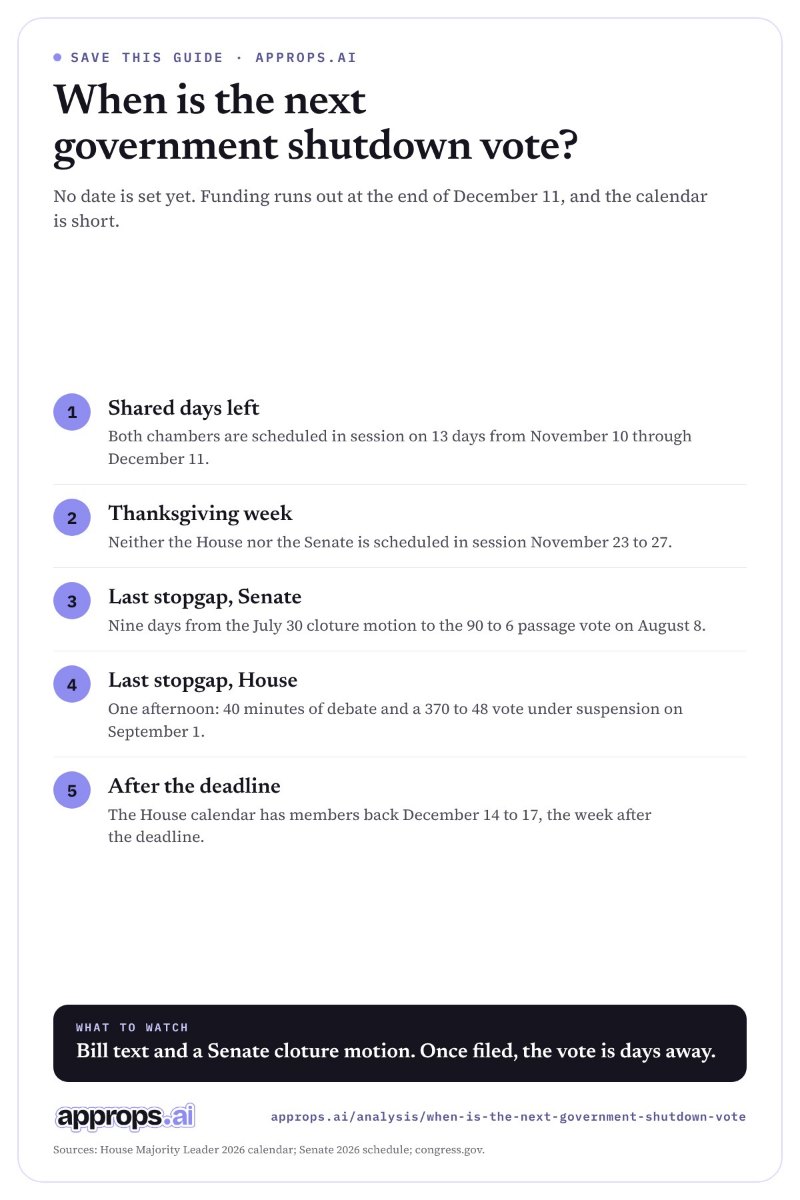
That is the number of days from November 10 through December 11 when both chambers' published calendars have them in session. The House's 2026 calendar shows these voting days:
- November 10 to 12 (the House stays in through Veterans Day)
- November 17 to 20
- November 30 to December 3
- December 8 to 11
The Senate's tentative 2026 schedule takes November 11 to 13 off for Veterans Day and the whole week of November 23 for Thanksgiving. Line the two up and the days when both are in town come to 13: one this week, then four in each of the next three working weeks.
Neither chamber is in on Thanksgiving week. Nobody is surprised.
How long does a stopgap take to pass?
Longer than people think, mostly in the Senate. The last one is a good guide because it is the law we are living under now.
On the Senate side, the clock started on July 30, when a cloture motion was filed to begin debate. Cloture (the vote to end debate) on taking up the bill passed 89 to 4 on August 3. The Senate then worked through amendments and passed it 90 to 6 on August 8, according to the congress.gov record. That is nine days from the first motion to passage, with the votes nobody fought.
The House went much faster. On September 1, Rep. Tom Cole of Oklahoma, the House Appropriations chair, moved to pass the Senate's version under suspension of the rules, a fast track that allows 40 minutes of debate but needs two thirds of the members voting. It passed 370 to 48 that afternoon, and the President signed it the next day. (We wrote about why the House used suspension for a stopgap when it happened.)
Nine days in the Senate, one afternoon in the House. That ratio is why the Senate's calendar is the one to watch.
Why the Senate's 60 votes set the pace
Ending debate in the Senate takes three fifths of the chamber, 60 of 100 senators, a bar set in 1975. A stopgap clears that easily on the final vote. The time goes into the steps before it: in August there was a cloture motion, a cloture vote to take up the bill, a second cloture motion on the Senate's own text, a cloture vote on that, a motion to table an amendment, and only then passage.
What finally sped things up was an agreement. On August 8 the remaining amendments were handled "under the order of 8/8/2026" by unanimous consent, and passage came the same day. Any one senator can withhold that consent, which is why a vote everyone expects to pass can still run right up to midnight on December 11.
When did the last lame duck vote happen?
Late, and on a Thursday. In the 2022 lame duck, the Senate passed the Consolidated Appropriations Act, 2023 68 to 29 on December 22. The amendment votes that day ran "under the order of 12/22/22," the same kind of unanimous consent deal that closed out August. The House agreed 225 to 201 the next afternoon after an hour of debate, and the President signed it on December 29.
That was a full year package for all 12 bills, signed four days after Christmas. This year the money runs out on December 11, so a finish that late would need another stopgap first.
What else is competing for those 13 days
Funding is not the only item on the list. States Newsroom names the annual defense policy bill (the NDAA), the farm bill, a college sports bill and a permitting reform bill, plus a Senate push to confirm nominees before the majority changes hands in January.
Each of those wants floor time too. Some of them could end up riding on the funding bill instead of getting floor time of their own.
What happens next
Watch the House Majority Leader's weekly schedule and the Senate floor. The first sign of a real vote is bill text: a stopgap gets introduced, then a cloture motion gets filed in the Senate. Once that motion is filed, the vote is days away, not weeks.
One more date on the House calendar is worth knowing. It has the House back in session December 14 to 17, the week after the deadline. That is room for a short stopgap and a bigger package after it, if leaders want it. That package may also carry new air traffic control money: here is what the FAA's $50 billion request means for the December 11 bill.
For what each side is asking for in those days, see where the government funding talks stand. If nothing passes by the end of December 11, here is what a December 12 shutdown would stop and what keeps going. For what past lame ducks did with the same deadline, see will there be a government shutdown in December. The live countdown is on the shutdown page, and the status of all 12 bills is on the appropriations tracker.
Save this guide
Frequently asked questions
When is the next government shutdown vote?
No date has been set. The House floor schedule for the week of November 9 lists no funding bill, and funding runs out at the end of December 11, so a stopgap vote has to land on one of the session days before then.
How many days is Congress in session before December 11?
Counting from November 10, the House and Senate calendars have both chambers in session on 13 days: November 10, November 17 to 20, November 30 to December 3, and December 8 to 11.
Is Congress in session Thanksgiving week?
No. The House calendar marks November 23 to 27 as a district work week, and the Senate's tentative schedule takes the same week off for Thanksgiving.
How long did the last stopgap take to pass?
Nine days in the Senate, from the July 30 cloture motion to the 90 to 6 vote on August 8. The House passed the Senate's version in one afternoon on September 1, 370 to 48, and it was signed September 2.
Sources
- House Majority Leader, weekly schedule, week of Nov. 9, 2026
- House Majority Leader, 2026 House calendar
- U.S. Senate, tentative 2026 legislative schedule
- Congress.gov, H.R. 6500 actions (P.L. 119-103)
- Congress.gov, H.R. 2617 actions (P.L. 117-328)
- U.S. Senate, about filibusters and cloture
- States Newsroom via KTTN, lame duck to do list, Nov. 10, 2026