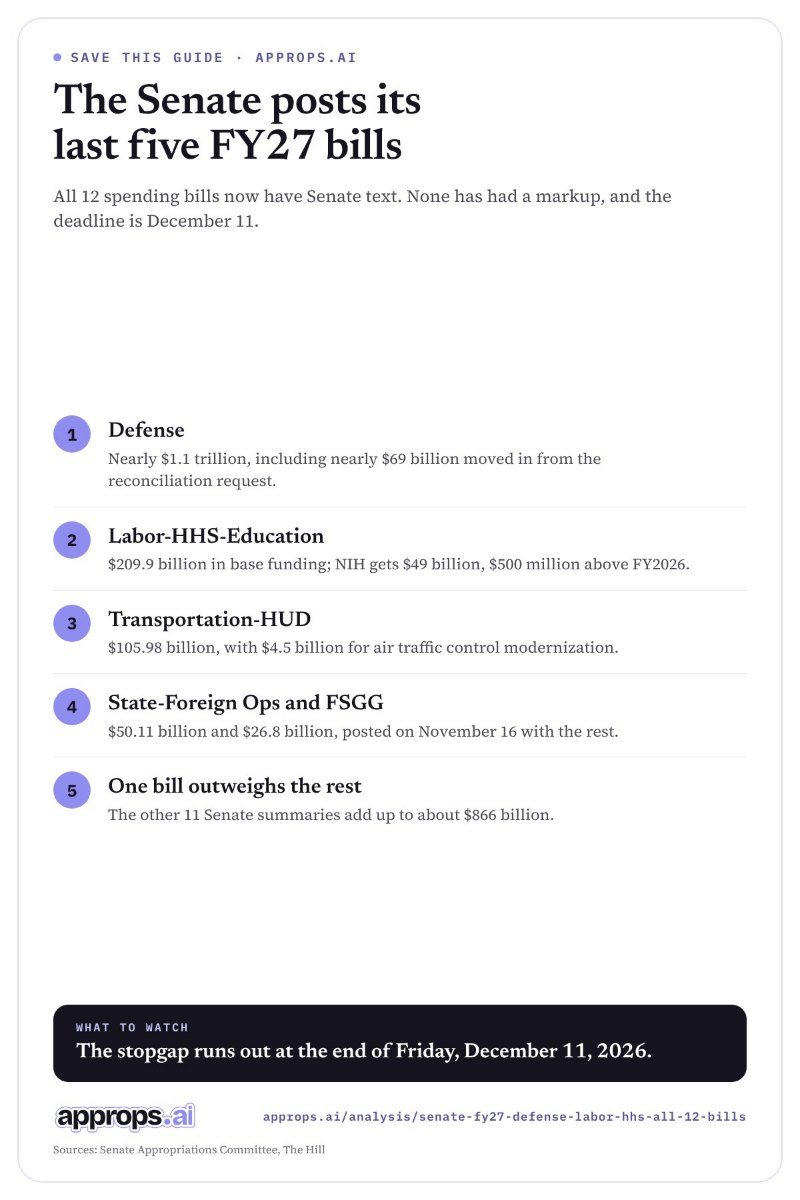
On Monday, November 16, the Senate Appropriations Committee posted its last five FY2027 spending bills: Defense, Labor-HHS-Education, Transportation-HUD, State-Foreign Operations, and Financial Services and General Government. The Defense bill alone provides nearly $1.1 trillion. With these five, all 12 annual bills now have Senate text.
None of them has had a markup. The deadline is still December 11.
What did the Senate post on November 16?
Bill text, an explanatory statement (the report that tells agencies how to spend the money and carries the earmark tables) and a one page summary for each of the five. It is the same routine the committee used on November 10 for Agriculture and MilCon-VA and on November 12 for five more.
The release went up on the Republican majority's press page, with a statement from each subcommittee chair. No committee vote was taken. That makes these the Senate majority's offer for the endgame, not a bipartisan committee product.
The five bills by the numbers
Each figure below is the committee's own number from its summary.
- Defense: nearly $1.1 trillion. Nearly $69 billion of that was first requested by the administration as one time mandatory money (the reconciliation request) and is now in the regular bill. Pay and benefits get $202.9 billion, enough for a 3.6 percent raise. Munitions get $47.2 billion. Summary.
- Labor-HHS-Education: $209.9 billion in base discretionary funding, plus $3.2 billion for program integrity and $1 billion in extra money for the Low Income Home Energy Assistance Program. The National Institutes of Health get $49 billion, $500 million above FY2026. Summary.
- Transportation-HUD: $105.98 billion. Air traffic control modernization gets $4.5 billion, $500 million more than the administration asked for, plus money to hire 2,300 new controllers. Summary.
- State-Foreign Operations: $50.11 billion. That includes $3.3 billion in military aid for Israel, $300 million for Taiwan and $129 million in security assistance for Ukraine. Summary.
- Financial Services and General Government: $26.8 billion. The courts get $1.1 billion for security, $150 million of it for the Supreme Court. Summary.
One bill outweighs the other 11
Add up the other 11 Senate summaries and you get about $866 billion. Defense, at nearly $1.1 trillion, is bigger than all of them combined.
That comparison is rough. Some summaries count disaster and wildfire money inside their totals and some do not, so treat the sum as a size check rather than a topline. The point holds anyway: most of the money, and most of the argument, sits in one bill.
The Defense number also leans on a trick of timing. The Hill reported that the $69 billion moved over from the reconciliation request reflects doubt that the full $350 billion party line Pentagon package will pass. Senators would rather have the money in a bill that has to move by December than in one that may never move.
What is inside Labor-HHS and Defense
Labor-HHS is the biggest domestic bill, and its summary leads with medical research. Alzheimer's research gets $4 billion, $100 million more than FY2026. The National Cancer Institute gets $7.5 billion, up $160 million. The summary also promises money to cover the Pell Grant shortfall and keep the maximum award where it is.
The Defense summary puts munitions up front. Of the $47.2 billion for munitions, $40.6 billion pays for new multiyear contracts covering nine missiles, from PATRIOT interceptors to Tomahawks. The Hill counted $42 billion for shipbuilding and $35.6 billion for air and missile defense, including the Golden Dome program the President has pushed. Military construction is not in this bill; it rides in MilCon-VA.
Why post bills nobody has voted on?
Because the clock is short and negotiators need numbers on paper. The committee has not scheduled a markup, and fewer than four weeks remain before December 11. Posting text lets House and Senate staff trade offers line by line while the leaders work out the toplines.
It also sets a marker. Each side's bill is the first number in a trade, and a posted bill is easier to defend than one that lives in a negotiator's head.
What each side said
Sen. Mitch McConnell of Kentucky, who chairs the Defense subcommittee, called the bill "a roadmap to sustainably and responsibly delivering generational investments in the national defense." Sen. Patty Murray of Washington, the committee's top Democrat, called it a "truly massive windfall" for the Pentagon, according to The Hill, and said it does next to nothing to rein in the President.
The fight is not only about Defense. Sen. Bill Hagerty of Tennessee, who chairs the Financial Services subcommittee, said Senate Democrats "sabotaged the process earlier this summer by insisting on partisan markups." Sen. Cindy Hyde-Smith of Mississippi, the Transportation-HUD chair, struck a different note: "I hope this package will serve as the foundation for a bipartisan agreement that can be signed into law."
Both can be read as the opening of a negotiation. Neither is a deal.
Where do the House bills stand?
The House is further along on paper. Its committee reported all 12 bills by June, and the House passed three: Agriculture, MilCon-VA and State-Foreign Operations. Of today's five, only State-Foreign Operations (H.R. 8595) has passed the House, 217 to 209 on July 15. Defense (H.R. 9495), Labor-HHS (H.R. 9260), Transportation-HUD and Financial Services are reported from committee and waiting.
So for the first time this year, negotiators have a House version and a Senate version of every bill to line up account by account. You can see each bill in both chambers on the tracker.
Does this touch the FAA fight?
Yes. The Transportation-HUD bill is where the air traffic control money lives, and its $4.5 billion is regular annual funding. That is separate from the $50 billion the administration asked for after the November 13 ground stop. Hyde-Smith tied the two together herself, saying "recent incidents show us the importance of investments included in this important legislation."
The Senate earmark tables for these bills are in the explanatory statements. The House project lists are already searchable for Defense, Labor-HHS-Education, Transportation-HUD and Financial Services.
What happens next
The stopgap runs out at the end of Friday, December 11. Congress can pass full year bills built from these texts, another stopgap, or some of each. Some Democrats want to use the deadline to force an end to the war with Iran, The Hill reported, which could slow any of those paths.
Watch for a markup notice from either committee, a first package of bills (Republicans have talked about starting with Defense), and the White House list of stopgap fixes, which would signal a CR. The countdown is on the shutdown page, and where the funding talks stand has each side's position. You can stay up to date at approps.ai!
Save this guide
Frequently asked questions
How much is the Senate FY27 defense appropriations bill?
Nearly $1.1 trillion in discretionary funding, according to the Senate Appropriations Committee summary. Nearly $69 billion of it was first requested as one time mandatory money and is now in the regular bill.
Has the Senate released all 12 FY27 appropriations bills?
Yes. The committee posted the last five on November 16, 2026: Defense, Labor-HHS-Education, Transportation-HUD, State-Foreign Operations, and Financial Services and General Government. None has had a markup.
How much is the Senate FY27 Labor-HHS bill?
$209.9 billion in base discretionary funding, plus $3.2 billion for program integrity and $1 billion in extra LIHEAP money. NIH gets $49 billion, $500 million above FY2026.
When is the next government funding deadline?
The end of Friday, December 11, 2026, when the current stopgap runs out. Congress has to pass full year bills, another stopgap, or some of each by then to avoid a shutdown.
Sources
- Senate Appropriations Committee, final five FY2027 funding bills released (Nov. 16, 2026)
- Senate summary, Defense FY2027
- Senate summary, Labor-HHS-Education FY2027
- Senate summary, Transportation-HUD FY2027
- Senate summary, State-Foreign Operations FY2027
- Senate summary, Financial Services and General Government FY2027
- The Hill, Senate GOP unveils nearly $1.1T defense appropriations bill (Nov. 16, 2026)