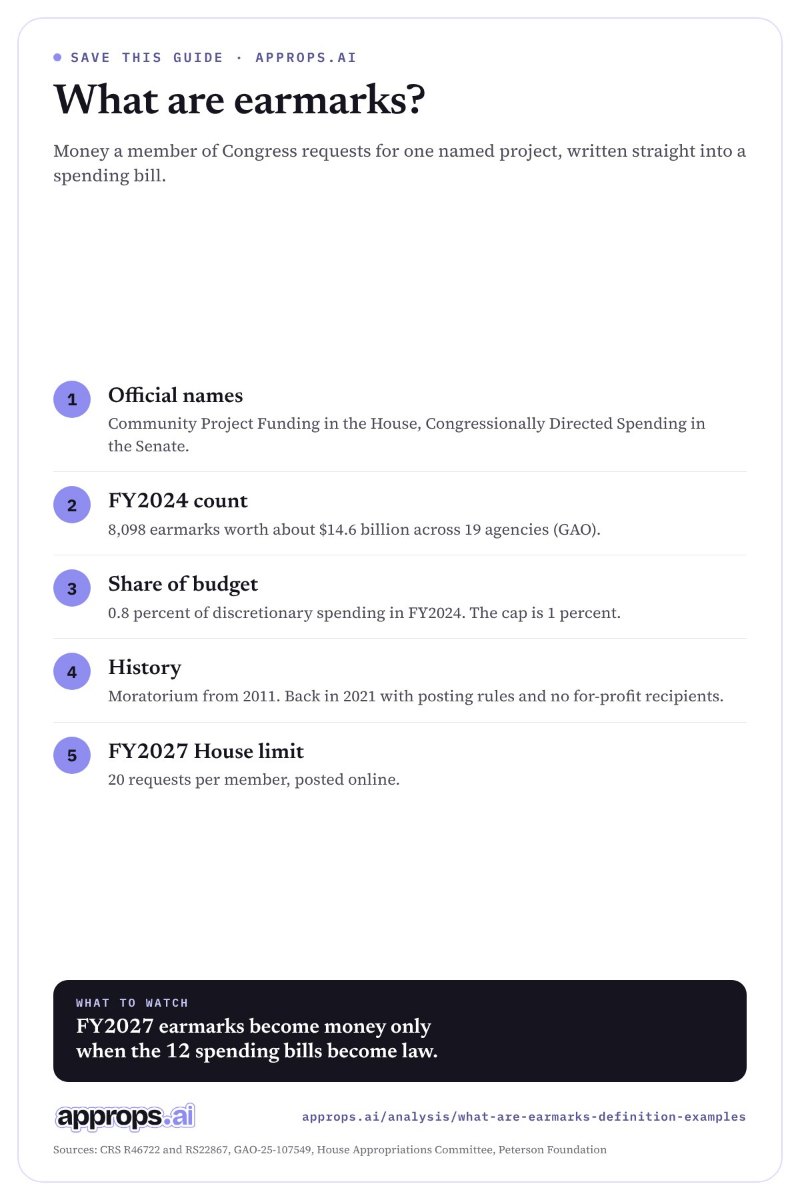
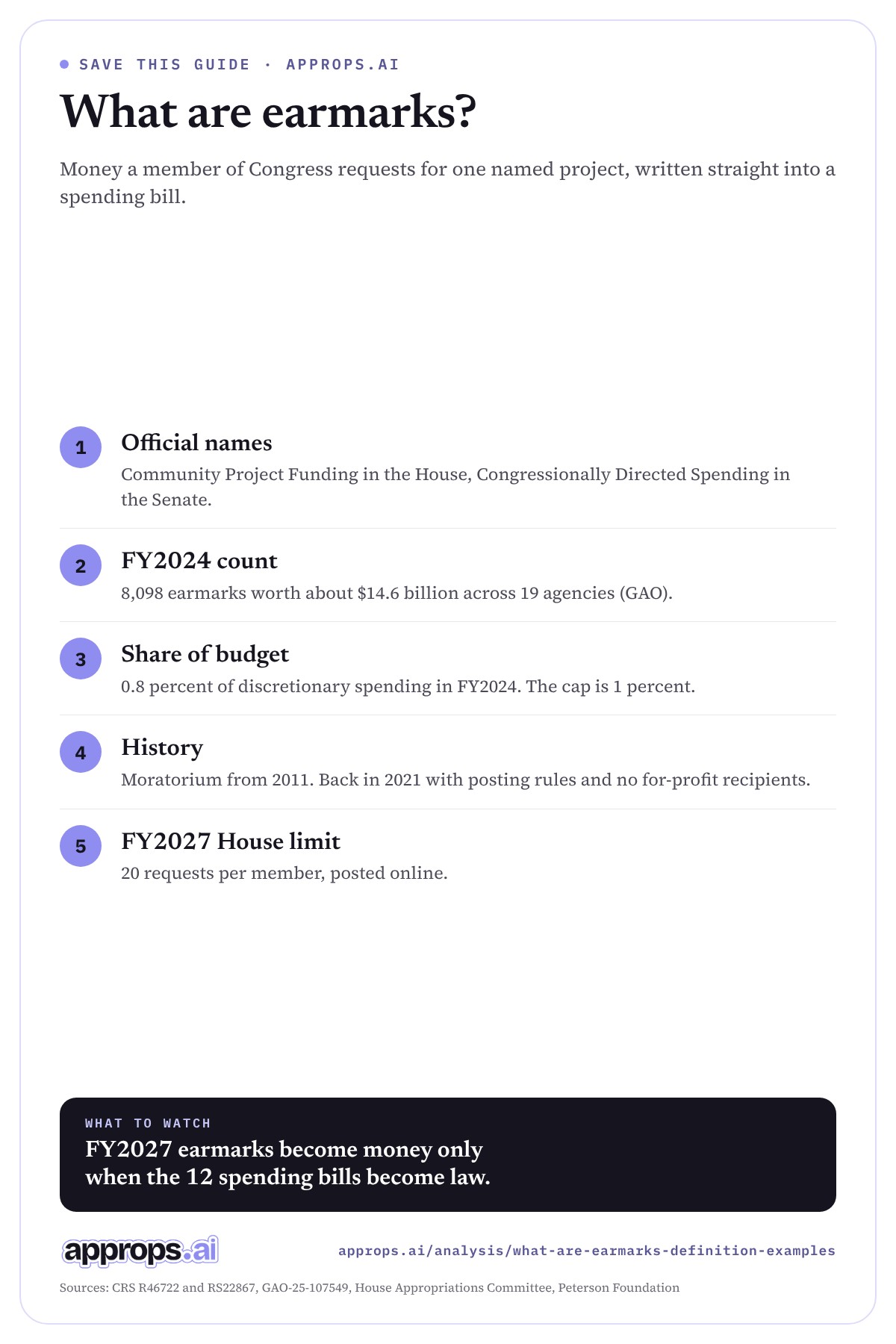
An earmark is money a member of Congress asks for, by name, for one project back home, and gets written straight into a spending bill. The House rule puts it in one line: a provision or report language "included primarily at the request of a Member," as quoted in CRS report R46722.
That is the whole idea. Everything else is the rules around it.
A lot of the people looking it up are studying for AP Government, so this guide starts with the textbook answer. Then it shows what an earmark looks like in a real bill, how big they are, and why the system you read about in 2010 is not the one running today.
What are earmarks? The short definition
An earmark sets aside federal money for a specific recipient or place, chosen by a lawmaker instead of by an agency. Normally an agency like the Department of Transportation runs a grant competition or uses a formula to decide who gets money. An earmark skips that step. The member picks the project, the bill names it, and the agency sends the money.
The Senate's definition, in Rule XLIV, says the same thing from the other side. A congressionally directed spending item is money requested by a senator "other than through a statutory or administrative formula driven or competitive award process," according to CRS report RS22867, updated January 16, 2026.
Congress has stopped saying the word. The House calls them Community Project Funding and the Senate calls them Congressionally Directed Spending. Same thing!
Earmarks vs. pork barrel spending
Pork barrel is the old, unflattering nickname. Earmark is the term the rules define. No House or Senate rule defines pork, so whether a given project counts as pork is a judgment call, and critics and supporters make it differently.
Supporters argue that a member knows the needs of their district better than an agency in Washington, and that written requests with a name attached are more open than leaving every decision to the executive branch. Critics argue that earmarks reward seniority and committee seats, and that lawmakers can trade them for votes on the larger bill.
The textbook point is the trade: an earmark can help pass a big bill by giving members something local to vote for.
Real earmark examples
The best count of a full year comes from the Government Accountability Office. Its report GAO-25-107549, released November 21, 2024, found about $14.6 billion for 8,098 earmarks in fiscal year 2024, spread across 19 agencies. The year before was $15.3 billion for 7,233.
What does that money buy? GAO's own examples include water infrastructure upgrades, a welding and machining training facility, trail improvements, sewer system extensions, road improvements, airport terminal expansions and public transit upgrades.
The range is wide. The largest FY2024 earmark GAO found was about $237 million for the Chickamauga Lock construction project in Tennessee. The smallest was $8,000 for patrol vehicle equipment in West Virginia.
Housing and Urban Development handled the most of them: 2,407 projects worth $3.29 billion. Transportation was next by dollars at $2.76 billion. Nearly half the money, about 48 percent, went to state, local, tribal and territorial governments.
You can look up every enacted project in your state, with the account it sits in and the member who asked for it, on the earmarks map.
How big are earmarks in the federal budget?
Smaller than their reputation. The Peter G. Peterson Foundation puts FY2024 earmarks at 0.8 percent of discretionary spending, or about 0.2 percent of all federal outlays.
They used to be bigger. From 2000 to 2006, earmarks averaged 2.8 percent of discretionary spending a year, then 1.3 percent from 2007 to 2010, by the same count. Today's rules cap them at 1 percent of discretionary spending.
So the fight over earmarks is a fight about who decides, not about the deficit.
Why earmarks went away and came back
Congress wrote its first modern disclosure rules in 2007. The Honest Leadership and Open Government Act, signed September 14, 2007 (P.L. 110-81), created the Senate rule that requires the list of earmarks in a bill to be public at least 48 hours before the vote, according to CRS RS22867.
Then both chambers stopped. A moratorium began in the 112th Congress, in 2011, and held for a decade. The 117th Congress lifted it in 2021, and the practice has continued in the 118th and 119th Congresses, CRS says.
They came back with more strings attached. The House rules announced in February 2021, laid out in CRS R46722, added a ban on earmarks for for-profit companies, a requirement that every request be posted online, a 1 percent cap, and a GAO audit of a sample of funded projects. That audit is where the numbers above come from.
How a member gets an earmark today
The FY2027 cycle shows the steps. The House Appropriations Committee opened its request portal on February 25, 2026, with a limit of 20 projects per member, according to the committee's FY27 guidance. Deadlines ran by subcommittee from March 13 to March 27. It helps to hold a seat: the members of the Appropriations Committees have their names on more than half of the FY2026 earmark dollars.
Not every bill takes them. The House did not accept Community Project Funding for Defense, Financial Services and General Government, Legislative Branch, or National Security and State. The Labor-HHS bill took requests for one purpose only: health facilities construction and equipment.
Each request needs paperwork. The Labor-HHS guidance asks for a signed letter in which the member writes, "I certify that neither I nor my immediate family have any financial interest in this project," posted on the member's website along with a federal nexus statement (the link to a real federal program). In the Senate, members also certify that no recipient is a for-profit entity.
The money is still not real at that point. A request becomes an earmark only when the bill carrying it becomes law, and the agency then pays the named recipient instead of running a competition, as GAO describes.
What happens next
The FY2027 requests are sitting in the 12 spending bills, and the bills are not law yet. Government funding runs on a stopgap through December 11, and the lame duck Congress has to decide what replaces it. You can follow each bill on the appropriations tracker and the deadline on the shutdown page.
For the case for and against earmarks in more depth, read the accountability problem with earmarks. For what the FY2026 bills delivered, see earmarks are back, and for your own state's projects, start on the earmarks map.
Save this guide
Frequently asked questions
What are earmarks in simple terms?
An earmark is federal money a member of Congress requests for a specific project or recipient back home, written directly into a spending bill. The agency pays that named recipient instead of choosing one through a competition or a formula.
What is the AP Gov definition of earmarks?
In AP Government terms, an earmark is a provision in an appropriations bill that directs money to a specific project in a member's state or district. It is often taught alongside pork barrel spending and logrolling, since earmarks can help win votes for a larger bill.
What is the difference between earmarks and pork barrel spending?
Earmark is the term House and Senate rules define. Pork barrel is the older, unflattering nickname, and no rule defines it, so calling a project pork is a judgment call.
What is an example of an earmark?
GAO counted 8,098 earmarks in fiscal year 2024. The largest was about $237 million for the Chickamauga Lock in Tennessee, and the smallest was $8,000 for patrol vehicle equipment in West Virginia.
Are earmarks still allowed?
Yes. Congress stopped earmarking in 2011 and brought it back in 2021 under new rules: requests posted online, no for-profit recipients, a no financial interest certification and a cap of 1 percent of discretionary spending.
Sources
- CRS R46722, Community Project Funding: House Rules and Committee Protocols
- CRS RS22867, Earmark Disclosure Rules in the Senate (updated Jan. 16, 2026)
- GAO-25-107549, Tracking the Funds: Specific Fiscal Year 2024 Provisions
- House Appropriations Committee, FY27 member request guidance
- House Appropriations Committee, FY27 Labor-HHS CPF guidance
- Peter G. Peterson Foundation, What are earmarks