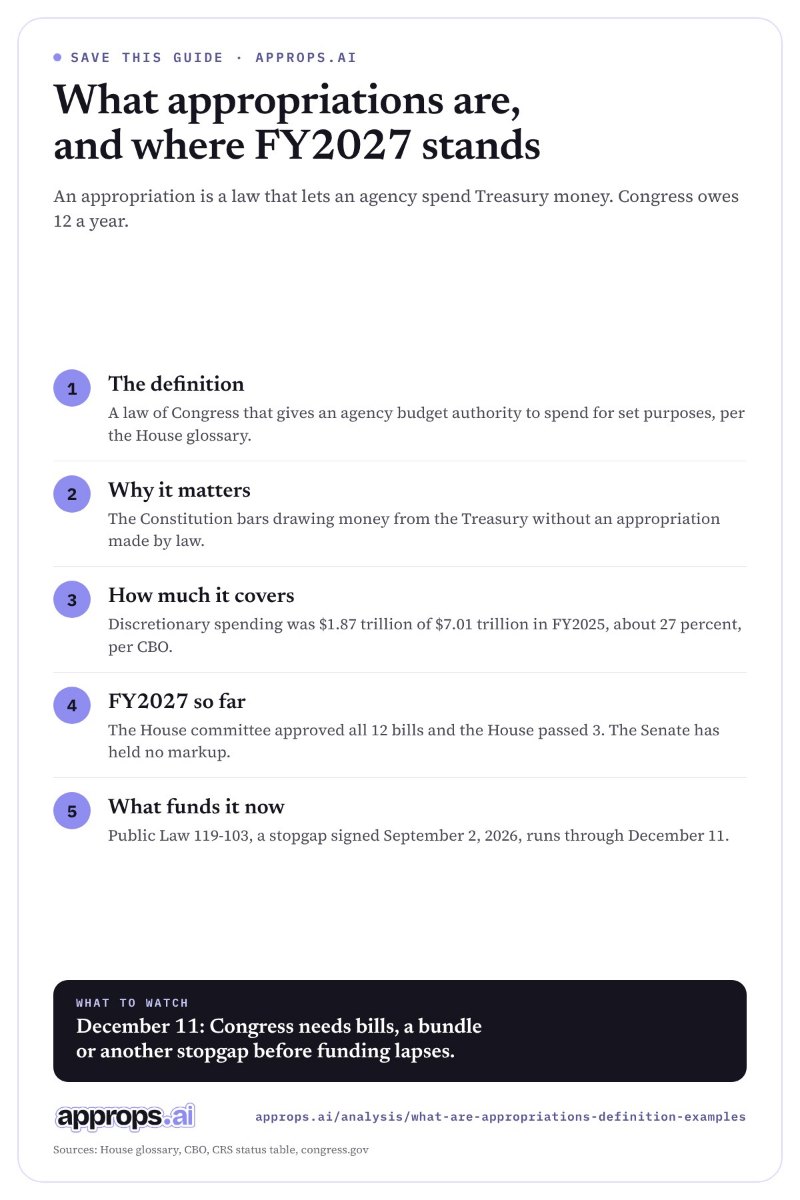
An appropriation is a law that lets a federal agency spend money from the Treasury, for a stated purpose, up to a stated amount. The House puts it plainly in its glossary of budget terms: an appropriation is "a law of Congress that provides an agency with budget authority."
Appropriations are the part of the budget Congress has to vote on every year. Miss the vote and the money stops.
That is why the word keeps showing up next to "shutdown." Right now, as of November 15, 2026, none of the 12 regular appropriations bills for fiscal year 2027 is law, and the government is running on a stopgap that ends December 11.
What are appropriations in government?
They are the permission slip for spending. An agency can have a program on the books, a staff and a mission, and still not be able to spend a dollar until an appropriation says it can.
The rule goes all the way back to the Constitution. Article I, Section 9 says "No Money shall be drawn from the Treasury, but in Consequence of Appropriations made by Law." That one sentence is the reason Congress holds the purse and the President does not.
The House glossary adds two details worth knowing. An appropriation can be definite, a specific sum of money, or indefinite, written as "such sums as may be necessary." And most of them are annual, which means the money is available for one fiscal year and then lapses.
What is appropriation in simple terms?
Think of it in three parts: what the money is for, how much, and for how long. A line in an appropriations act names the account (say, a grant program at the Department of Transportation), gives the dollar amount and says when the money is available.
Agencies have to stay inside all three. A federal law called the Antideficiency Act says an officer may not spend or commit money "exceeding an amount available in an appropriation," and may not sign the government up for payments "before an appropriation is made unless authorized by law," per 31 U.S.C. 1341.
That second clause is the one that matters in December. When an appropriation runs out and nothing replaces it, agencies cannot keep obligating money for most work. That is a shutdown.
Appropriation vs. authorization
People mix these up all the time, and for good reason. An authorization law creates or continues a program and often suggests how much it should get. An appropriation actually provides the money.
So a program can be authorized at $500 million and appropriated $300 million, or authorized and never funded at all. Different committees write the two kinds of laws, too. We walk through the difference, with examples, in authorization vs. appropriation.
How many appropriations bills are there?
Twelve a year. The House glossary says Congress passes "12 annual appropriation acts, as well as supplemental appropriation acts, each year." Each of the 12 comes from one subcommittee of the House and Senate Appropriations Committees: Agriculture, Commerce and Justice, Defense, Energy and Water, Homeland Security, Interior, Labor and Health, the Legislative Branch, Military Construction and VA, and so on. (Here is the full list and how each one works.)
When some of the 12 are not done by October 1, Congress passes a continuing resolution, or CR, a stopgap that keeps money flowing at last year's rate for a set number of weeks. A CR is still an appropriation. It is just a temporary one.
Supplemental appropriations are extra bills passed mid year, usually after a disaster or for a war.
What is an example of appropriation in government?
The one running the government today. The Continuing Appropriations and Extensions Act, 2027 (H.R. 6500) became Public Law 119-103 on September 2, 2026. It keeps most agencies funded at fiscal 2026 levels through December 11.
Earmarks are the most local example. Of the 8,311 earmarks Approps tracks in the enacted fiscal 2026 bills, totaling $15.49 billion, each one is a line in an appropriations act that sends a set amount to a named project. You can look up every one in your state on the earmarks map.
How much of the budget goes through appropriations?
Less than people think. In fiscal year 2025 the government spent $7.01 trillion, and discretionary spending, the money set in the annual bills, was $1.87 trillion of it, according to CBO's budget outlook figures. Defense was $893 billion and everything else $980 billion.
That is about 27 percent. The rest is mandatory spending like Social Security and Medicare ($4.17 trillion all together), which runs under permanent law, plus $970 billion in interest on the debt.
So the yearly fight that gets all the headlines decides roughly a quarter of federal spending. It is still the quarter that pays for the FBI, NIH, national parks, air traffic control and most agency staff. (Air traffic control is in the news right now: see the FAA's $50 billion funding request.) More on the split in discretionary vs. mandatory spending.
Where the FY2027 appropriations stand
The CRS appropriations status table on congress.gov shows the House Appropriations Committee approved all 12 bills between April and June. The full House passed three: Military Construction and VA (400 to 15 on May 15), Agriculture (213 to 210 on June 4) and National Security and State (217 to 209 on July 15).
The Senate side is thinner. The Senate committee has posted text for seven of its 12 bills, the last five on November 12, but has not held a single markup. No bill has gone to the President.
Twelve bills, zero laws. You can follow every one, chamber by chamber, on the tracker.
What happens next
The stopgap runs out at the end of December 11, 26 days from today. Before then, Congress has to pass something: some of the 12 bills, a bundle of them, another CR, or a mix. If it does nothing, funding lapses and the shutdown rules kick in. The countdown and the latest official status are on the shutdown page.
Save this guide
Frequently asked questions
What are appropriations in government?
An appropriation is a law of Congress that lets a federal agency spend money from the Treasury for a stated purpose, up to a stated amount. Without one, the Constitution says no money can be drawn.
What is appropriation in simple terms?
It is permission to spend: what the money is for, how much, and for how long. Agencies cannot spend past it, under the Antideficiency Act.
What is an example of appropriation in government?
The stopgap funding the government right now. H.R. 6500 became Public Law 119-103 on September 2, 2026 and keeps most agencies funded at fiscal 2026 levels through December 11.
How many appropriations bills does Congress pass each year?
Twelve regular bills, one per subcommittee, plus any supplementals. As of November 15, 2026, none of the 12 for fiscal 2027 is law.
Sources
- U.S. House of Representatives, glossary of budget terms
- Constitution Annotated, Article I, Section 9
- 31 U.S.C. 1341, the Antideficiency Act (LII)
- CBO, The Budget and Economic Outlook: 2026 to 2036, By the Numbers
- CRS appropriations status table, FY2027 (congress.gov)
- Congress.gov, H.R. 6500, Continuing Appropriations and Extensions Act, 2027
- Senate Appropriations Committee, majority news releases