On Tuesday night, CBS News projected that Democrats had won the House at 10:15 p.m. and the Senate shortly after 11:30 p.m. Sen. Susan Collins lost in Maine, which means the chair of the Senate Appropriations Committee is going home in January. Federal funding runs out on December 11, and that is 37 days from today.
The new majorities take over on January 3. The deadline does not wait for them.
So the Congress that just lost has to deal with the bills first, or decide to hand them over. Here is where it all stands.
Where do the appropriations talks stand right now?
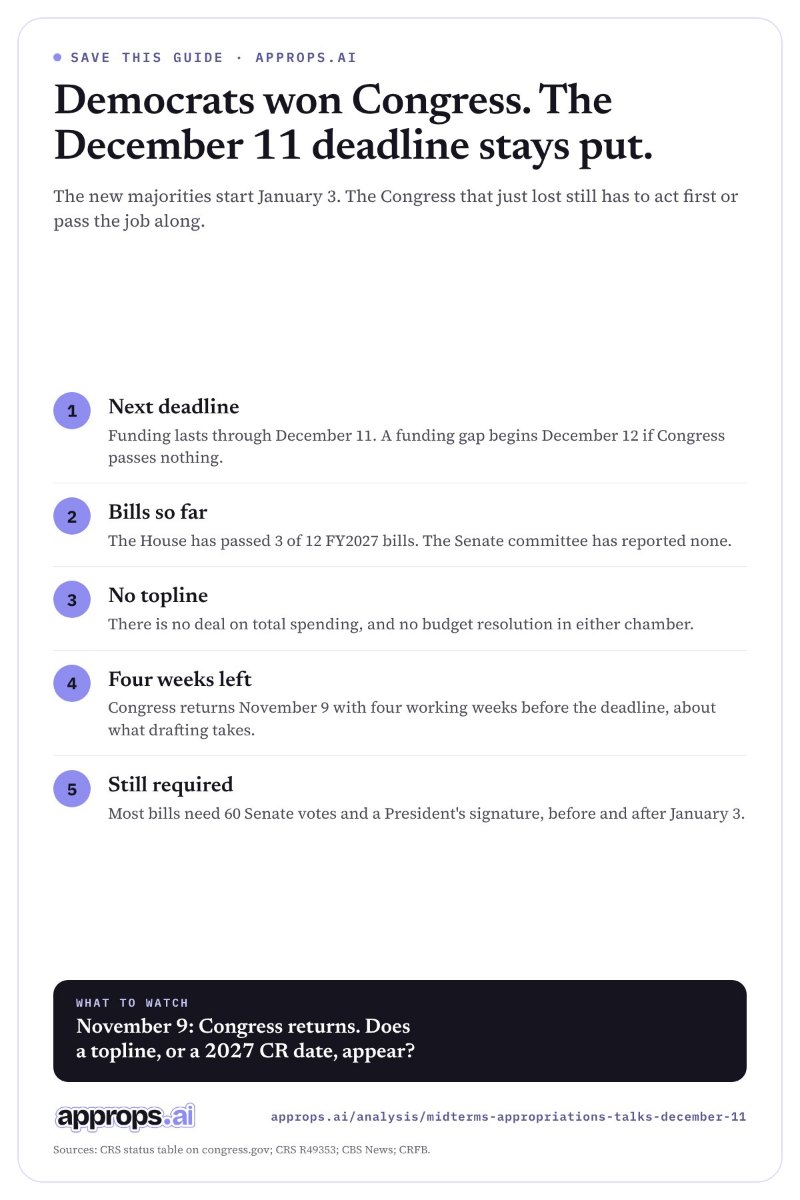
Not far along. The CRS status table on congress.gov is the official scoreboard for FY2027, and it looks the way it did when everyone left town. The House committee has approved all 12 bills. The House has passed three: Agriculture (213-210), Military Construction-VA (400-15) and National Security-State (217-209). The Senate committee has reported none, and nothing has been enacted. You can see each one on the tracker.
The bigger problem is that there is no topline, the one number that sets how much each subcommittee gets to spend. Collins called off a planned markup in June after, she said, Democrats rejected the first offers on a topline deal. By September 30, Actum's Kevin Kelly wrote that topline talks had made no progress. Neither chamber has adopted a budget resolution, so CRFB lists "no enforceable caps for FY 2027."
Defense is the center of it. The President asked for about $1.814 trillion in base funding, $1.154 trillion of it for Defense, plus another $350 billion for defense through reconciliation. The stopgap now in force runs at an annualized $1.701 trillion, by the Congressional Budget Office's estimate cited by CRS.
The math on the calendar is already bad
Both chambers come back on November 9 for two weeks, leave for Thanksgiving, then return for two or three more. Only four of those weeks fall before the deadline. Kelly's note says appropriators generally need about four weeks to draft and vote on final bills once they have a topline.
Do that subtraction. To finish on time, they would need the topline deal on the day they walk back in. They do not have one!
That does not make a shutdown likely by itself. It does make a clean finish by December 11 hard to picture, and it is why the word stopgap keeps coming up.
Who is actually in charge until January 3?
The same people as last week. Republicans still run both chambers through the lame duck (the session between an election and the new Congress). Collins remains chair, and Rep. Tom Cole of Oklahoma remains chair of the House committee.
What changed is everyone's sense of next year. The Hill reported in October that a Democratic takeover would put Rep. Rosa DeLauro of Connecticut in line for the House gavel, though she told Punchbowl she doesn't take it for granted. In the Senate, Sen. Patty Murray of Washington is the committee's vice chair and top Democrat. Sen. Darline Graham of South Carolina, who joined the committee in July, lost too. The House margin is still unknown, with about 75 races undecided at 4:19 this morning by CBS's count.
Losing Collins matters beyond the org chart. She helped write the stopgap that passed 90-6, and in September she called the $810 million pocket rescission an attempt to "undermine Congress's Constitutional power of the purse." That was a Republican chair saying it to a Republican White House.
Finish in December, or wait for January?
This part is our read, not a reported plan. We have not seen leaders in either party commit to a path as of Wednesday morning.
Democrats will have more seats and the gavels in two months, so the case for waiting is simple: why cut a deal now that you could cut better later? The case against waiting is that DeLauro and other House Democrats have said they want real bills instead of more stopgaps, and a stack of unfinished FY2027 work would land on top of the FY2028 budget.
Republicans have the mirror image. December is the last time they hold the pen, which argues for closing out. But any deal has to clear 60 votes in the Senate, so it has to give Democrats something, and that is a hard vote to whip after a loss like this one.
Before the election, Harbinger Strategies put the odds of another CR into 2027 at "high," and did not rule out a December shutdown. Holland & Knight listed the options as an omnibus or minibuses, a CR into early 2027, or a hybrid, with a partial shutdown still possible. Both were written in October, before anyone knew how large this was going to be.
What the election doesn't change
Most bills still need 60 votes in the Senate, and the President still has a veto. That was true before Tuesday and it will be true in January. Spending bills need his signature or two thirds of both chambers.
Trump said on Politico's livestream, "We'll work with the Democrats," and also said he would use the veto if he thought it was warranted. Senate Majority Leader John Thune wrote on X that Republicans would work with the President to stop what he called the "worst impulses of Democrat extremism." Senate Democratic Leader Chuck Schumer's line was shorter: "against all odds, we Democrats have won the Senate."
The fight over who owns a shutdown is also already written. DeLauro told Punchbowl in September, "If [Trump] wants to shut the government down, then it's up to him in doing that." House Republicans on the committee wrote on October 1 that the earlier shutdowns were "instigated by Minority Leader Chuck Schumer and Senate Democrats." Neither side is shy about it.
What else expires with the funding
December 11 is carrying passengers. Holland & Knight's list includes the National Flood Insurance Program, TSCA fee authority and the surface transportation extension, all on the same day. On December 31, TANF, mandatory money for community health centers and the 2.5 percent Medicare physician payment increase run out.
There is one more rider to watch. The stopgap bars OMB's federal grants rule through December 11, so a CR that drops that language would let the rule move again. Collins asked OMB in July to withdraw parts of it, so that section will get read closely.
When is the next government shutdown deadline?
Still December 11. Funding lasts through that Friday under P.L. 119-103, and a funding gap begins December 12 if Congress enacts neither full year bills nor another CR. The election did not move that date by a minute. Our shutdown page has the live countdown and the status of the stopgap, and if a new CR moves, the date there moves with it. If the deadline passes with nothing signed, here is what a December 12 shutdown would stop and what keeps going.
What happens next
Members return November 9 (here is where each of the 12 bills stands going in). Watch for three things in those first two weeks: whether Cole, Collins, DeLauro and Murray restart topline talks, whether any bill text gets posted, and whether leaders start saying a date in 2027 out loud.
The four met on November 9, and here is where the government funding talks stand since.
Thanksgiving is November 26. The deadline is December 11. The new Congress is sworn in January 3, and the President's FY2028 budget is due by law no later than February 1, so the next fight could start before this one ends. You can follow all of it at approps.ai.
Save this guide
Frequently asked questions
Where do the appropriations talks stand right now?
There is no topline deal. The House has passed 3 of the 12 FY2027 bills, the Senate committee has reported none, and nothing has been enacted, according to the CRS status table.
When is the next government shutdown deadline?
December 11, 2026. Funding lasts through that day under P.L. 119-103, and a funding gap begins December 12 if Congress enacts neither full year bills nor another stopgap.
Does the midterm election change the December 11 deadline?
No. The new Congress is sworn in January 3, so the current Congress has to pass something before the deadline or a shutdown begins.
When does Congress come back after the midterms?
November 9, for two weeks. After Thanksgiving, members return for two or three more weeks, so four working weeks fall before the deadline.
Sources
- CRS appropriations status table, FY2027
- CRS R49353, continuing appropriations for FY2027
- CBS News election live updates, Nov. 3 and 4, 2026
- CRFB Appropriations Watch FY2027
- Holland & Knight on the year end deadlines
- Harbinger Strategies lame duck preview
- Actum, Congress' crowded lame duck
- The Hill on Democrats and appropriations