On July 21, the White House science office and the Office of Management and Budget sent every agency head a memo numbered M-26-16, the administration's research and development priorities for fiscal year 2028. FY2028 does not start until October 1, 2027. Congress has not finished FY2027.
That gap is the point. The memo shapes what agencies ask for. Appropriators decide what they get.
What is the FY2028 R&D priorities memo?
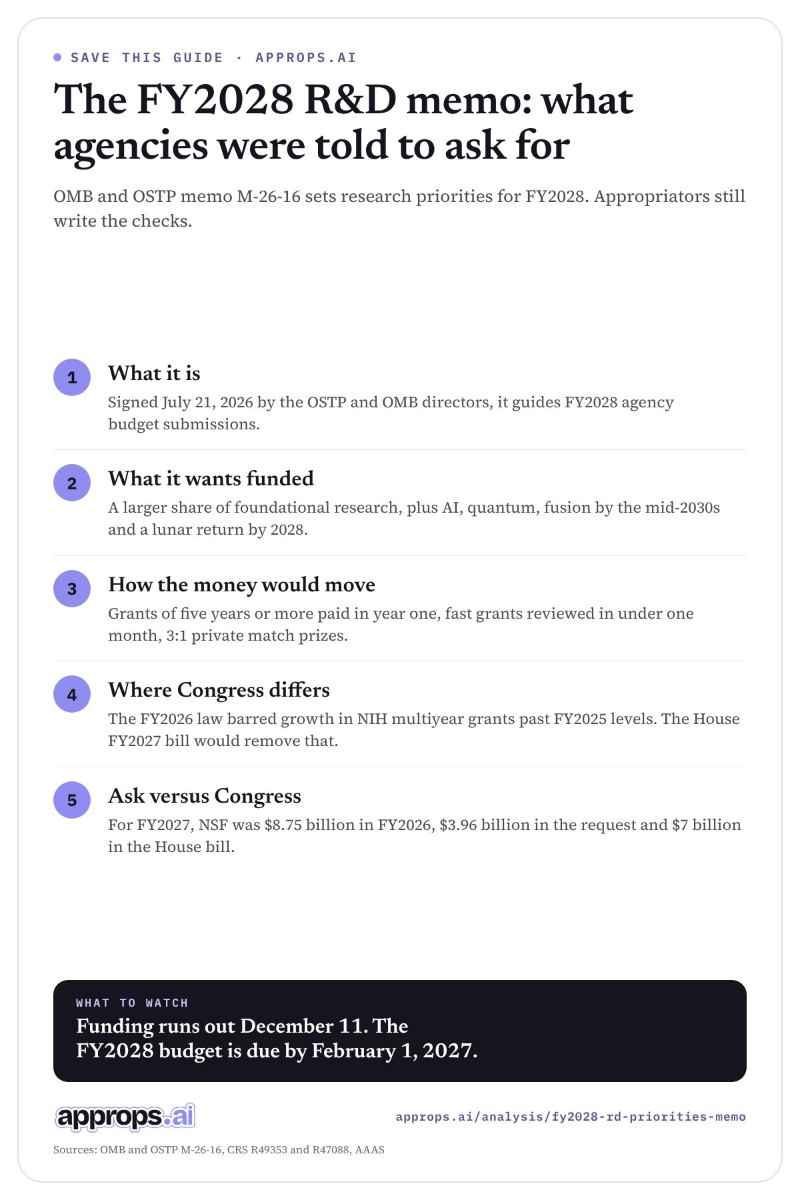
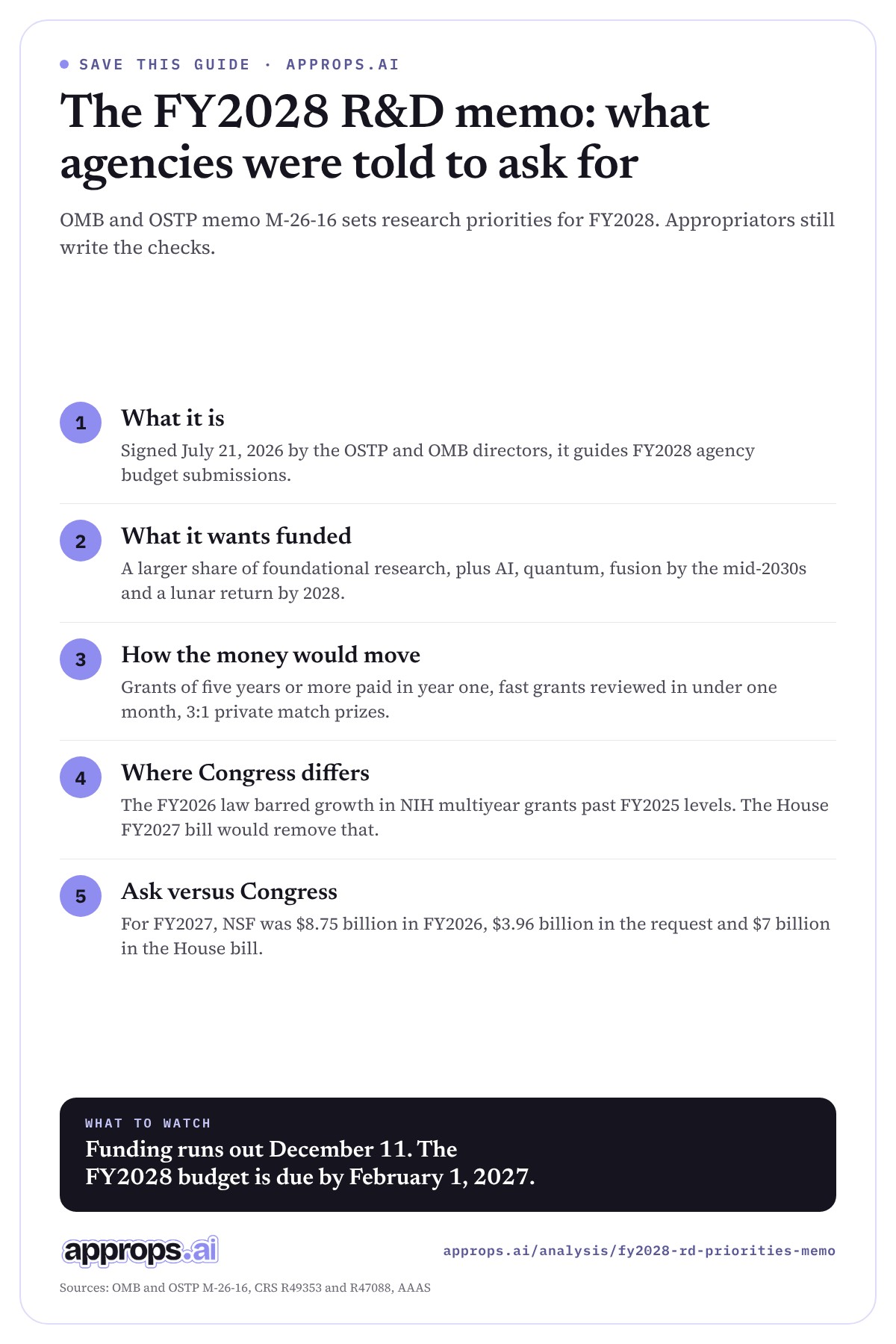
It is the yearly guidance telling agencies how to build the research part of their budget requests. This one is signed by Michael Kratsios, who runs the Office of Science and Technology Policy (OSTP), and OMB Director Russell Vought. It came out as an annex to a report called Science: A New Golden Age, which Kratsios said "lays a policy foundation that frees American scientists to do their most groundbreaking work."
Last year's version, for FY2027, came out on September 23, 2025. This one arrived two months earlier in the calendar and reads less like a list of topics and more like a change in how grants work. The stakes are large: the memo puts federal research spending at "approximately two hundred billion dollars" a year. It names no dollar amount for any agency, and the word Congress does not appear in it.
Compare the two lists. Last year's memo named critical and emerging technologies, energy dominance, national and economic security, health including chronic disease, and space exploration. This year's still has the technologies and space, but it spends far more of its length on who gets a grant, how long it lasts and who reviews it.
If the FY labels trip you up, FY2028 runs from October 1, 2027 through September 30, 2028. The number is the year it ends.
What it tells agencies to fund
There are five priority areas:
- Foundational research: agencies "should seek to increase the share of foundational research relative to later-stage development." The named fields are physical sciences, chemistry and materials science, mathematics and computer science, engineering sciences, and biological sciences.
- National missions: AI through the Genesis Mission, quantum, robotics, semiconductors, commercial fusion power "by the mid-2030s," and Americans back on the lunar surface by 2028.
- AI as an instrument of science: field specific AI models, shared scientific data, and automated labs.
- Research infrastructure: user facilities open to industry and outside researchers, plus advanced computing and midsize instruments.
- Regional manufacturing: pilot lines and demonstration plants, with cost sharing generally expected for the later stage work.
Two details are easy to miss. The memo says to "prioritize foundational research in the biological sciences over the life sciences," a line NIH watchers will read twice. And social and behavioral science is not on the field list at all.
The bigger change is how the money goes out
The second half of the memo is about the plumbing, and that is where it runs into appropriators.
It asks agencies to expand long grants "ideally lasting five years or more," with the money "fully-funded in year one." It wants "fast grants" with simplified applications and review in under one month. It wants coordinated teams of ten to a hundred people, a job the memo says "no existing institution is well-suited" to do. It wants prizes with at least a 3:1 ratio of private money to federal money. And it tells agencies to pick talent on "criteria predictive of STEM success" rather than essays, referrals or credentials.
The argument is in one sentence: "Federal R&D funding is most effective when it catalyzes, rather than substitutes for, private and non-Federal investment."
Paying five years up front has a cost the memo does not spell out. Out of a fixed pot, every grant paid in one lump leaves less for other grants that year. Congress has already been in this fight.
Congress has its own view on paying up front
The FY2026 Labor-HHS law prohibited increasing the number of NIH grants funded with multiyear money beyond FY2025 levels. That was appropriators drawing a line, in law, on the exact tool the memo wants more of.
It is not settled. The House's FY2027 Labor-HHS bill would remove that language. The Senate committee had not reported one as of September 17. So the rule for FY2028 could depend on a FY2027 deal nobody has written yet.
Grant review is a second front. OMB proposed a rewrite of the government wide grant rules on May 29, and the stopgap now in force bars that rule, or one substantially similar, through December 11. A grant rules rider on a stopgap! It tells you how closely appropriators are watching who controls grant decisions. Senate Appropriations Chair Susan Collins, a Maine Republican, put out a release on September 21 titled "OMB Should Not Be Involved in Agency Decisions on Grant Awards."
How far apart the ask and Congress can be
The FY2027 cycle is the best guide to how much a White House request survives. Here is the AAAS tally of the request against the House committee's bills:
- National Science Foundation: $8.75 billion in FY2026. The request was $3.96 billion. The House bill has $7 billion.
- NASA Science: $7.25 billion in FY2026. The request was $3.89 billion. The House bill has $6 billion.
- NIST: $1.85 billion in FY2026. The request was $854 million. The House bill has $1.3 billion.
- NIH: $47.2 billion in FY2026. The request was $41.2 billion. The House bill has $47.3 billion.
- DOE Office of Science: $8.25 billion in FY2026. The request was $7.14 billion. The House bill has $8.53 billion.
Even a House committee run by the President's party went well past his numbers on all five. These accounts sit in Commerce, Justice, Science, Energy and Water and Labor-HHS, and none of them has been enacted.
What happens to the money right now
Nothing in the memo changes a dollar of FY2027 funding. Those agencies are running on P.L. 119-103, the stopgap signed September 2. As of the Congressional Research Service's September 17 report, the House committee had reported all 12 bills and the House had passed three. The Senate committee had reported none. You can watch each one move on the tracker.
What happens next
The memo set two clocks. Every agency with $3 billion or more in FY2026 research budget authority owed OSTP and OMB an action plan within 90 days, which works out to October 19. The memo does not require those plans to be published, so you may never read them. The research priorities also go into each agency's FY2028 budget submission, which OMB has set for September in past practice.
The dates that come next are public. Current funding runs out on December 11. The President's FY2028 budget is due by law no later than the first Monday in February, which is February 1, 2027, though Presidents do not always hit that date. That budget is where this memo turns into numbers, and then appropriators get their say. We will have the FY2028 bills on approps.ai when they start moving.
Save this guide
Frequently asked questions
What is the FY2028 R&D priorities memo?
It is memo M-26-16, issued July 21, 2026 by the directors of OSTP and OMB. It tells agencies what research to favor and how to fund it as they build their FY2028 budget submissions.
Does the memo set funding levels?
No. It names no agency dollar amounts. Agencies use it to shape their requests, and Congress decides the money in the appropriations bills.
When does fiscal year 2028 start?
FY2028 starts October 1, 2027 and ends September 30, 2028. The President's FY2028 budget is due no later than the first Monday in February, which is February 1, 2027.
Which agencies owe an action plan under M-26-16?
Every agency with $3 billion or more in FY2026 research budget authority. The plans were due to OSTP and OMB within 90 days, about October 19, 2026, and the memo does not require publishing them.
Sources
- OMB and OSTP memo M-26-16, July 21, 2026
- White House release on Science: A New Golden Age
- CRS R49353, continuing appropriations for FY2027
- CRS R47088, the executive budget process timeline
- AAAS, FY2027 House R&D appropriations report
- Society for Neuroscience on the FY2026 Labor-HHS law
- AAMC on the House FY2027 Labor-HHS bill