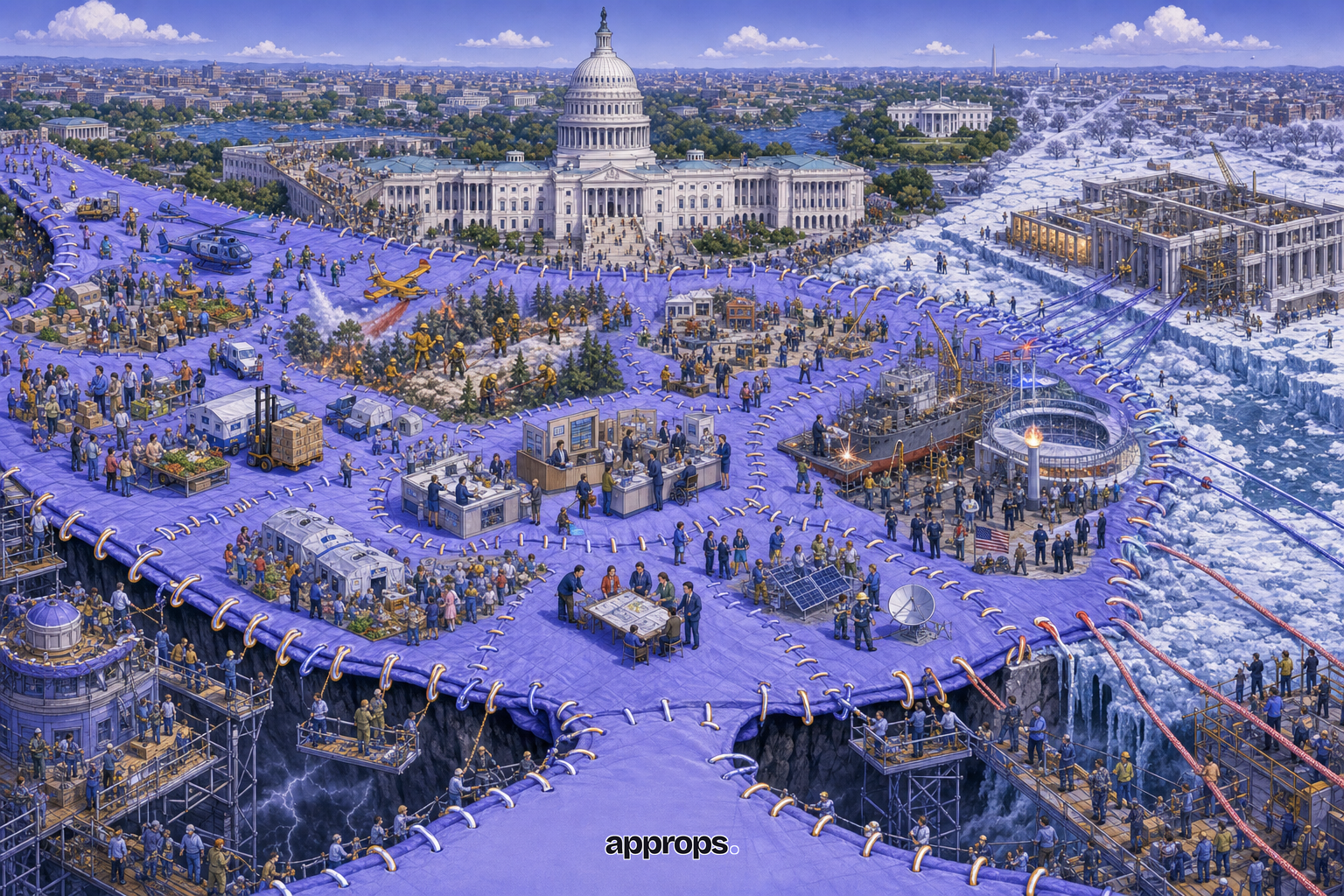
The House voted 370-48 on September 1 to pass the Senate's continuing resolution without changes, sending H.R. 6500 to the President's desk and all but ending the threat of an October 1 shutdown. Funding now now runs through December 11.
The fold that was always coming
When the Senate passed its version 90-6 in August, our analysis said the House would take the Senate text for one simple reason: everyone has an election in November. That is exactly what happened. The House's own July bill (H.R. 9770, through December 4, no OMB provision) died quietly; the Senate's longer, carve-out-laden version is what moves.
It was not close. With 418 members voting, two thirds meant 279, and the bill drew 370. The official roll call shows Republicans splitting 193 to 19 and Democrats 176 to 29, with the chamber's lone independent voting yes and 14 members not voting.
Those Democratic numbers are the story. Leadership needed roughly seventy Democratic votes to clear two thirds. It got 176, more Democratic yes votes than Republican ones were available to lose. The suspension gamble, in other words, was never really a gamble: once the Senate had produced a bipartisan bill and the alternative was a shutdown five weeks before an election, the votes were there in both parties, and the members with genuine objections were left casting protest votes that changed nothing about the outcome.
The one member with a real grievance had no way to act on it. House Freedom Caucus Chair Andy Harris, who wrote the original hemp restriction, objected to the CR's 30 day delay of that ban and told Punchbowl News he would vote against the rule for the rest of the week's bills in protest. Because the CR came up under suspension, there was no rule to vote against and no amendment to offer, so his leverage landed on unrelated legislation instead of on the bill he actually opposed.
What the President signed
The bill the House just passed is the same one the Senate wrote: funding frozen at FY2026 levels through December 11, the OMB grants rule blocked for the duration, the defense and Navy shipbuilding additions the White House requested, Olympics-security money for the FBI, housing-voucher flexibility, and the standard anomalies for WIC, FEMA disaster relief, wildfire suppression, SBA lending, Census preparation, and NOAA satellites. The President signed it on September 2, and it is now law.
A footnote worth knowing
The roll call lists the bill by its original name: the AGOA Extension Act. H.R. 6500 started life as a bill to extend the African Growth and Opportunity Act, and the Senate used it as the vehicle for the stopgap by stripping it and writing the CR into it. That is ordinary practice, a bill that has already cleared one procedural hurdle gets hollowed out and refilled, but it is why the official record of the vote that prevented a government shutdown carries the title of a trade bill.
December 11 is now the whole story
With October 1 defused, every fuse in the fall runs to the same date. Funding lapses December 11. The block on OMB's grants rule lifts December 11. The delay of the federal hemp ban, which pushed the new THC limits back from November 12, expires December 11. The National Flood Insurance Program and TANF extensions ride the same date. That is by design: bundling every expiration onto one afternoon concentrates the leverage, and it means the outgoing Congress holds every one of those votes four weeks after the midterms. The twelve full-year FY2027 bills are the only texts that can move in the lame duck, and they are not close to ready: all twelve have cleared House committee, three have passed the House floor, and the Senate has passed none and has not yet released its own versions or its project tables.
Follow every step on the tracker, and the live answer to the question everyone asks at approps.ai/shutdown.
You can stay up to date at approps.ai!