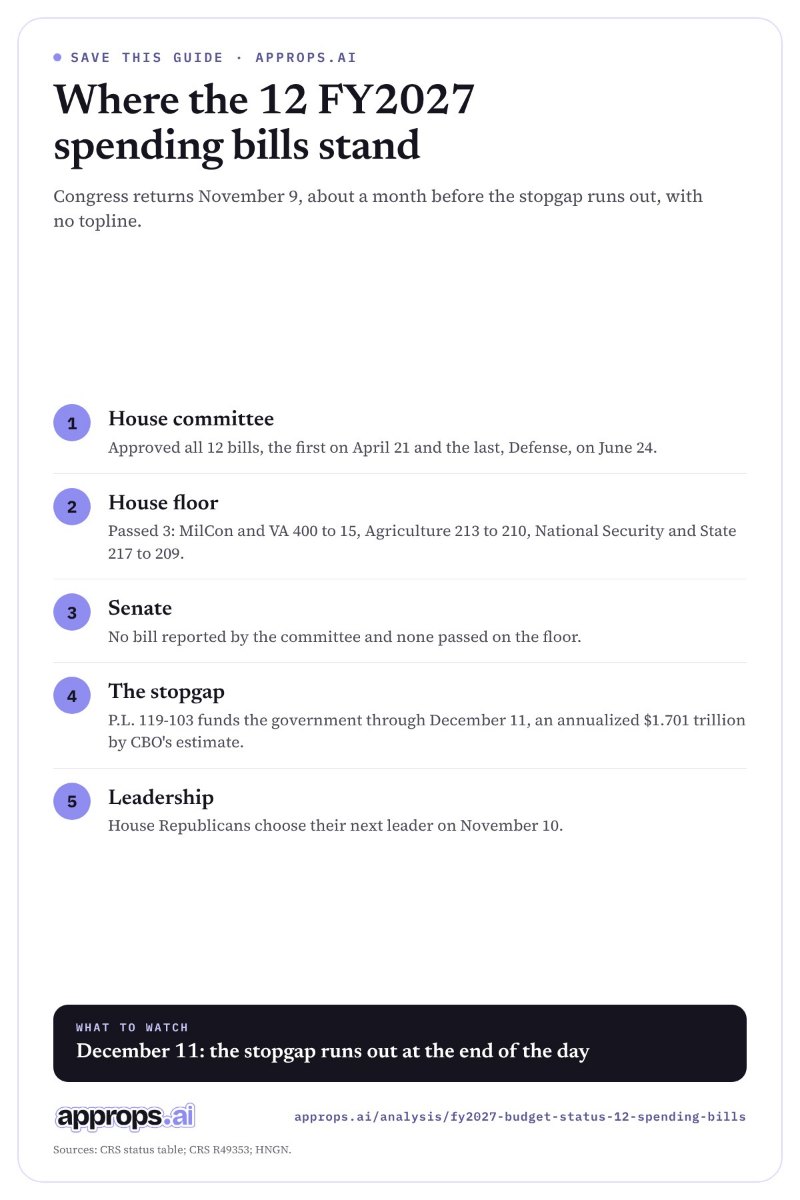
Congress comes back to Washington on Monday, November 9, and the CRS status table on congress.gov still reads the way it did when members left to campaign. The House Appropriations Committee has approved all 12 of the FY2027 spending bills. The full House has passed three. The Senate has passed none, and its committee has not reported a single one.
That leaves 34 days, nine bills that never reached the House floor and none that reached the Senate floor. Nothing has been signed.
The whole government runs on one stopgap, the Continuing Appropriations Act, 2027 (Division A of P.L. 119-103), which pays for everything through December 11. People keep searching for the status of the FY2027 budget, so here it is, bill by bill, with what the next few weeks have to settle.
What is the status of the FY2027 budget?
Short version: committee work in the House is finished, floor work in the House is a quarter done, and the Senate side has not started. (Our always current answer updates itself as bills move.) The numbers come straight from the CRS table, which the Congressional Research Service keeps as the official scoreboard.
The House committee finished in about nine weeks. It approved its first bill, Military Construction and VA, on April 21 by a vote of 58 to 0, and its last, Defense, on June 24. The ten in between all cleared with between 32 and 35 votes in favor.
The floor was slower. Military Construction and VA passed 400 to 15 on May 15, Agriculture passed 213 to 210 on June 4, and National Security and State passed 217 to 209 on July 15. Then the House stopped.
A three vote margin on Agriculture tells you how thin the House majority has been. The other nine bills never got a floor vote.
Where each of the 12 bills stands
Here is every bill with its House committee vote, from the CRS table. The Senate columns are blank for all twelve.
- Agriculture: committee 35 to 25 on April 29; passed the House.
- Commerce, Justice, Science (H.R. 8845): committee 32 to 28 on May 13.
- Defense (H.R. 9495): committee 34 to 27 on June 24.
- Energy and Water (H.R. 9022): committee 34 to 25 on May 20.
- Financial Services (H.R. 8495): committee 34 to 28 on April 22.
- Homeland Security (H.R. 9310): committee 34 to 27 on June 10.
- Interior and Environment (H.R. 9171): committee 35 to 27 on June 3.
- Labor, HHS, Education (H.R. 9260): committee 34 to 28 on June 9.
- Legislative Branch (H.R. 9010): committee 34 to 28 on May 20.
- Military Construction and VA (H.R. 8469): committee 58 to 0 on April 21; passed the House.
- National Security and State (H.R. 8595): committee 35 to 27 on April 28; passed the House.
- Transportation and HUD (H.R. 9170): committee 34 to 27 on June 3.
Each bill has its own page with the House text and the projects inside it, for example the Defense bill or the Labor, HHS, Education projects. The tracker shows all twelve on one screen and moves the moment a vote happens.
Why the Senate column is empty
No topline. The topline is the one number that sets how much the whole package spends, and from it come the 302(b) allocations (the spending ceiling each subcommittee gets). Without it, the Senate committee has nothing to write to, and it has not reported a bill this year.
The biggest gap is Defense. HNGN reported on November 5 that the administration is asking for a record $1.5 trillion for the military, a figure Senate Democrats reject, and that about $350 billion of it is mandatory money that could be tried through a third reconciliation bill. Spending bills still need 60 votes in the Senate, so whatever passes has to get some Democrats on board.
Update, November 11: the committee has since posted its first two bills, Agriculture-FDA and MilCon-VA, as drafts without a markup. Here is how the Senate's first FY27 bills compare with the House's.
What is funding the government right now?
The stopgap. CRS says Division A of P.L. 119-103 provides continuing appropriations for FY2027 through December 11, 2026. The Congressional Budget Office estimates it provides an annualized $1.701 trillion in discretionary budget authority.
A CR (continuing resolution) mostly carries last year's levels forward, so agencies can keep the lights on but can't start much that is new. If you want the difference spelled out, here is how a full year bill differs from a CR.
Can all 12 bills pass by December 11?
On paper, yes. In practice it would take a lot of floor time nobody has scheduled. The House would have to pass nine more bills, the Senate committee would have to write and report all twelve, the Senate would need 60 votes to get each one moving, and the two chambers would then have to settle their differences.
That is why year end deals usually come as one package. An omnibus rolls all twelve bills into a single vote in each chamber; a minibus does the same with a few. Either way, the people who write it are the four leaders of the two committees, working from a topline their party leaders sign off on.
The other option is the one Congress already used in September. Another CR would keep funding at last year's rates past December 11 to a new date, and leave the twelve bills for later. That is what past lame duck Congresses did twice in the last five House flips.
What this means for earmarks
FY2027 earmarks live inside these bills, so they wait with them. The projects in the House committee bills are requests that made it into a bill, not money, and none of them is funded until a bill is signed. A CR usually does not carry them, because a stopgap continues accounts at last year's rate rather than funding new projects.
You can see the pending FY2027 projects in your state on the earmarks map, next to what was enacted for FY2026.
Who negotiates in the lame duck?
The same chairs, for now. Republicans keep both chambers until the new Congress is sworn in on January 3, even though Democrats won both on November 3 (we covered what the election did to the talks on Wednesday).
The House side gets a new wrinkle first. The National News Desk reported, citing the AP, that Speaker Mike Johnson will not run for Republican leader in the next Congress. Majority Leader Steve Scalise and Judiciary Chair Jim Jordan plan to run, and House Republicans vote on November 10. Johnson stays Speaker through January 3, but whoever wins will be in the room for the endgame.
So the first week back is a leadership week. The appropriations calendar does not care (December 11 stays December 11).
What happens next
HNGN says the session is expected to run until Christmas, with a Thanksgiving break, and lays out the two real paths: an omnibus that wraps up all 12 bills, or another short extension that hands the fight to the new Democratic House. HNGN lists that choice, and a shutdown, as still open.
The dates to hold onto are November 9 (members return), November 10 (the House Republican leadership vote), December 11 (the stopgap runs out) and January 3 (the new Congress). If nothing is signed by the end of December 11, a shutdown starts the next morning, and here is what a December 12 shutdown would stop and what keeps going. The live countdown is on the shutdown page.
Save this guide
Frequently asked questions
What is the status of the FY2027 federal budget?
As of November 7, 2026, the House Appropriations Committee has approved all 12 FY2027 bills and the House has passed three. The Senate has passed none, and no bill is law. A stopgap funds the government through December 11.
Which FY2027 appropriations bills have passed the House?
Three: Military Construction and VA (400 to 15 on May 15), Agriculture (213 to 210 on June 4) and National Security and State (217 to 209 on July 15).
How is the government funded right now?
By a continuing resolution, Division A of P.L. 119-103, which runs through December 11, 2026. CBO estimates it provides an annualized $1.701 trillion in discretionary budget authority.
When does Congress come back to finish the spending bills?
Members return November 9 for a lame duck session. House Republicans pick their next leader November 10, and the stopgap runs out at the end of December 11.