Congress came back to Washington on Monday, November 9, with two money problems on the list. CNBC reports that government funding expires December 11, and that some Republicans, Sen. Kevin Cramer of North Dakota among them, want to raise the debt limit before their party hands over both chambers in January.
They sound like the same fight. They are not.
One is about whether agencies are allowed to spend money this year. The other is about whether the Treasury can borrow to pay bills the government already owes. People mix them up every time both are in the news at once, and this lame duck is one of those times.
What is the difference between the debt ceiling and a government shutdown?
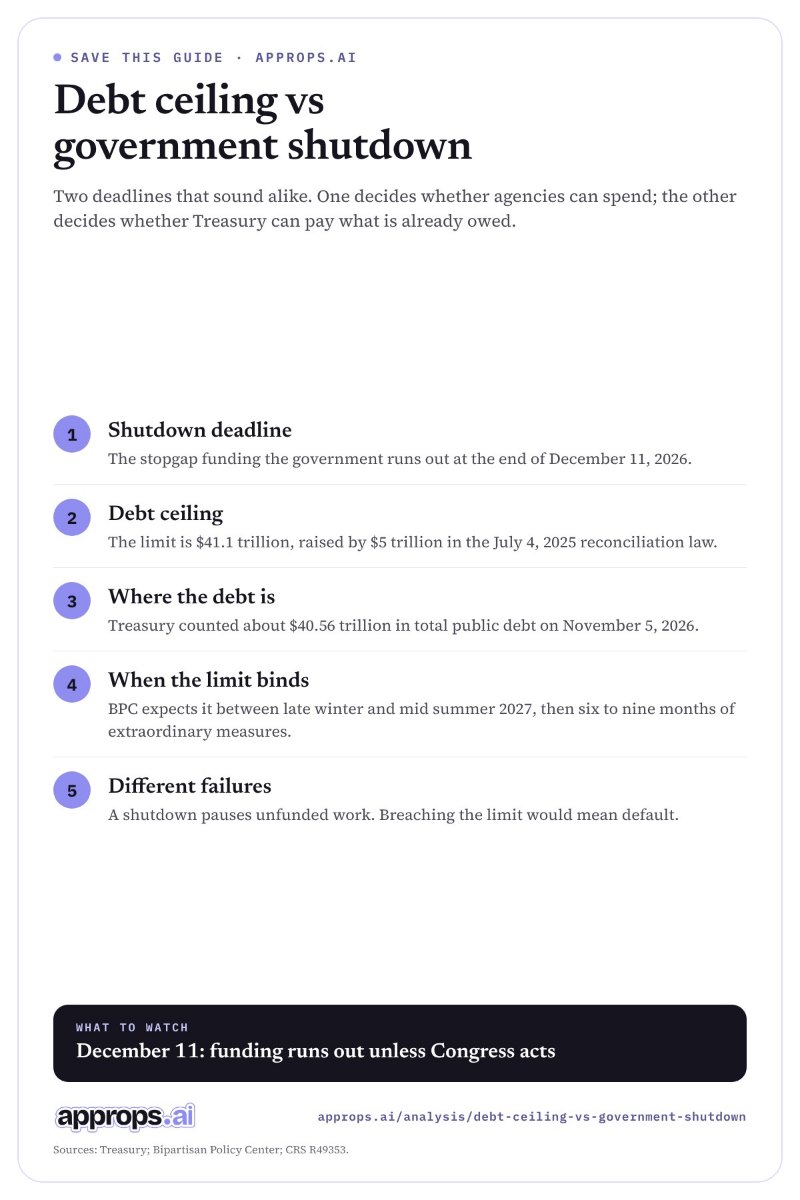
A shutdown happens when appropriations run out. Every year Congress has to pass spending bills (or a stopgap, called a continuing resolution or CR) that give agencies legal authority to spend. Right now that authority comes from the Continuing Appropriations Act, 2027, which ends on December 11. If nothing replaces it, agencies without money have to stop most work on December 12.
The debt ceiling is a cap on borrowing. The Treasury describes it as the total amount the government is authorized to borrow "to meet its existing legal obligations," naming Social Security and Medicare benefits, military salaries, interest on the debt and tax refunds. Treasury also says the limit "does not authorize new spending commitments."
So the shutdown deadline decides whether the government can spend. The debt limit decides whether it can pay for what it already spent.
How close is the debt to the limit?
Closer than most people realize. Treasury's daily Debt to the Penny count put total public debt at about $40.56 trillion on November 5, 2026.
The limit is $41.1 trillion. The Bipartisan Policy Center notes that the 2025 reconciliation law (H.R. 1, signed July 4, 2025 as P.L. 119-21) raised it by $5 trillion, from $36.1 trillion. By June of this year, debt subject to the limit had already grown $2.9 trillion, more than half of the new room.
One honest caveat on the math. The limit applies to a slightly narrower measure called debt subject to limit, so the gap is not exactly the difference between those two numbers. It is in the neighborhood of half a trillion dollars either way.
When does the debt ceiling become a deadline?
Not this year. BPC estimates the government will most likely hit the limit again sometime between late winter and mid summer of 2027.
Hitting the limit is not the cliff, though. Once it binds, Treasury switches to its cash on hand and a set of accounting moves known as extraordinary measures. BPC expects those to last roughly six to nine months. After that comes what budget people call the X Date, the day the government can no longer pay every bill in full and on time.
CNBC cites a Bank of America estimate from November 6 that puts that point around November 2027. Treat both as estimates. Tax receipts, tariff refunds and war spending all move the date, and BPC says so plainly.
The funding deadline is 32 days out. The debt limit fight is most likely a 2027 problem.
Why are both on the table this month?
Because of the election. Democrats won both chambers on November 3 and take over on January 3. That changes the math for each deadline in a different way.
Spending bills and stopgaps need 60 votes in the Senate, so they need both parties no matter who is in charge. The debt limit can be raised another way. CNBC points out that Republicans raised it in their 2025 reconciliation law, which skips the filibuster, and could in theory do it again. That takes near total party unity with very narrow margins, in a Congress where many members just lost their seats.
That is why Cramer and others want it done now. And it is why, according to CNBC, Democrats may prefer to wait and use the debt limit as leverage once they hold the gavels.
Each side has a reason to want the debt limit handled on its own schedule. Neither reason changes the December 11 deadline.
What happens if each one is missed?
They fail in very different ways.
A shutdown is a pause. Agencies furlough staff whose work is not funded, while programs with their own permanent money (Social Security checks, for one) keep going. When Congress passes a bill, the pause ends. The last one, the funding gap that began September 30, 2025, ran 42 full days, the longest on the Congressional Research Service's list. We walked through what stops and what keeps going in a December 12 shutdown.
Breaching the debt limit would be a default. Treasury's own page calls the result of failing to raise it "catastrophic," and it has never happened. The money would still be appropriated. The government just could not borrow enough cash to pay it all out.
A shutdown stops new spending. A default stops paying old bills. One is a bad week for federal workers; the other is a bad day for the world's bond market.
Does the debt limit affect appropriations?
Not directly. Raising the debt limit does not add a dollar to any agency's budget, and passing all 12 spending bills would not raise the limit.
They meet in one place: the deficit. Appropriations (and the much larger mandatory programs, explained in our piece on discretionary vs mandatory spending) set how much goes out. When that is more than what comes in, Treasury borrows the difference, and the borrowing counts against the limit.
That is why the two get tangled in negotiations even though they are separate laws with separate deadlines. Leaders can put both in one bill, or keep them apart. Congress gets to pick the fight it wants!
What happens next
The first deadline that matters is still Friday, December 11. Watch for which kind of funding bill leaders introduce, and whether a debt limit increase rides along with it. If one does, that tells you Republicans chose to settle it before January.
If nothing on the debt limit moves by Christmas, expect it to return as a 2027 fight under a Democratic Congress, with BPC's late winter to mid summer window as the start of the clock.
For the funding side, our look at whether there will be a shutdown in December covers what past lame ducks did. The live countdown is on the shutdown page, and every bill's status is on the appropriations tracker.
Save this guide
Frequently asked questions
What is the difference between the debt ceiling and a government shutdown?
A shutdown happens when appropriations lapse and agencies lose legal authority to spend. The debt ceiling caps how much Treasury can borrow to pay bills the government already owes. Missing the first is a pause; breaching the second would be a default.
What is the current debt ceiling?
$41.1 trillion. The 2025 reconciliation law, P.L. 119-21, raised it by $5 trillion from $36.1 trillion. Treasury counted total public debt at about $40.56 trillion on November 5, 2026.
When will the US hit the debt ceiling again?
The Bipartisan Policy Center estimates sometime between late winter and mid summer of 2027. Treasury's extraordinary measures would then buy roughly six to nine more months before the X Date.
Does raising the debt ceiling prevent a government shutdown?
No. Only a spending law or a stopgap prevents a shutdown. The current stopgap funds the government through December 11, 2026, and raising the debt limit would not extend it.
Sources
- Treasury, Debt to the Penny (Nov. 5, 2026)
- Treasury, the debt limit
- Bipartisan Policy Center, When Will We Reach the Debt Limit (Again)? (June 4, 2026)
- Congress.gov, H.R. 1 (119th), P.L. 119-21
- CRS R49353, continuing appropriations for FY2027 (P.L. 119-103)
- CNBC, Congress returns to government funding and debt limit debates, Nov. 9, 2026