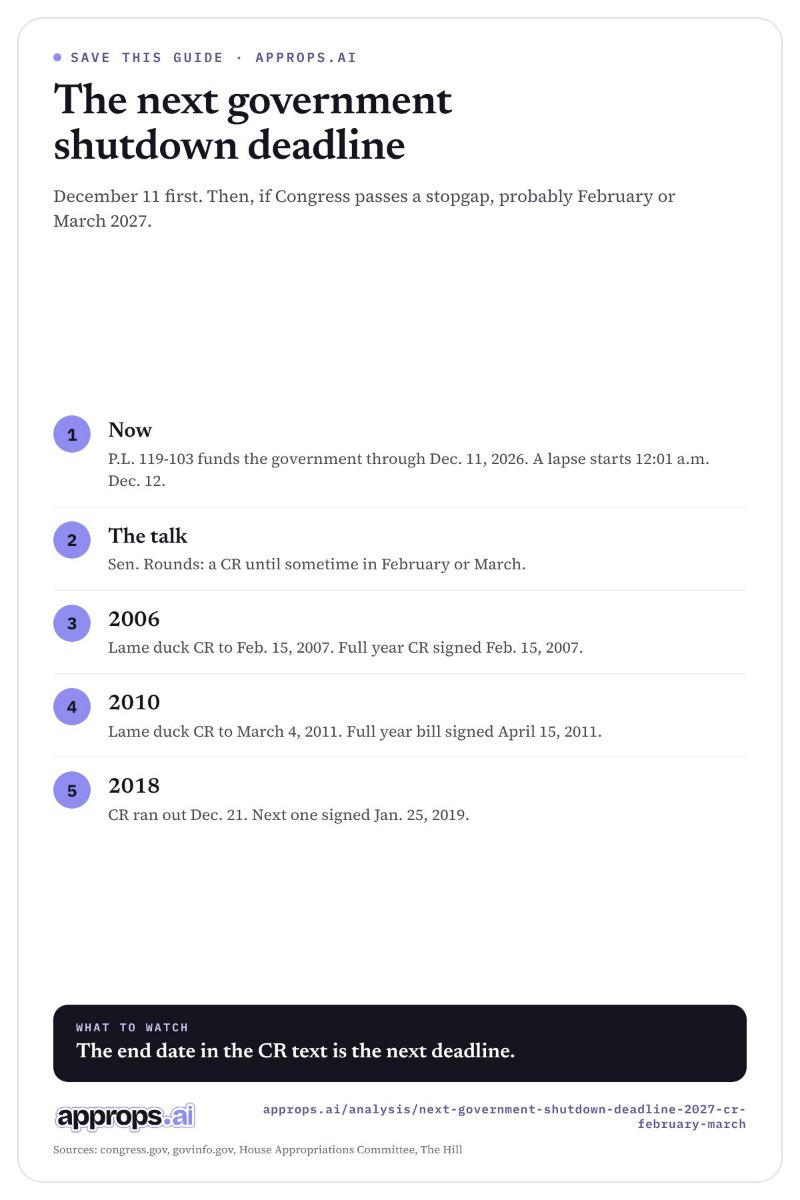
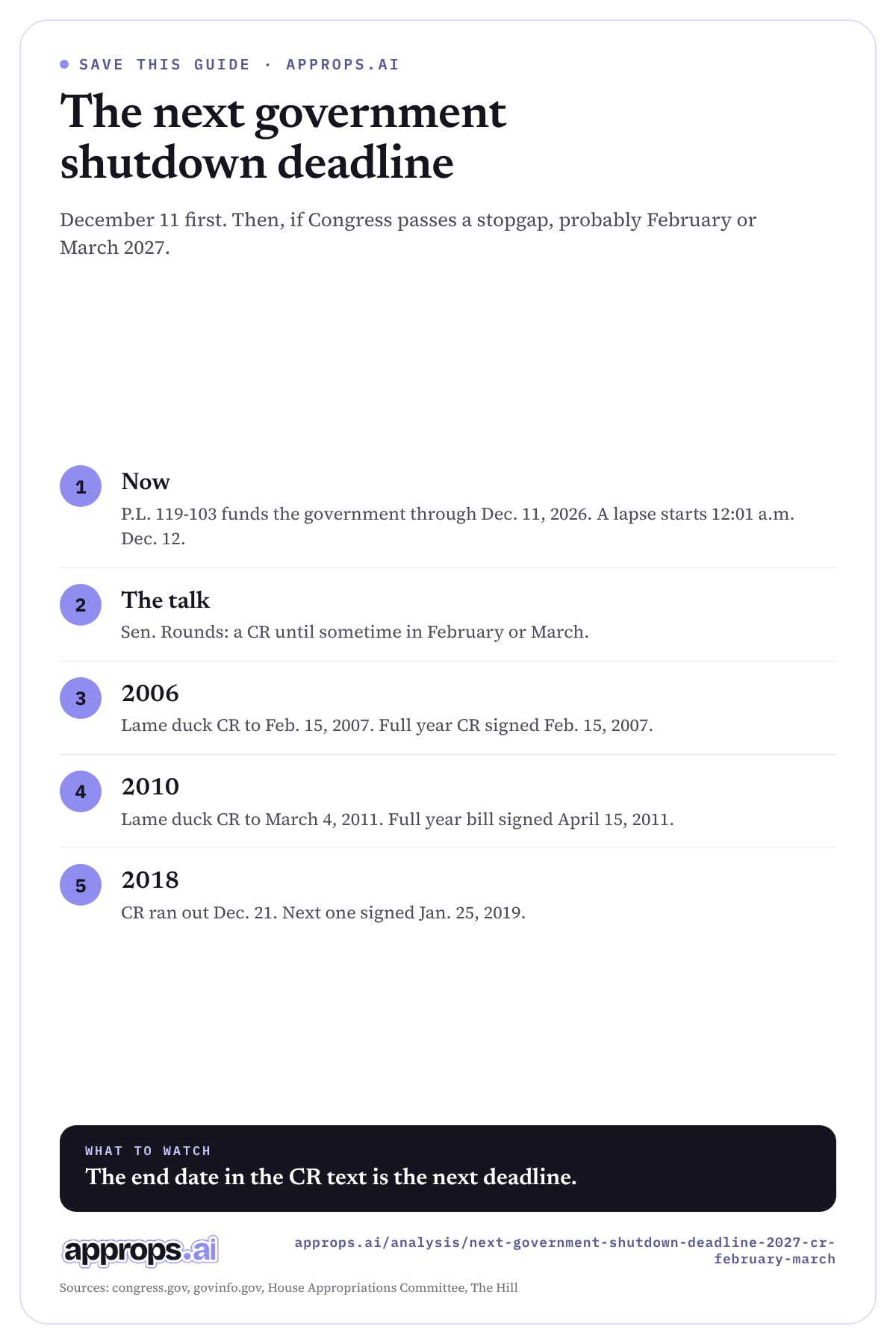
The next government shutdown deadline is still Friday, December 11, 2026, when the stopgap in P.L. 119-103 runs out. The deadline after that is the one people are starting to ask about, and Senate appropriators are now saying it will probably land in February or March 2027.
"Everybody's talking about a continuing resolution," Sen. Mike Rounds, a South Dakota Republican on the Appropriations Committee, said last week, according to The Hill. He said he isn't hearing anyone talk about finishing the bills "other than a continuing resolution until sometime in February or March."
That would make the next deadline a 2027 problem. And a new Congress's problem.
When is the next government shutdown deadline?
Right now there is only one: 11:59 p.m. on December 11. If nothing new is signed by then, a lapse starts at 12:01 a.m. on Saturday, December 12. You can watch the clock on /shutdown.
A 2027 deadline exists only once Congress passes a new stopgap (a continuing resolution, or CR) and writes a new end date into it. Nobody has released that text yet. February or March is what appropriators are floating, not a date in any bill.
Lawmakers are home for Thanksgiving this week. That leaves the first two weeks of December.
Why February or March?
Because the people who would finish the job in January are different people. Democrats take control of both chambers in the new Congress in January, The Hill reported. A CR that runs into February or March hands the final FY2027 bills to that Congress instead of this one.
Not everyone wants to wait. House Appropriations Chair Tom Cole of Oklahoma said on November 18 that "a lame duck doesn't have to leave full-year bills dead in the water," and that he wants to move "as many full-year FY27 bills as possible before the end of the year," in a committee statement. Rep. Rosa DeLauro of Connecticut, the top Democrat on the committee, told reporters she favors full year bills for as many uncontroversial priorities as possible plus a "short" CR for the rest.
So the House chair wants bills, the House ranking member wants some bills and a short CR, and Senate appropriators are talking about a long one. Those can all be true at once (a CR with a few full year bills attached is a cromnibus).
Has this happened before?
Yes. Three times in the last twenty years a lame duck Congress with unfinished spending bills handed the deadline to the next Congress (our piece on what past lame ducks did has the politics of each). What matters for the next deadline is the dates: where the old Congress set the clock, and when the new one actually finished. Here they are, straight from the public laws on govinfo.gov.
| Lame duck | What the old Congress did | What the new Congress did | | --- | --- | --- | | 2006 | P.L. 109-383, signed Dec. 9, 2006, moved the FY2007 CR to Feb. 15, 2007 | P.L. 110-5, signed Feb. 15, 2007, a full year CR through Sept. 30, 2007 | | 2010 | P.L. 111-322, signed Dec. 22, 2010, moved the FY2011 CR to March 4, 2011 | P.L. 112-10, the full year bill, signed April 15, 2011 | | 2018 | P.L. 115-298, signed Dec. 7, 2018, ran only to Dec. 21, 2018, and nothing followed it | P.L. 116-5, signed Jan. 25, 2019, a CR to Feb. 15, 2019; then P.L. 116-6, the full year bill, signed Feb. 15, 2019 |
Two things jump out. First, the February and March dates Rounds mentioned are exactly where the 2006 and 2010 handoffs landed: February 15, 2007 and March 4, 2011.
Second, the new Congress did not always finish on that first date. In 2011 the full year bill came six weeks after the March 4 deadline. The handoff buys time; it doesn't buy agreement.
What went wrong in 2018?
The old Congress ran out the clock without a handoff. The December 21, 2018 stopgap expired, nothing replaced it, and the agencies it covered went unfunded until the new Congress passed the January 25, 2019 CR. That is the version everyone at the table this year remembers.
The 2026 math looks more like 2006 and 2010 so far: appropriators in both parties are talking openly about a CR, and the argument is over how long and what rides on it. But there are real fights in the way. Some Senate Democrats say they won't back a funding bill without a limit on money for the war in Iran (we covered whether Congress can defund a war in a stopgap), and Republicans, with 53 seats, need at least seven Democrats to reach 60 votes in the Senate, The Center Square noted.
Did the 2027 budget pass?
No. FY2027 started October 1 and none of the 12 regular spending bills is law. The House has passed three, Military Construction and VA, State and Foreign Operations, and Agriculture, and Senate Appropriations Chair Susan Collins of Maine has released text for all 12 Senate bills, The Hill reported.
Every bill's stage, chamber by chamber, is on the tracker. If a December deal carries a few full year bills, the likeliest candidates are the ones that already passed the House: MilCon VA, State and Agriculture.
What a long CR means for you
A CR mostly freezes agencies at last year's rates. New programs don't start, and a CR does not carry new earmarks (we explain why in appropriations bill vs continuing resolution). So a CR into March means the FY2027 community projects in the House and Senate bills wait until at least March too. You can look up every project in your state on the earmarks pages.
If no CR passes by December 11, agencies follow their shutdown plans. We walked through what stops and what keeps going on December 12.
What happens next
- CR text. The end date in it is the next shutdown deadline. February or March is the talk; the bill is what counts.
- What rides along. Watch whether any full year bills, or a limit on Iran war funding, get attached.
- The vote. Both chambers have to pass it, and the President has to sign it, by 11:59 p.m. on December 11.
We'll update /shutdown the moment a new date is in a bill. You can stay up to date at approps.ai!
Save this guide
Frequently asked questions
When is the next government shutdown deadline?
December 11, 2026. Current funding under P.L. 119-103 runs through that day, and a lapse would start at 12:01 a.m. on Saturday, December 12, unless Congress passes and the President signs new funding first.
Will the next government shutdown deadline be in 2027?
Only if Congress passes a new stopgap with a 2027 end date. Sen. Mike Rounds said appropriators are talking about a CR until sometime in February or March, but no bill text has been released.
Has a lame duck Congress pushed spending bills to the next Congress before?
Yes. In 2006 a stopgap signed December 9 ran to February 15, 2007, and in 2010 one signed December 22 ran to March 4, 2011. In 2018 the stopgap ran out December 21 and the next one was not signed until January 25, 2019.
Did the 2027 budget pass?
No. None of the 12 FY2027 appropriations bills is law. The House has passed three, and the Senate committee has released text for all 12, so the government runs on a stopgap through December 11, 2026.
Sources
- House Appropriations Committee, Cole Statement on End of the Year Appropriations Work (Nov. 18, 2026)
- The Hill via Yahoo News, This Week on The Hill: Lawmakers break for Thanksgiving (Nov. 22, 2026)
- The Center Square via Yahoo News, U.S. Senate inches forward on govt. funding (Nov. 22, 2026)
- congress.gov, H.R. 6500, Continuing Appropriations and Extensions Act, 2027 (P.L. 119-103)
- govinfo.gov, P.L. 109-383 and P.L. 110-5 (FY2007 stopgaps)
- govinfo.gov, P.L. 111-322 and P.L. 112-10 (FY2011)
- govinfo.gov, P.L. 115-298, P.L. 116-5 and P.L. 116-6 (FY2019)