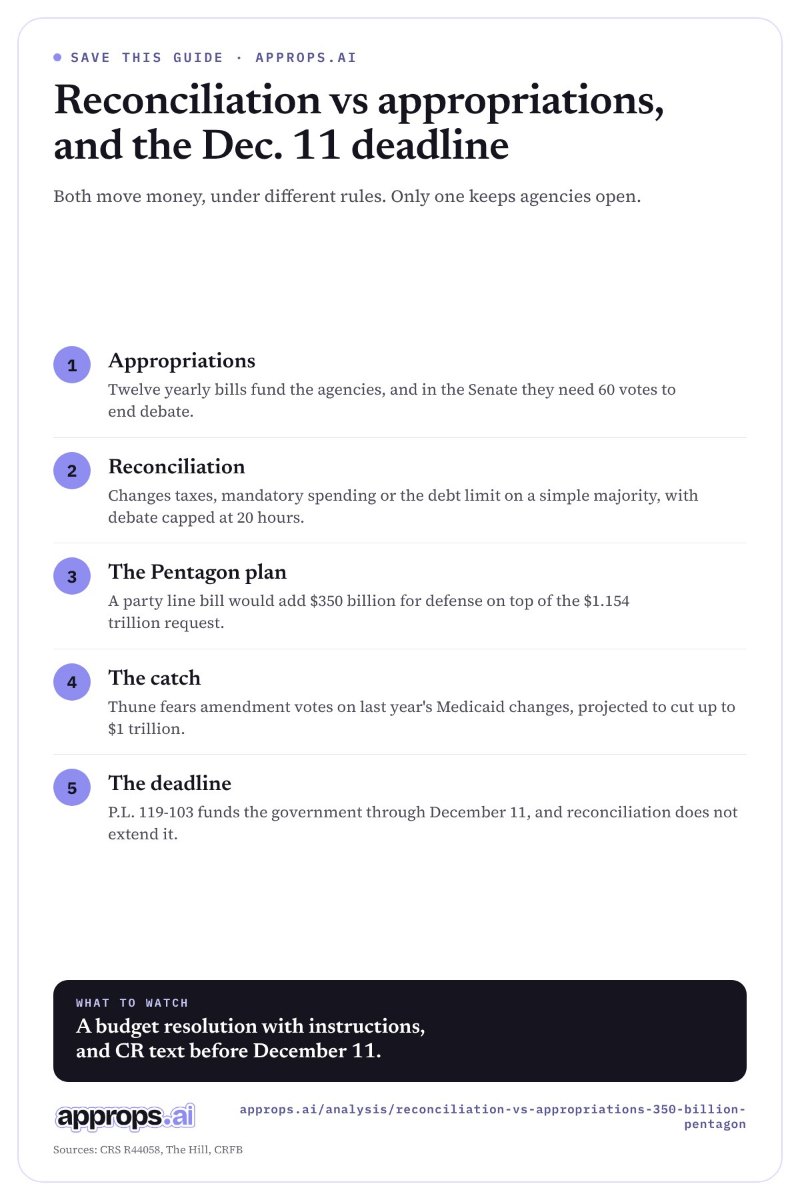
A budget reconciliation bill changes taxes, mandatory spending or the debt limit and can pass the Senate with a simple majority. An appropriations bill sets the yearly funding agencies run on, and in the Senate it needs 60 votes to get past a filibuster.
That difference is why Senate Majority Leader John Thune of South Dakota is weighing a party line reconciliation bill that would give the Pentagon an extra $350 billion, a sum President Trump has asked for, The Hill reported on November 20. He is also wary of it.
Either way, it does not touch the December 11 deadline.
Budget reconciliation vs appropriations, side by side
The two get mixed up because both move money. They do it under different rules, through different committees, on different clocks.
| Appropriations bills | Budget reconciliation | |
|---|---|---|
| What it covers | Yearly discretionary funding for agencies, in twelve bills | Revenue, direct (mandatory) spending and the debt limit |
| How often | Every fiscal year, by October 1 | Only when a budget resolution carries reconciliation instructions |
| Who writes it | The House and Senate Appropriations Committees | The committees named in the instructions |
| Senate votes to pass | 60 to end debate, then a majority | A simple majority, with debate capped at 20 hours |
| What happens if it stalls | A continuing resolution or a shutdown | Nothing shuts down |
The one line in that table that drives everything is the vote count. Since 1975, ending a filibuster has taken "three-fifths of all senators duly chosen and sworn," which is 60, per the Senate.
Reconciliation skips that. The Budget Act limits debate on a reconciliation bill, amendments included, to 20 hours, and each amendment to two, according to the Congressional Research Service's guide to the reconciliation process. No filibuster is possible when the clock runs out on its own.
How a reconciliation bill gets made
It starts with a budget resolution. That is a concurrent resolution, so it never goes to the President and never becomes law. It only sets Congress's own targets.
Reconciliation is optional. CRS says it "occurs only if reconciliation instructions are included in the budget resolution," and those instructions tell specific committees how much to change in the laws they control. The committees write the changes, the Budget Committee pulls them together, and both chambers vote.
Then comes the Byrd rule, adopted in 1985 to stop committees from loading "extraneous" provisions into reconciliation. Anything that does not change spending or revenue can be struck on the Senate floor.
Senate Budget Committee Chair Ron Johnson of Wisconsin would manage the budget resolution and the bill that follows it, per The Hill.
This is not hypothetical. Republicans passed the One Big Beautiful Bill Act as a reconciliation bill, and it was signed July 4, 2025 as P.L. 119-21.
Why Pentagon money would go this way
Defense is the biggest fight in the regular bills. Congress enacted $838.7 billion for Defense in FY2026, and the President asked for $1.154 trillion for FY2027, a figure that "does not include the additional $350 billion that the administration is requesting through the reconciliation process," per CRFB's Appropriations Watch.
Some Republicans see reconciliation as a way to take that fight out of the funding talks. "They want to hold up defense, right? And if we just do that through reconciliation, takes it off the table," Sen. John Hoeven of North Dakota told The Hill.
Democrats see the same talks differently. They want any broader agreement to balance defense against domestic spending on things like infrastructure and health care, The Hill reported. A group of them also plans to offer an amendment to "any proposed funding bill" barring money for the war in Iran. We explain how a war funding cutoff works in can Congress defund a war.
Using reconciliation for appropriations fights has been tried this year already. CRFB notes that the final FY2026 Homeland Security bill left out ICE and Border Security Operations funding, which Congress has been trying to fund through reconciliation instead.
Why Thune is hesitant
The risk is in the amendments. With debate capped, senators can still offer amendments, and a reconciliation bill opens the door to votes on what last year's law did.
Thune and other GOP leaders fear Democrats could persuade a few Republicans to instruct the Senate Finance Committee to review last year's Medicaid changes, which are projected to reduce Medicaid spending by as much as $1 trillion, The Hill reported. That could set up a later vote to reverse them.
"It's a real concern," Johnson said. Sen. Josh Hawley of Missouri said he wants to "reverse the provider tax for rural hospitals."
So the fast lane comes with a toll. Getting $350 billion for the Pentagon through on 50 votes means holding those same 50 votes on every amendment along the way.
Leaders were already cooling on it after a meeting on November 18. "Before we go directly into reconciliation, let's find out whether or not there is any possibility at all of finding a supplemental," said Sen. Mike Rounds of South Dakota. Johnson said "probably not this week," then added, "we're not taking it off the table at all."
Does reconciliation stop a shutdown?
No. The government is running on P.L. 119-103, a continuing resolution that funds agencies through December 11. That is 20 days from today.
What keeps agencies open past that date is an appropriations law: the twelve bills, a CR, or a mix of the two (the cromnibus senators floated this week). All of those need 60 votes in the Senate. A reconciliation bill for the Pentagon, even if it passed tomorrow, would leave the rest of the government on the same clock.
What reconciliation could change is the bargaining. If extra defense money moved on its own, the regular Defense bill would carry less of the weight in the December talks. That is the Hoeven argument. The Democratic answer is that the balance between defense and domestic money is the negotiation, so pulling one side out does not settle it.
Nobody has settled which view wins.
What happens next
Three things will tell you which way this goes.
- A budget resolution. No reconciliation bill can move until both chambers adopt one with instructions. Watch the Senate Budget Committee.
- CR text. Rep. Rosa DeLauro of Connecticut, the top Democrat on House Appropriations, said on November 18 there was none yet. Whether defense money rides in it, or waits for reconciliation, is the tell.
- The calendar. Democrats take the majority in both chambers in January, so any party line bill has to pass in this lame duck session.
For the plain difference between the two kinds of federal spending, see discretionary vs mandatory spending. For how a stopgap works, see appropriations bill vs continuing resolution. The countdown to December 11 is on /shutdown, every bill's status is on the tracker, and you can stay up to date at approps.ai!
Save this guide
Frequently asked questions
What is the difference between budget reconciliation and appropriations?
Appropriations bills set the yearly funding agencies run on and need 60 votes to end debate in the Senate. Reconciliation changes revenue, mandatory spending or the debt limit, and passes the Senate with a simple majority under a 20 hour debate limit.
What is a reconciliation bill?
It is a bill that carries out the reconciliation instructions in a budget resolution, telling named committees how much to change the tax and spending laws they control. It can only move after both chambers adopt that budget resolution.
Can a reconciliation bill prevent a government shutdown?
No. Agencies stay open on appropriations: the twelve bills or a continuing resolution. The current stopgap, P.L. 119-103, runs through December 11, 2026, and a Pentagon reconciliation bill would not extend it.
Why would Republicans fund the Pentagon through reconciliation?
It needs only a simple majority in the Senate, so the extra $350 billion the President asked for could pass without Democratic votes. Sen. John Hoeven said it would take defense off the table in the funding talks.
Sources
- The Hill, Thune fears GOP revolt over Medicaid cuts in Pentagon funding push (Nov. 20, 2026)
- The Hill, Congress drifts toward shutdown deadline without a funding strategy (Nov. 19, 2026)
- Congressional Research Service, R44058, The Budget Reconciliation Process: Stages of Consideration
- U.S. Senate, About Filibusters and Cloture
- CRFB, Appropriations Watch: FY 2027
- congress.gov, H.R. 1, reconciliation pursuant to H. Con. Res. 14 (P.L. 119-21)
- congress.gov, H.R. 6500, Continuing Appropriations and Extensions Act, 2027 (P.L. 119-103)