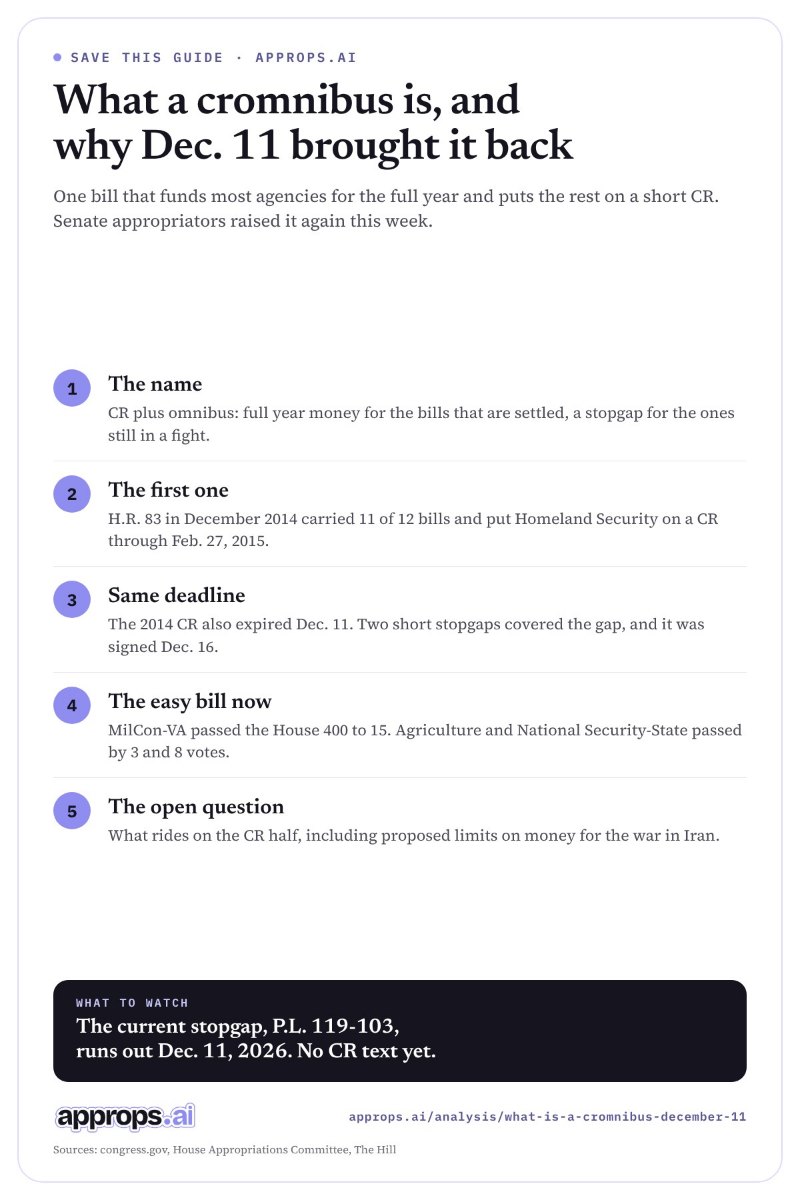
A cromnibus is one spending bill that funds most of the government for the full year and puts the leftover agencies on a short continuing resolution. The name is just CR plus omnibus, and this week Senate appropriators started saying it out loud as a way past the December 11 deadline.
"What you have to do is have some kind of an omnibus, 'cromnibus' taking some of them, maybe passing some others," Sen. John Boozman of Arkansas, a Republican on the Appropriations Committee, told The Hill.
There is no bill text yet. There is a precedent, and it had the same deadline.
What a cromnibus actually is
Congress has three ways to fund the government on time. It can pass the regular bills, one by one or bundled together (two or three is a minibus, most or all of them is an omnibus). It can pass a continuing resolution, or CR, which keeps agencies running at last year's rate for a set number of days. Or it can do both in one vote.
That last one is the cromnibus. The agencies whose bills are settled get a full year of funding at the new numbers. The ones still in a fight get a stopgap, and the fight moves to a later date.
The appeal is simple: it takes most of the government off the table without forcing a deal on everything.
The first one had the same deadline
Twelve years ago, Congress was also running on a CR that expired on December 11. The Continuing Appropriations Resolution, 2015 (P.L. 113-164) funded agencies "until December 11, 2014."
What came next was H.R. 83, the Consolidated and Further Continuing Appropriations Act, 2015. It carried eleven of the twelve regular bills for the full year. The twelfth, Homeland Security, got a CR through February 27, 2015, because that was where the immigration fight sat.
The House passed it 219 to 206 on December 11, the day the old CR ran out. The Senate needed two more days, so Congress passed two tiny stopgaps to cover the gap: one to December 13 and one to December 17. The Senate cleared the cromnibus 56 to 40 on December 13, and it was signed December 16 as P.L. 113-235.
So the deadline slipped twice in a week, and nothing shut down.
Who is talking about one now
Boozman was the most direct. "We've started posting the bills, and if you do a CR, those will be the basis," he said, pointing to the twelve Senate bills the committee put online between November 10 and November 16.
Not everyone expects that much. "I'm not hearing anybody talking about actually getting the appropriation bills done at this stage of the game, other than a continuing resolution until sometime in February or March," said Sen. Mike Rounds of South Dakota.
House Appropriations Chair Tom Cole of Oklahoma wants the full year bills. "A lame duck doesn't have to leave full-year bills dead in the water," he said in a statement on November 18, adding that with all twelve Senate bills public and the House bills "long on the table, we have what we need to negotiate in earnest."
On the Democratic side, Rep. Rosa DeLauro of Connecticut, the committee's top Democrat, told reporters she favors full year bills for as many uncontroversial priorities as possible plus a "short" CR for the rest, per The Hill. That is a cromnibus in everything but the name.
Which bills could go full year
Nothing is law yet. But the record shows which bills have the most behind them, and one stands out.
| Bill | House | Senate |
|---|---|---|
| MilCon-VA | Passed 400 to 15 | Text posted Nov. 10, no markup |
| Agriculture-FDA | Passed 213 to 210 | Text posted Nov. 10, no markup |
| National Security-State | Passed 217 to 209 | Text posted Nov. 16, no markup |
| The other nine | Approved in full committee | Text posted Nov. 12 or Nov. 16, no markup |
MilCon-VA, the bill for military construction and veterans' health care, got 400 votes in the House. If a cromnibus carries any full year bill, that is the easy one. The other two bills that passed the House cleared by three and eight votes, which is a different kind of easy.
There is a money reason to care which bills make the full year list. A CR runs last year's programs at last year's rate, so the new earmarks in a bill get funded only if that bill goes full year. The Senate's MilCon-VA bill alone lists 87 of them, about $1.13 billion, and you can look up the ones in your state on the earmarks map.
You can see every bill's latest step, and the text that passed, on the tracker.
What rides along with it
A cromnibus is still one vote, and anything attached to it rides along. Sens. Kirsten Gillibrand of New York, Tammy Duckworth of Illinois and Elizabeth Warren of Massachusetts said Wednesday they will offer an amendment to "any proposed funding bill" barring money for the war in Iran, per The Hill. Other Democrats have called war limits a must for any stopgap. Congress has done this before: see can Congress defund a war in a stopgap.
Republicans see it differently. Sen. Katie Britt of Alabama said she wants to keep working on full year bills, because "anytime we pass a CR, it costs taxpayers more." Sen. John Hoeven of North Dakota floated moving defense money through a party line reconciliation bill to take it out of the talks, though senators were cooler on that after a meeting Wednesday. We explain how that path works in budget reconciliation vs appropriations.
DeLauro did not commit to holding funding up over the war, and warned that a shutdown is what "further puts our forward-looking agenda in jeopardy."
That is the honest state of it: nobody has settled what goes in the CR half.
What happens next
The current stopgap, P.L. 119-103, funds the government through December 11. That is 21 days from today, and DeLauro said this week there is no CR text yet.
Watch for three things:
- Text. A cromnibus would show up as one long bill with a list of full year divisions and a short CR at the end. The list of divisions is the deal.
- The CR date. Rounds mentioned February or March. That date decides how much of the fight lands on the new Congress in January.
- Riders. Whether war limits are in the text, offered as an amendment or dropped.
For the full rundown of the talks, see where the funding talks stand, and for what stops if the deadline passes, see what happens if the government shuts down December 12. The countdown is on /shutdown, and you can stay up to date at approps.ai!
Save this guide
Frequently asked questions
What is a cromnibus?
It is one spending bill that combines an omnibus, which funds most agencies for the full fiscal year, with a continuing resolution that keeps the rest running at last year's rate for a short time.
When did Congress pass the first cromnibus?
In December 2014. H.R. 83, the Consolidated and Further Continuing Appropriations Act, 2015, carried eleven of the twelve bills and put Homeland Security on a CR through February 27, 2015. It was signed December 16, 2014 as P.L. 113-235.
Is a cromnibus likely before December 11, 2026?
Nobody has written one yet. Sen. John Boozman raised the idea in remarks reported November 19, Sen. Mike Rounds said he hears mostly about a CR into February or March, and Rep. Rosa DeLauro said there was no CR text.
What is the difference between an omnibus, a minibus and a cromnibus?
An omnibus bundles most or all of the twelve bills, a minibus bundles a few, and a cromnibus is an omnibus with a short CR attached for the bills that are not settled.
Sources
- The Hill, Congress drifts toward shutdown deadline without a funding strategy (Nov. 19, 2026)
- House Appropriations Committee, Cole statement on end of the year appropriations work (Nov. 18, 2026)
- congress.gov, H.R. 83, Consolidated and Further Continuing Appropriations Act, 2015 (P.L. 113-235)
- congress.gov, H.J.Res. 124, Continuing Appropriations Resolution, 2015 (P.L. 113-164)
- congress.gov, H.J.Res. 130 and H.J.Res. 131, the December 2014 stopgaps
- congress.gov, H.R. 6500, Continuing Appropriations and Extensions Act, 2027 (P.L. 119-103)