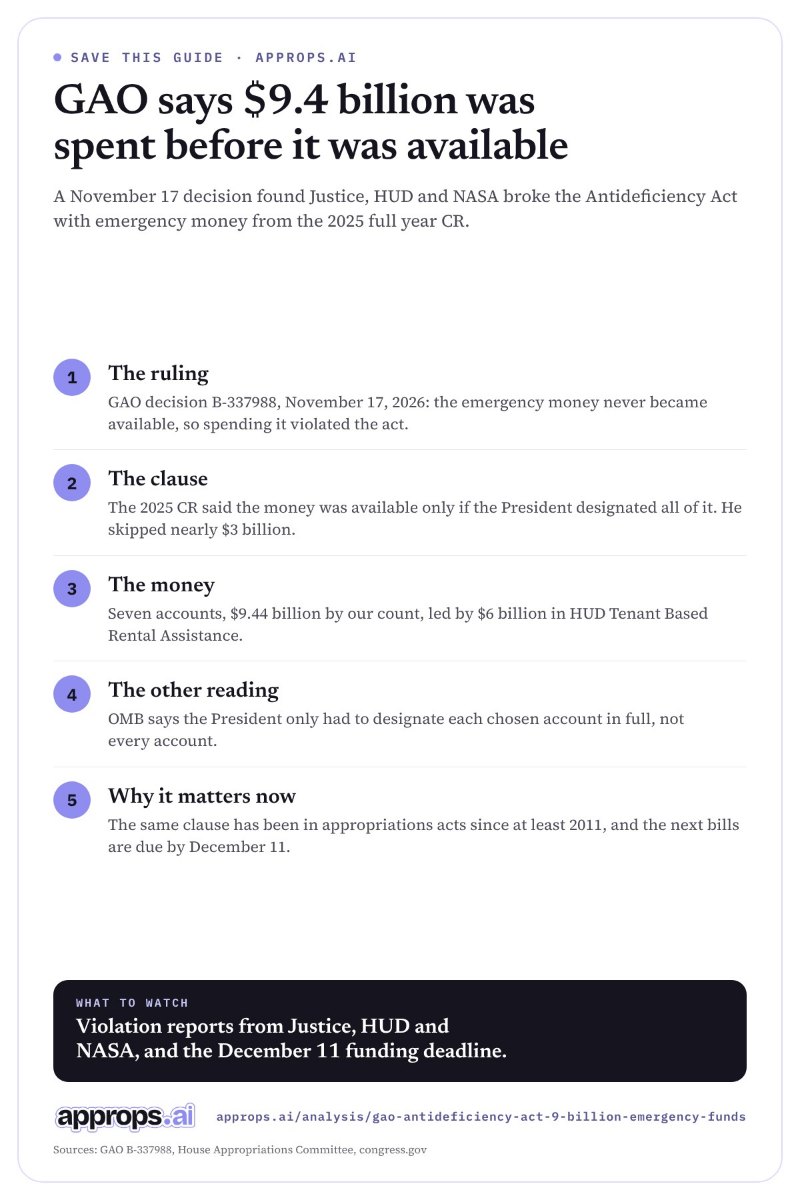
The Justice Department, HUD and NASA broke the Antideficiency Act by spending emergency money from the 2025 full year CR before it was legally available, the Government Accountability Office ruled on Tuesday, November 17. In decision B-337988, GAO's lawyers said the money never became available because the President designated only part of the emergency funding, and the law required all of it.
Seven accounts are covered. By our count of the amounts in the decision, they add up to $9.44 billion, most of it rental assistance.
The money went out anyway.
What GAO decided
The fight is over one clause in the Full-Year Continuing Appropriations and Extensions Act, 2025, the stopgap that funded the whole government for FY2025 and became P.L. 119-4 on March 15, 2025.
Section 1110(a) of that law labeled money in a list of accounts as an emergency requirement, across Agriculture, Commerce, HUD, Justice, State, NASA, NOAA and the National Science Foundation. An emergency label matters because it keeps the money from counting against the spending caps. But the label only works if the President signs off too, and section 1110(b) set the terms: the money "shall be available ... only if the President subsequently so designates all such amounts and transmits such designations to the Congress."
On March 24, 2025, the President sent Congress a message designating some of the accounts and skipping the rest, "nearly $3 billion," according to the decision. His reason, as GAO quotes it, was that he did "not concur that the added spending is truly for emergency needs."
GAO read "all such amounts" to mean all of them. "Section 1110(b) requires the President to make a choice: designate all or none of Congress's emergency designations," the decision says. Since he designated less than all, none of it became available, and the agencies that spent it spent money they did not legally have yet.
Where the $9.44 billion went
Here are the seven accounts the President did designate, with what each agency reported doing with the money, per the decision:
| Agency and account | Amount | What the agency reported |
|---|---|---|
| HUD, Tenant Based Rental Assistance | $6 billion | $6.0 billion obligated in FY2025, $5.84 billion spent |
| HUD, Project Based Rental Assistance | $2 billion | $1.97 billion obligated in FY2025, $1.05 billion spent |
| NASA, Exploration | $450 million | $450 million obligated in FY2025, $66.5 million spent |
| DEA, Salaries and Expenses | $328 million | Obligated and spent in full |
| U.S. Marshals, Federal Prisoner Detention | $250 million | Obligated and spent in full |
| NASA, Construction and Environmental Compliance | $250 million | $140.8 million obligated in FY2025, $26.1 million spent |
| U.S. Marshals, Salaries and Expenses | $163 million | Obligated and spent in full |
One program is most of the total. The $6 billion for Tenant Based Rental Assistance is about 64 percent of it, and HUD reported obligating all but about $195,000 of that $6 billion in FY2025.
Justice and NASA told GAO that OMB would answer for them. HUD had not responded when the decision went out.
Two readings of one sentence
OMB's case, in its own words from the decision: the President "need not designate all accounts, just all of the amounts in the accounts that he chooses to designate." Its argument leans on the budget enforcement law the clause points to, which handles emergency designations "on an account by account basis." Read that way, picking whole accounts is fine, as long as each one is designated in full.
OMB also acknowledged that it used to read the clause the other way, as all or nothing, and said it had "concluded that this 'all or nothing' interpretation is not required by the text."
GAO's answer is that the budget law is about the spending caps and sequestration, while section 1110(b) is about when money can be spent, so there is no conflict to smooth over. "We cannot add words to an unambiguous statute," it wrote. And it points out the clause is not new: the same language, or close to it, has been in appropriations acts since at least 2011.
So this is about more than one 2025 stopgap. It is a reading of boilerplate that Congress keeps writing into its bills.
What is the Antideficiency Act?
The Antideficiency Act is the law that says no federal official can obligate or spend money in advance of, or beyond, an appropriation. It is also the reason a funding lapse turns into a shutdown: the furloughs that come with one are "largely a function" of this collection of statutes, as the Congressional Research Service puts it. You can see how that plays out on our shutdown page.
GAO has applied the same rule before. In 2002 it found that a board created after the September 11 attacks violated the act by obligating airline aid before the President had sent the emergency designation that made it available, even though the board relied on OMB's apportionment. Today's decision cites that case and reaches the same answer.
When an agency violates the act, it has to report the violation. GAO says Justice, HUD and NASA "should report their violations as required by law." The decision does not say what should happen to money that has already gone out the door.
Why it lands in the December 11 talks
The timing is awkward for everyone at the table. The government runs on a stopgap through December 11, and House Appropriations Committee Chairman Tom Cole of Oklahoma said on November 18 that he wants real bills, not another punt. "A lame duck doesn't have to leave full-year bills dead in the water," he said in a statement. "With all twelve Senate bills now public and the House measures long on the table, we have what we need to negotiate in earnest."
Democrats now have a fresh GAO decision to bring into that room. Rep. Rosa DeLauro of Connecticut, the committee's top Democrat, said the day it came out that "it is Congress that holds the power of the purse, not the President, and not Executive Branch agencies." She and Sen. Patty Murray of Washington, the Senate committee's vice chair, had asked GAO for this decision in December 2025.
The clause GAO read has sat in appropriations acts since at least 2011, so the bills coming out of that room may carry it too. The people writing them now know how GAO reads it, and so does OMB.
This is the second time this fall the two branches have split over who controls money Congress already passed (the first was the $810 million pocket rescission in September). Neither fight has been settled in a spending bill yet.
What happens next
Three things to watch:
- The violation reports. DeLauro wants the agencies to send the committee "all relevant facts and a statement of actions taken," as the act requires. Whether and when Justice, HUD and NASA file them is the first test of the decision.
- The bill text. If a full year bill or a new stopgap moves before December 11, look at its emergency designation clause. A change in its wording would be Congress answering GAO, or OMB.
- The deadline. December 11 is 22 days away. Where the talks stand is on the tracker, and the latest on the stopgap is in our rundown of the funding talks.
For how a full year CR differs from regular bills, and why FY2025 ran on one, see appropriations bill vs. continuing resolution.
Save this guide
Frequently asked questions
What did GAO decide on November 17, 2026?
In decision B-337988, GAO found that the Justice Department, HUD and NASA violated the Antideficiency Act by obligating and spending emergency funds from the 2025 full year CR before they were legally available.
Why was the money not available?
Section 1110(b) of the 2025 CR made the emergency money available only if the President designated all of it. His March 24, 2025 message designated some accounts and skipped nearly $3 billion, so GAO says none of it became available.
How much money is involved?
Seven accounts totaling $9.44 billion by our count of the decision: $6 billion and $2 billion in HUD rental assistance, $450 million and $250 million at NASA, and $741 million across three Justice Department accounts.
What is the Antideficiency Act?
It is the law that bars federal officials from obligating or spending money in advance of, or beyond, an appropriation. It is also why agencies stop work during a shutdown.
Sources
- GAO, B-337988, Application of the Antideficiency Act: Designation of Amounts as an Emergency Requirement (Nov. 17, 2026)
- House Appropriations Democrats, DeLauro statement on the GAO decision (Nov. 17, 2026)
- House Appropriations Committee, Cole statement on end of the year appropriations work (Nov. 18, 2026)
- congress.gov, H.R. 1968, Full-Year Continuing Appropriations and Extensions Act, 2025
- CRS R48930, Government Shutdowns: Applying the Antideficiency Act to a Lapse in Appropriations