Yes, Congress can defund a war. It can write a line into a spending bill that says no money may be used for a military operation, and it has done exactly that inside a stopgap before, in 1973.
That is the play some Democrats now want to run on the bill that has to pass by December 11. On Wednesday, November 18, Sens. Kirsten Gillibrand of New York, Tammy Duckworth of Illinois and Elizabeth Warren of Massachusetts said they will offer an amendment to "any proposed funding bill" barring money for the war in Iran, The Hill reported.
The power is clear. The votes are not.
Can Congress cut off money for a war?
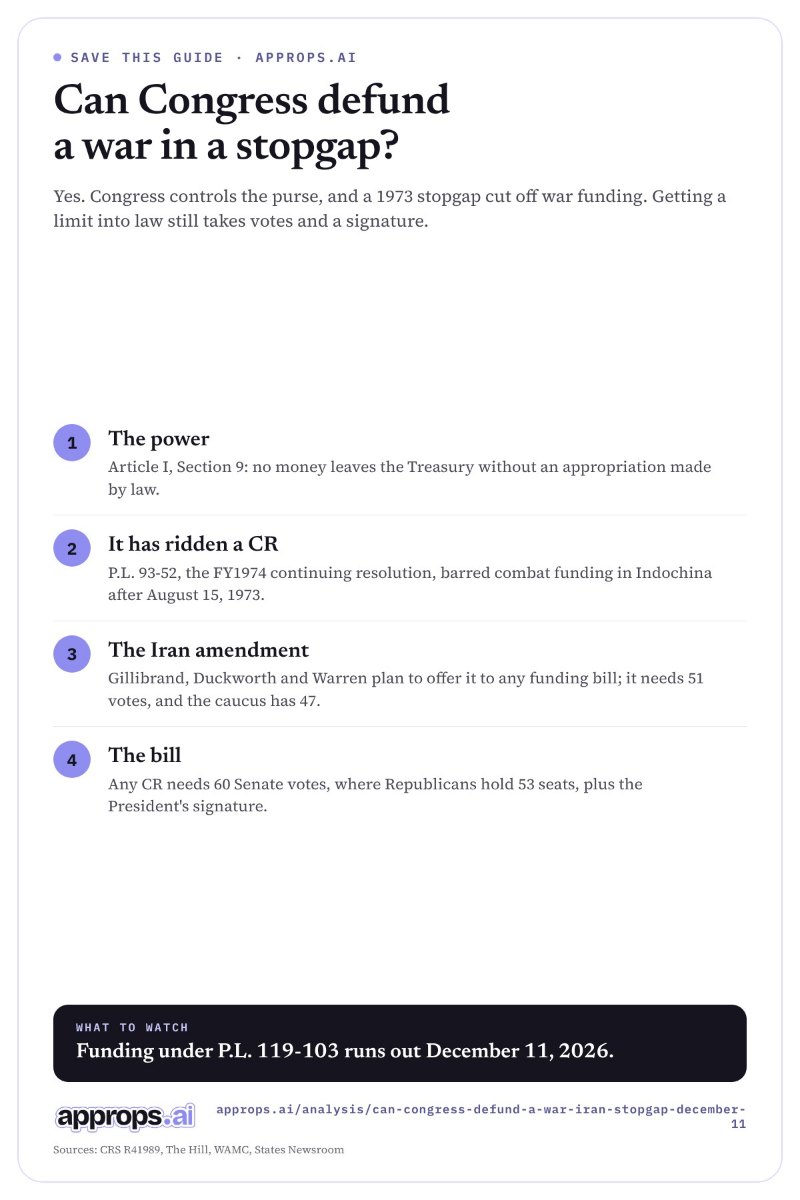
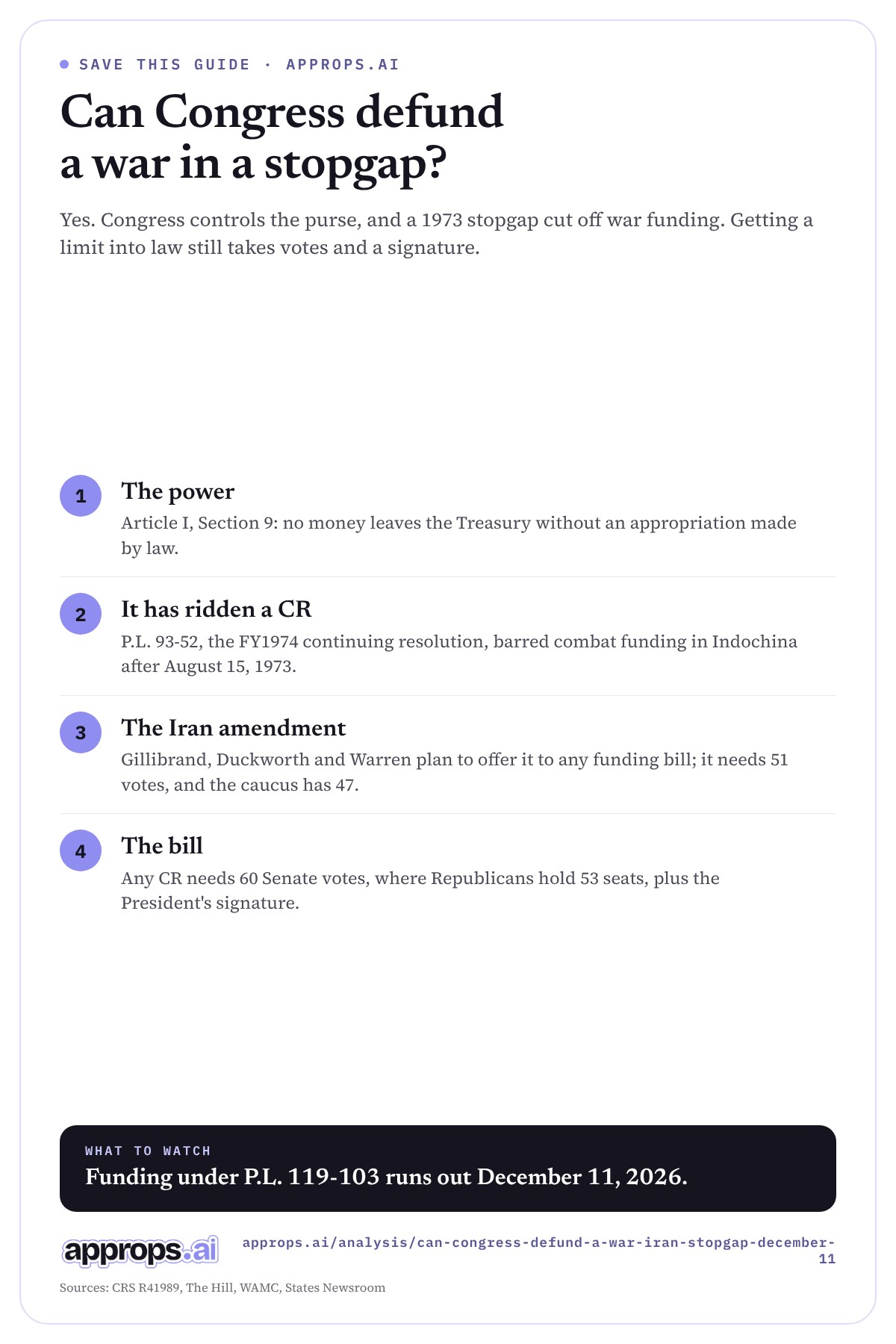
The Constitution gives Congress the purse. Article I, Section 9 says "No Money shall be drawn from the Treasury, but in Consequence of Appropriations made by Law." The Congressional Research Service calls that power "virtually plenary" in its report on congressional authority to limit military operations, and notes that Congress can set the terms and conditions on how any appropriation is used.
Even people who argue for a strong President mostly agree on the big version of this. CRS writes that proponents of strong executive power "appear to concede" that Congress can end U.S. participation in hostilities "by cutting off funding entirely." The fights are over the narrower versions: a limit on how many troops, or which missions, which some argue intrudes on the Commander in Chief.
So the legal question is the easy one. The hard part is getting a limit into law.
It has ridden a stopgap before
This would not be new. Every precedent below moved on an appropriations bill, and two of them rode continuing resolutions.
| Year | Law | What the funding limit did | | --- | --- | --- | | 1973 | Second Supplemental Appropriations Act for FY1973, P.L. 93-50, Section 307 | Barred funds for combat in or over Cambodia, Laos, North Vietnam and South Vietnam | | 1973 | Continuing Appropriations Resolution for FY1974, P.L. 93-52, Section 108 | No funds for U.S. combat activities in or over Indochina on or after August 15, 1973 | | 1984 | Continuing Appropriations Resolution for FY1985, P.L. 98-473, Section 8066 (a Boland Amendment) | No funds for military activity in or around Nicaragua | | 1993 | Defense Appropriations Act for FY1994, P.L. 103-139 | Cut off funding for operations in Somalia after March 31, 1994, with a carve out to protect Americans |
Source: CRS R41989.
Look at the second row. The 1973 cutoff rode a continuing resolution, the same kind of bill Congress has to pass by December 11. So did the 1984 Nicaragua limit. CRS adds the context that matters: those 1973 limits were approved only after a cease fire and the withdrawal of U.S. troops from South Vietnam, and they mainly ended the bombing of Cambodia.
In other words, they passed when both branches were already most of the way there.
Why the Iran amendment is harder than it sounds
Here is the twist in the CRS report. Blocking new war money is easy; writing a ban into law is hard.
"A simple majority of a single house could prevent the appropriation of funds necessary for the continuation of a military conflict," CRS writes. If one chamber simply refuses to pass the money, the money does not exist. But a ban written into a bill is a positive law, and that has to clear both chambers and get a signature (or a two thirds override). CRS also flags that legislation "probably would be required" to stop the President from shifting money that was appropriated for other operations under existing transfer authority.
That is the problem for a stopgap. A CR does not add new money for Iran. It keeps the lights on at last year's rates. So stopping the war through the CR means writing a prohibition into it, and a prohibition is the hard kind.
The math, as it stands this month:
- The amendment. It would need 51 votes to survive, and there are 47 members of the Senate Democratic caucus, WAMC reported.
- The bill. Any CR needs 60 votes to move in the Senate, where Republicans hold 53 seats for the rest of this year, States Newsroom reported.
- The signature. The President has to sign it, unless both chambers can override a veto.
The last time Congress tried to put a war deadline on a must pass bill over a President's objection, in 2007, the Iraq supplemental was vetoed, the override failed, and Congress sent back a bill with no timetable. That one is also in the CRS report.
What each side is saying
The Gillibrand amendment would stop "every new dollar for offensive operations in Iran," she said, and would still allow spending "in direct defense of the American people or our troops." It would also block travel money for the Secretary of Defense until the department reports on the war's effect on readiness, per WAMC.
A second group went further on November 12. Sens. Michael Bennet of Colorado, Duckworth, Chris Van Hollen of Maryland and Bernie Sanders of Vermont said a short term funding bill "must include language that restricts the Trump Administration from using appropriated funds to continue his war against Iran." Sen. Patty Murray of Washington, the top Democrat on Senate Appropriations, said only, "We're exploring all options at this point."
Not every Democrat is ready to hold the whole government for it. Rep. Rosa DeLauro of Connecticut, the top Democrat on House Appropriations, told reporters November 18 that she wants full year bills plus a short CR, and cautioned that a shutdown is what would put Democrats' agenda in jeopardy. "I'm sure there's some who have that appetite," she said of the hard line. House Democratic Leader Hakeem Jeffries said on November 12 he did not want to get ahead of her.
Republicans want the defense fight out of the CR entirely. Sen. John Hoeven of North Dakota has argued for moving defense money through a party line reconciliation bill: "They want to hold up defense, right? And if we just do that through reconciliation, takes it off the table." (We explain why that path needs only 51 votes in budget reconciliation vs appropriations.) House Appropriations Chair Tom Cole of Oklahoma is still pushing for full year bills, saying "the biggest disservice to the American people would be not to try."
Could this cause a shutdown on December 12?
Only if it blocks the bill. The government runs on P.L. 119-103, which funds agencies through Friday, December 11. If nothing new is signed by then, a lapse starts at 12:01 a.m. on Saturday, December 12.
An amendment that fails on the floor does not shut anything down. A CR that cannot get to 60 because enough Democrats insist on the language, or a CR that carries it and draws a veto, could. That is the trade Democrats are arguing about right now, and it is why the vote count on the amendment matters less than the vote count on the bill.
Congress is out the week of Thanksgiving. That leaves the first two weeks of December for all of it.
What happens next
- CR text. DeLauro said on November 18 there was none yet. Whether it carries any limit on war funding, even a narrow one like a reporting requirement, is the first tell.
- The amendment vote. If Senate leaders allow amendments to the CR, Gillibrand's will be one of them. A vote count in the high 40s tells you it was a message; anything near 51 changes the conversation.
- January. Democrats take the majority in both chambers in the new Congress, and the FY2027 Defense bill is still not law. A funding limit that fails in December can come back in the next spending bill.
Every bill's status is on the tracker, the countdown to December 11 is on /shutdown, and if the deal ends up as a hybrid package, here is what a cromnibus is. You can stay up to date at approps.ai!
Save this guide
Frequently asked questions
Can Congress defund a war?
Yes. The Constitution says no money leaves the Treasury without an appropriation, and Congress has written funding cutoffs for military operations into spending laws before, including Indochina in 1973 and Somalia in 1994.
Has a continuing resolution ever cut off war funding?
Yes. Section 108 of the Continuing Appropriations Resolution for FY1974, P.L. 93-52, barred funds for U.S. combat in or over Indochina on or after August 15, 1973, according to CRS report R41989.
What does the Gillibrand amendment on Iran do?
Sens. Kirsten Gillibrand, Tammy Duckworth and Elizabeth Warren plan to offer it to any funding bill. It would bar new money for offensive operations in Iran while allowing spending to defend Americans and U.S. troops.
Could the Iran war fight cause a shutdown on December 12?
Only if it blocks the funding bill. Current funding under P.L. 119-103 runs through December 11, 2026, and any new CR needs 60 votes in the Senate and the President's signature.
Sources
- Congressional Research Service, R41989, Congressional Authority to Limit Military Operations
- The Hill, Congress drifts toward shutdown deadline without a funding strategy (Nov. 19, 2026)
- WAMC/WSHU, Gillibrand seeks to block Iran war funding ahead of shutdown deadline (Nov. 19, 2026)
- States Newsroom via Maryland Matters, Senators demand end to Iran war funding in any bill averting shutdown (Nov. 12, 2026)
- congress.gov, H.R. 6500, Continuing Appropriations and Extensions Act, 2027 (P.L. 119-103)