Fiscal year 2028 starts on Friday, October 1, 2027, and ends on Saturday, September 30, 2028. That comes straight from the law: the federal fiscal year begins October 1 and ends the following September 30, and it takes the number of the year it ends in. Congress has not finished FY2027, and on Tuesday voters handed both chambers to the other party.
So two budgets are now moving at once. Neither has a topline.
What is FY28, and what year is it?
FY28 is shorthand for fiscal year 2028, and so are FY 28, FY2028 and FY 2028. Most of it falls in calendar 2028, which is why the number looks a year ahead of where it starts. It runs 366 days, because February 29, 2028 lands inside it.
| Quarter | Starts | Ends |
|---|---|---|
| First quarter | October 1, 2027 | December 31, 2027 |
| Second quarter | January 1, 2028 | March 31, 2028 |
| Third quarter | April 1, 2028 | June 30, 2028 |
| Fourth quarter | July 1, 2028 | September 30, 2028 |
If you got here from a tax form or an earnings call, you may want a different FY28, because other countries and companies keep their own calendars. Everything below is the U.S. government's. Our fiscal year explainer has the history and the other calendars.
Who writes the FY2028 bills?
Not the people who wrote FY2027. Democrats won both chambers, and as of Wednesday evening Akin counted a 54-44 Senate with two races uncalled and 237 House seats with 51 uncalled. Akin lists Rep. Rosa DeLauro of Connecticut as the expected House Appropriations chair. Sen. Susan Collins of Maine, the Senate chair, lost her race, and Sen. Patty Murray of Washington is the committee's top Democrat today.
The President did not change. Spending bills still need his signature or two thirds of both chambers, and Akin puts that at 67 votes in the Senate and 290 in the House. Most bills also still need 60 votes in the Senate.
The opening fight is easy to see. The FY2027 request asked for $1.154 trillion for the Defense bill, against $838.7 billion enacted for FY2026. Akin expects Democrats to use the defense talks to win more for domestic programs, and to write in limits on holding back money Congress has already provided. Those are the same arguments, one year on, with the gavels swapped.
That is the whole shape of FY2028. One party writes, the other signs!
The road to October 1, 2027
Here is the schedule the Budget Act sets out, with next year's dates filled in. The President's date comes from a separate law, which says the budget is due no later than the first Monday in February.
| Due by | What is supposed to happen |
|---|---|
| February 1, 2027 | The President submits the FY2028 budget |
| February 15, 2027 | The Congressional Budget Office reports to the Budget Committees |
| Six weeks after the budget | Committees send their views and estimates to the Budget Committees |
| April 1, 2027 | The Senate Budget Committee reports a budget resolution |
| April 15, 2027 | Congress finishes the budget resolution |
| May 15, 2027 | Spending bills may come up on the House floor |
| June 10, 2027 | House Appropriations reports its last bill |
| June 30, 2027 | The House finishes all 12 bills |
| October 1, 2027 | FY2028 begins |
Read that as the speed limit, not the traffic. This year the White House released its FY2027 budget on April 3, about two months after the February 2 due date. As of CRFB's last update, neither chamber had adopted a budget resolution. The June 30 finish line came and went with two bills through the House, and the CRS status table still shows only three.
Since October 1 became the start date, Congress has finished its bills on time four times. Nothing in the table above has a penalty attached.
FY2027 is still in the way
The FY2028 calendar assumes FY2027 is done. It isn't. Funding runs through December 11, the House has passed 3 of 12 bills, the Senate has passed none, and you can check every line on the tracker.
The American Prospect, a progressive magazine, reported Thursday, citing House sources, that Democrats will only agree to a brief stopgap, "probably for just two or three months at most." That is one outlet's sourcing and no leader has said it on the record. Akin's list of options is full year bills, an extension into early 2027, or a hybrid, with a lapse on December 12 still possible.
Run the math on a two or three month stopgap. It would expire in February or March 2027, right when the FY2028 request is due and the new committees are trying to organize. Appropriators would be closing one year while opening the next, with new chairs learning the job.
When do FY28 earmark requests open?
Nobody has posted FY28 rules yet. The best guide is the last round. For FY27, the House committee's deadlines for Community Project Funding (the House's name for earmarks) fell on March 13, March 19 and March 20, 2026, depending on the subcommittee. Members then had to post their requests online between March 27 and April 17.
Treat that as a pattern, not a promise. A new chair sets the guidance, and a late FY2027 could push everything back. Anyone planning an ask should watch their own member's site early in 2027. You can see what each state got and what each member asked for last time on the earmarks map.
What is already baked into FY2028
Plenty of FY2028 is already on the books.
- SNAP: the 2025 reconciliation law makes states with high payment error rates share up to 15 percent of benefit costs starting in FY2028. Some have called for a delay, which CRFB prices at about $5 billion for one year.
- Highways: CRFB says the Highway Trust Fund heads for insolvency in 2028, and the highway bills on the table don't fix it.
- Research: the White House has already told agencies what to ask for in the FY2028 R&D priorities memo. It names no dollar amounts.
- The topline: the Fiscal Responsibility Act set discretionary numbers only through FY2025, though it suggests holding growth to 1 percent a year through FY2029. So the FY2028 number is a fight, not a formula.
Then there is the far end of the calendar. FY2028 ends 38 days before the November 7, 2028 presidential election. This Congress just bought itself time past a midterm with a stopgap, so you can guess what September 2028 might look like. (Congress does love a good extension.)
What happens next
Members return November 9. House Republicans and Senate Republicans hold leadership elections November 10, and House Democrats follow around November 18 or 19. The deadline is December 11, the new Congress starts in January, and the FY2028 budget is due February 1.
We will build out the FY2028 calendar here as the dates firm up. Until then, the live FY2027 picture is at approps.ai.
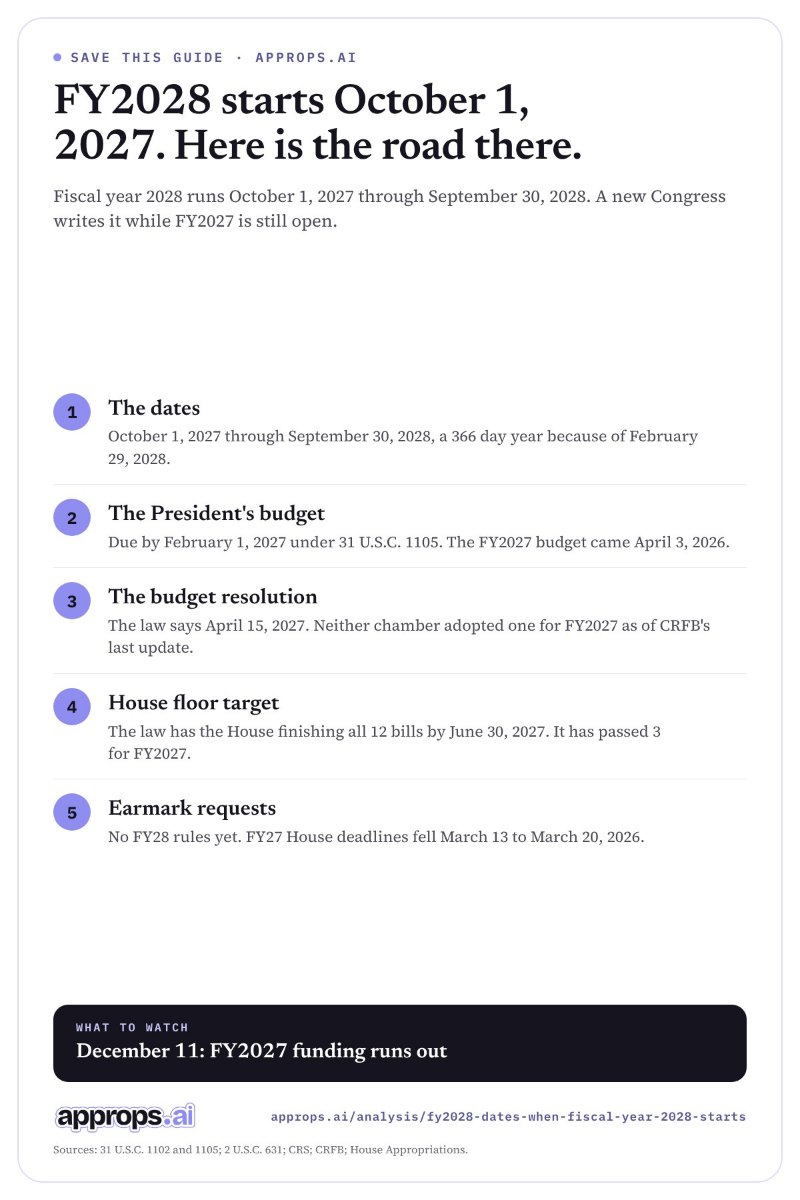
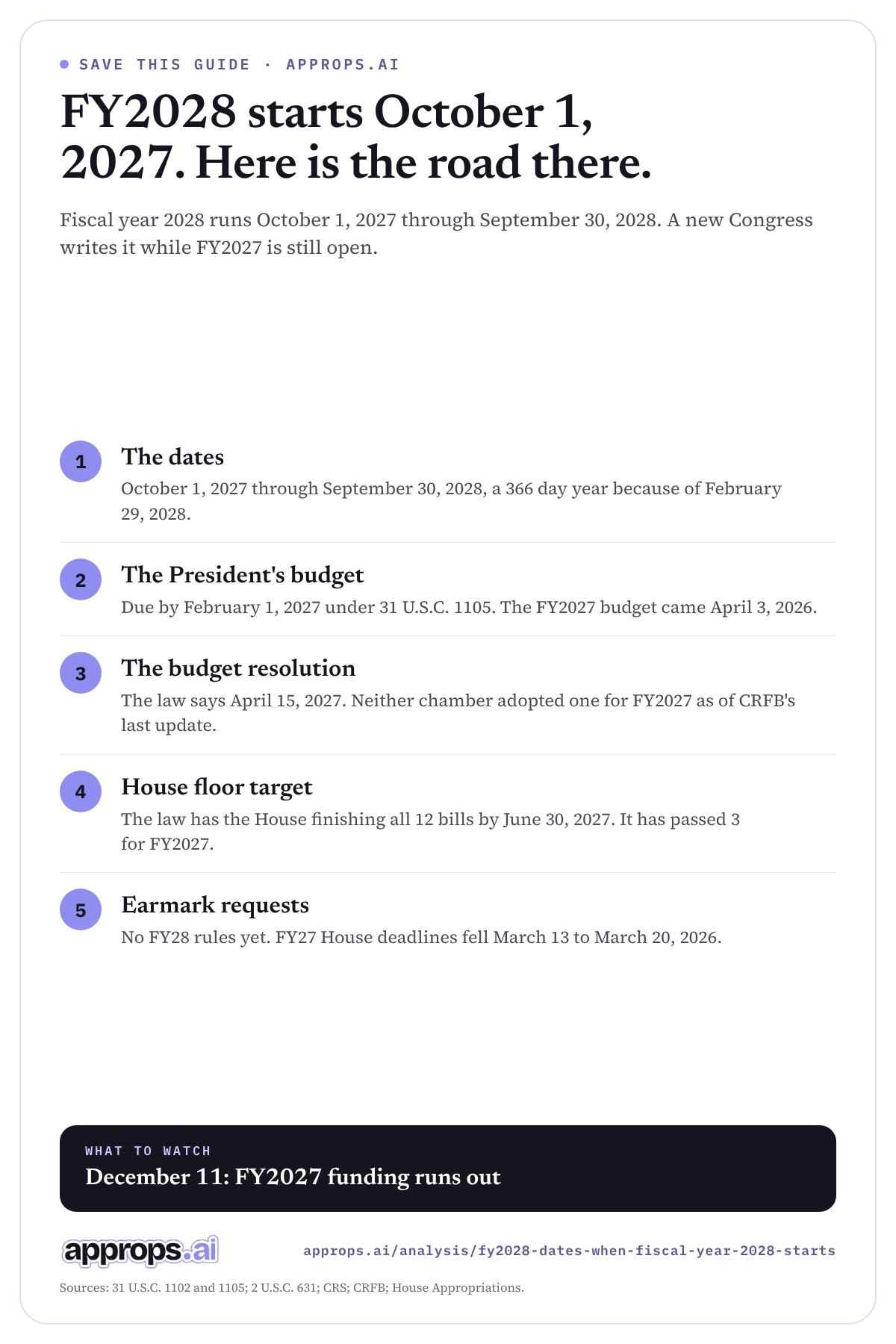
Save this guide
Frequently asked questions
When does fiscal year 2028 start and end?
The federal fiscal year 2028 starts October 1, 2027 and ends September 30, 2028. It runs 366 days because February 29, 2028 falls inside it.
What does FY28 mean?
Fiscal year 2028. Federal fiscal years take the number of the calendar year they end in, so FY28 starts in 2027 and ends in 2028.
When is the FY2028 budget request due?
By law, no later than the first Monday in February, which is February 1, 2027. The FY2027 request came out April 3, 2026, about two months after its due date.
When are FY28 earmark requests due?
No FY28 rules have been posted. For FY27, House committee deadlines fell on March 13, March 19 and March 20, 2026, depending on the subcommittee, and a new chair sets the next round.
Sources
- 31 U.S.C. 1102, the fiscal year
- 31 U.S.C. 1105, the President's budget
- 2 U.S.C. 631, the congressional budget timetable
- CRS appropriations status table, FY2027
- House Appropriations FY27 member request guidance
- CRFB Appropriations Watch FY2027
- CRFB on the lame duck session, Nov. 3, 2026
- Akin on the 2026 midterms, Nov. 4, 2026