THE PROCESS – FROM BUDGET REQUEST TO SIGNED LAW
How the money moves
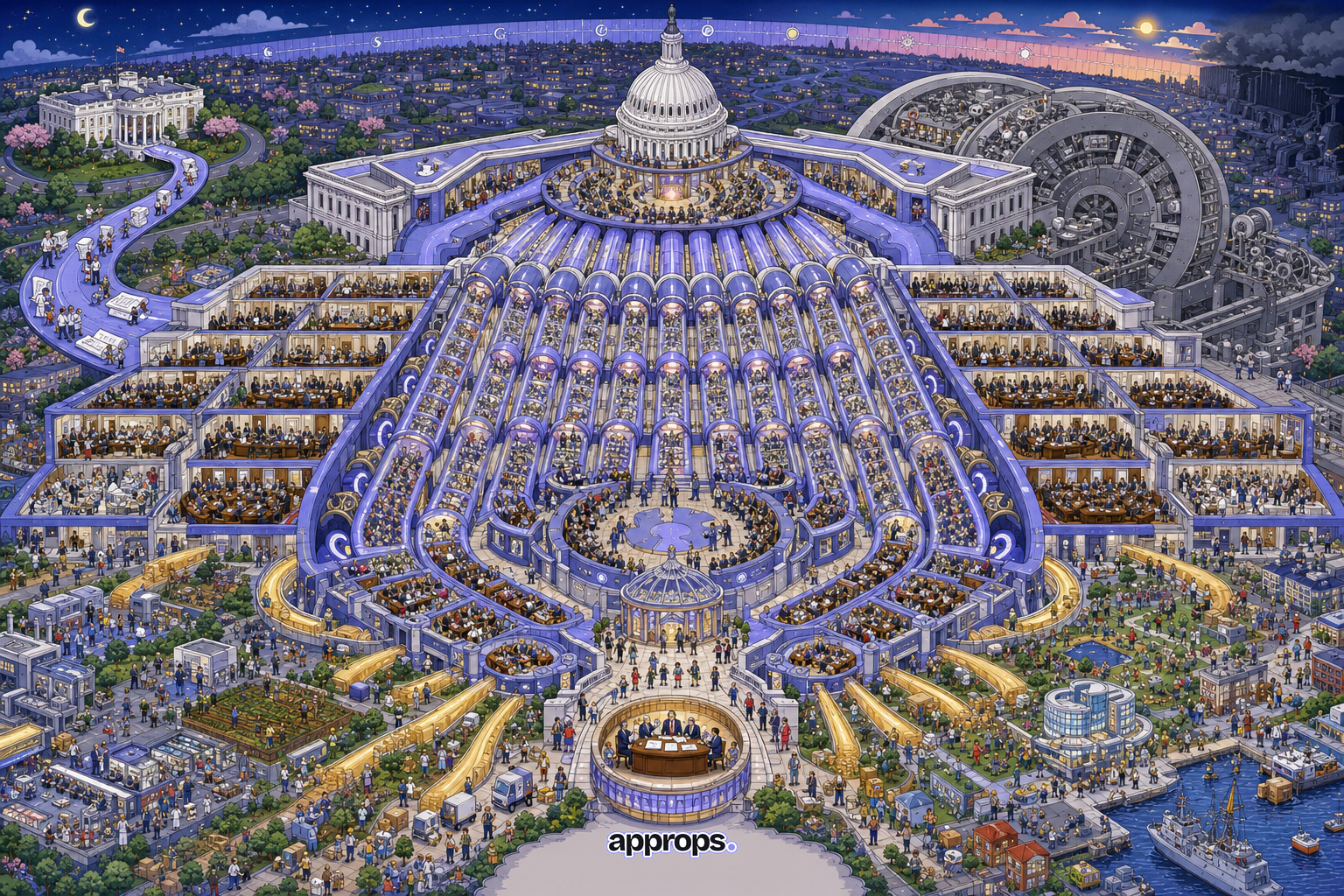
An appropriations bill is approved in five steps: subcommittee markup, full committee, a floor vote in each chamber, a conference to settle the differences, and the President's signature. Every dollar the federal government spends by choice passes through that process, across twelve annual bills. This page explains each step in plain language, from the Constitution to the signature, in both the House and the Senate. The tracker shows where this year's twelve bills actually are, live.
THE POWER OF THE PURSE
“No Money shall be drawn from the Treasury, but in Consequence of Appropriations made by Law.”
U.S. CONSTITUTION, ARTICLE I, SECTION 9, CLAUSE 7
That one sentence is the whole foundation. The executive branch cannot spend money Congress has not appropriated, no matter who holds the White House. The committees that write those appropriations, one in the House and one in the Senate, therefore control what the government can actually do each year. In Washington shorthand, this is the power of the purse.
TWO STEPS: PERMISSION, THEN MONEY
Congress funds the government in two separate steps, handled by different committees. First, an authorizing committee writes a law that creates or continues a program: it gives permission for the program to exist. Then the Appropriations Committees decide how much money that program actually gets this year, if any. The Armed Services Committees can authorize the Navy to build a new program, but the program only operates at the size the appropriators fund.
1 · AUTHORIZATION
“This program may exist, and here is what it may do.” Written by the subject committees: Armed Services, Judiciary, Agriculture, and the rest.
2 · APPROPRIATION
“This program gets this many dollars this year.” Written by the Appropriations Committees in the twelve annual bills this site tracks.
WHAT THE APPROPRIATORS CONTROL
The appropriators only control part of the budget. Most federal spending is mandatory: it runs on autopilot under permanent law, like Social Security, Medicare, and interest on the debt, and never comes up for an annual vote. The rest is discretionary spending, and that is what the twelve bills decide.
≈72%
MANDATORY SPENDING AND INTEREST
Runs automatically under permanent law. Not part of the annual appropriations process.
≈23%
DISCRETIONARY SPENDING
Set each year by the twelve appropriations bills. This is the money this site tracks.
FISCAL 2023 SHARES, PER THE HOUSE APPROPRIATIONS COMMITTEE
One more scale note: the Defense subcommittee alone manages about half of all discretionary spending. And the discretionary share of the budget has been shrinking for decades as mandatory programs grow, which is why fights over a few percent of discretionary spending are fights over real capability.
WHO DOES THE WORK
Each chamber has an Appropriations Committee, and each committee splits into the same twelve subcommittees, one per bill. The House committee currently has 63 members; the Senate committee is smaller. Subcommittee chairs hold so much sway over their slice of the budget that Washington calls them the cardinals. A bill must clear both chambers' versions of this structure before it can become law.
THE TWELVE BILLS OF FY2027
Every year, the entire discretionary budget is divided into the same twelve bills. Each covers a slice of the government, and each has a House version and a Senate version that must eventually match. Click any bill for its live status.
NAMES VARY SLIGHTLY BY CHAMBER: THE HOUSE NOW CALLS ITS STATE-FOREIGN OPERATIONS PANEL “NATIONAL SECURITY, DEPARTMENT OF STATE”; THE SENATE KEEPS THE OLD NAME.
THE ANNUAL PROCESS, START TO FINISH
The fiscal year runs October 1 through September 30. The process that funds it starts eight months earlier and follows the same steps every year.
The President asks
The White House budget office sends Congress the President's budget request, due the first Monday in February. It is a detailed proposal, and it is only a proposal: Congress can and does ignore any part of it. That is why the tracker does not treat the request as a stage.
The committees investigate
Through the spring, the subcommittees hold hearings where agency heads defend their numbers. Members of Congress and members of the public can also testify about what deserves funding. Hearings land on the calendar as they are scheduled.
Members put in their requests
Individual members submit funding requests for their districts and states, under public disclosure rules. These become the earmarks, officially Community Project Funding in the House and Congressionally Directed Spending in the Senate. Every funded one ends up on the map.
The topline: 302(a)
Congress sets one overall number for discretionary spending, called the 302(a) allocation after the section of the 1974 budget law that created it. In practice this number is often the product of hard negotiation between the parties and the chambers, and when it is late, everything behind it is late.
The split: 302(b)
Each Appropriations Committee divides the topline among its twelve subcommittees. These 302(b) allocations are each bill's spending ceiling: the Defense bill gets one number, Agriculture another, and the subcommittees write to fit.
EACH CHAMBER MOVES ITS OWN TWELVE BILLS
From here the House and Senate work in parallel, each writing its own version of each bill. These are the stages the tracker draws as bars: subcommittee, full committee, floor, passed. A markup is the meeting where a committee debates a bill and votes on amendments, line by line.
HOUSE
Traditionally moves first. A simple majority passes a bill, so the majority party can move quickly when it holds the votes.
SENATE
Sixty votes are needed to end debate, so Senate bills usually have to be bipartisan from the start. Bills are often bundled into small packages called minibuses.
The chambers reconcile
A bill only becomes law if both chambers pass identical text. Negotiators merge the House and Senate versions, in a formal conference committee or, more often now, in informal negotiations sometimes called ping-pong as the text moves back and forth.
Final passage and signature
The merged bill passes both floors one last time and goes to the President. With a signature, the money is law. The archive keeps every enacted vehicle back to FY2020.
FEB
President's request arrives
SPRING
Hearings and member requests
SUMMER
Markups and floor votes
SEP 30
Deadline: the fiscal year ends
WHEN THE CLOCK RUNS OUT
The twelve bills are supposed to be law by October 1. When they are not, Congress has exactly three options, and the countdown on the front page exists because of them.
REGULAR BILLS
The twelve annual bills, passed on time. The system working as designed.
CONTINUING RESOLUTION
A stopgap that extends last year's funding for weeks or months while negotiations continue. Agencies mark time: no new programs, no adjustments.
FUNDING LAPSE
No bills and no stopgap. Non-essential operations shut down until Congress acts. The FY2026 cycle ended this way before its final bill was signed in April.
Congress can also pass supplemental appropriations at any point in the year: extra money outside the twelve bills, usually for emergencies like disasters or wars.
FOLLOW IT LIVE
This page is the theory. The rest of the site is the practice: the tracker shows each bill's stage in both chambers, the calendar shows the next markups and hearings, the earmarks map shows who got what back home, and analysis explains what it all means.